Doskaliyev Aidos, Ogay Vyacheslav, Mussabekov Islambek, Satov Muratbek, Zhetpisbayev Berik, Mustafin Khalit, Bobrova Xeniya, Auezova Raushan, Akshulakov Serik
Department of Science and Strategy, National Center for Neurosurgery, Astana, Kazakhstan.
Stem Cell Laboratory, National Center for Biotechnology, Astana, Kazakhstan.
Front Surg. 2024 Dec 6;11:1432029. doi: 10.3389/fsurg.2024.1432029. eCollection 2024.
The reconstruction of dura matter is a challenging problem for neurosurgeons. A number of materials for dural reconstruction have recently been developed, but some of them have poor biocompatibility, poor mechanical properties, and adverse effects. Bovine parietal peritoneum is a promising natural material for regenerative medicine and reconstructive surgery. In this study, we conducted an evaluation of the safety and efficacy of using decellularized bovine peritoneum membranes (BPMs) as natural dural substitutes in a rabbit model.
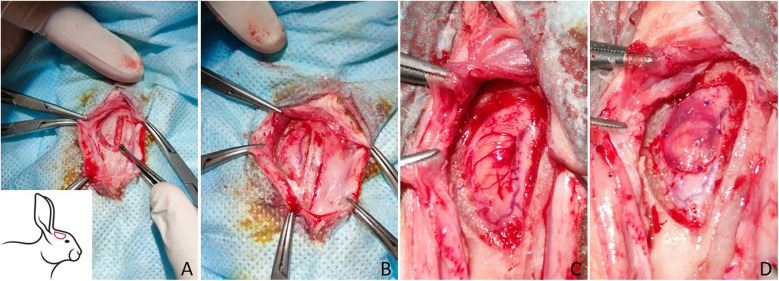
The dural defects in mature New Zealand rabbits were studied. A BPM was sutured on the dural defect area of each animal. Autologous periosteum and collagen membranes (Lyoplant®) were used to facilitate a comparison with the BPMs. ELISA, histomorphological analysis, and hematological analysis were carried out to examine the safety and efficacy of using BPMs as dural substitutes.
Our results showed that the BPMs demonstrated a deterioration rate that is suitable for gathering newly formed meningothelial tissue. The thickness and density of BPM fibers prevents resorption in the first few days after use as a plastic material, and the regeneration of the dura mater does not occur at an accelerated pace, meaning that the gradual formation of fibrous tissue prevents adhesion to the brain surface. It was observed that the BPM can integrate with the adjacent tissue to repair dural defects. Moreover, the transplantation of BPMs did not cause significant adverse effects or immunological responses, indicating the safety and good biocompatibility of the BPM.
Thus, our study in a rabbit model showed that decellularized BPMs may represent a biocompatible natural material that can be used in cases requiring dura matter repair without significant adverse effects.
对神经外科医生来说,硬脑膜重建是一个具有挑战性的问题。最近已开发出多种用于硬脑膜重建的材料,但其中一些材料的生物相容性差、机械性能不佳且存在不良反应。牛顶叶腹膜是再生医学和重建手术中一种有前景的天然材料。在本研究中,我们在兔模型中对使用去细胞牛腹膜(BPM)作为天然硬脑膜替代物的安全性和有效性进行了评估。
研究了成年新西兰兔的硬脑膜缺损情况。将BPM缝合在每只动物的硬脑膜缺损区域。使用自体骨膜和胶原膜(Lyoplant®)以便与BPM进行比较。进行酶联免疫吸附测定(ELISA)、组织形态学分析和血液学分析,以检查使用BPM作为硬脑膜替代物的安全性和有效性。
我们的结果表明,BPM显示出适合聚集新形成的脑膜内皮组织的降解率。BPM纤维的厚度和密度可防止其在用作塑形材料后的头几天内被吸收,并且硬脑膜不会加速再生,这意味着纤维组织的逐渐形成可防止与脑表面粘连。观察到BPM可与相邻组织整合以修复硬脑膜缺损。此外,BPM的移植未引起明显的不良反应或免疫反应,表明BPM具有安全性和良好的生物相容性。
因此,我们在兔模型中的研究表明,去细胞BPM可能是一种生物相容性天然材料,可用于需要硬脑膜修复且无明显不良反应的情况。