Emura Natsuko, Wavreil Florence D M, Fries Annaliese, Yajima Mamiko
Department of Molecular Biology, Cellular Biology, Biochemistry, Brown University, Providence, United States.
Elife. 2024 Dec 23;13:RP100086. doi: 10.7554/eLife.100086.
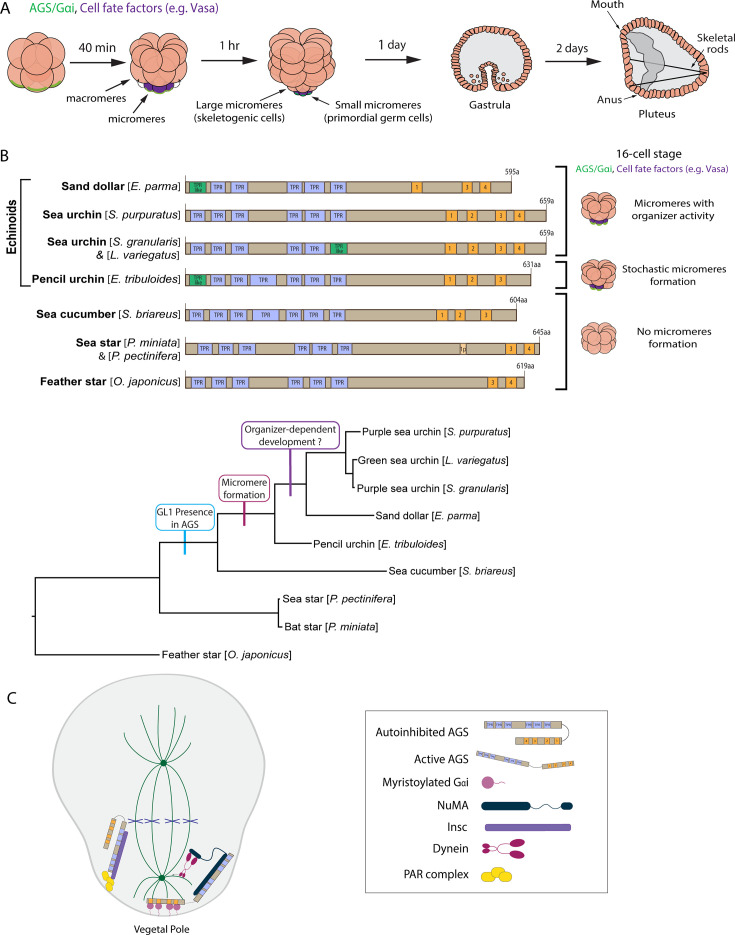
The evolutionary introduction of asymmetric cell division (ACD) into the developmental program facilitates the formation of a new cell type, contributing to developmental diversity and, eventually, species diversification. The micromere of the sea urchin embryo may serve as one of those examples: an ACD at the 16-cell stage forms micromeres unique to echinoids among echinoderms. We previously reported that a polarity factor, activator of G-protein signaling (AGS), plays a crucial role in micromere formation. However, AGS and its associated ACD factors are present in all echinoderms and across most metazoans. This raises the question of what evolutionary modifications of AGS protein or its surrounding molecular environment contributed to the evolutionary acquisition of micromeres only in echinoids. In this study, we learned that the GoLoco motifs at the AGS C-terminus play critical roles in regulating micromere formation in sea urchin embryos. Further, other echinoderms' AGS or chimeric AGS that contain the C-terminus of AGS orthologs from various organisms showed varied localization and function in micromere formation. In contrast, the sea star or the pencil urchin orthologs of other ACD factors were consistently localized at the vegetal cortex in the sea urchin embryo, suggesting that AGS may be a unique variable factor that facilitates ACD diversity among echinoderms. Consistently, sea urchin AGS appears to facilitate micromere-like cell formation and accelerate the enrichment timing of the germline factor Vasa during early embryogenesis of the pencil urchin, an ancestral type of sea urchin. Based on these observations, we propose that the molecular evolution of a single polarity factor facilitates ACD diversity while preserving the core ACD machinery among echinoderms and beyond during evolution.
不对称细胞分裂(ACD)在发育程序中的进化引入促进了新细胞类型的形成,有助于发育多样性,并最终导致物种多样化。海胆胚胎的小分裂球可能就是其中一个例子:16细胞期的ACD形成了棘皮动物中棘类动物特有的小分裂球。我们之前报道过,一种极性因子,即G蛋白信号激活剂(AGS),在小分裂球形成中起关键作用。然而,AGS及其相关的ACD因子存在于所有棘皮动物以及大多数后生动物中。这就提出了一个问题,即AGS蛋白或其周围分子环境的哪些进化修饰导致了仅在棘类动物中进化获得小分裂球。在本研究中,我们了解到AGS C末端的GoLoco基序在调节海胆胚胎小分裂球形成中起关键作用。此外,其他棘皮动物的AGS或包含来自各种生物的AGS直系同源物C末端的嵌合AGS在小分裂球形成中表现出不同的定位和功能。相比之下,其他ACD因子的海星或铅笔海胆直系同源物在海胆胚胎中始终定位于植物皮层,这表明AGS可能是促进棘皮动物中ACD多样性的独特可变因子。同样,海胆AGS似乎在铅笔海胆(海胆的一种原始类型)的早期胚胎发生过程中促进类小分裂球细胞的形成并加速生殖系因子Vasa的富集时间。基于这些观察结果,我们提出单个极性因子的分子进化在进化过程中促进了ACD多样性,同时保留了棘皮动物及其他生物中的核心ACD机制。