Bando Hideaki, Naito Yoichi, Yamada Tomoyuki, Fujisawa Takao, Imai Mitsuho, Sakamoto Yasutoshi, Saigusa Yusuke, Yamamoto Kouji, Tomioka Yutaka, Takeshita Nobuyoshi, Sunami Kuniko, Futamura Megumi, Notake Chiemi, Aoki Satoko, Okano Kazunori, Yoshino Takayuki
Translational Research Support Office, Division of Drug and Diagnostic Development Promotion, Department for the Promotion of Drug and Diagnostic Development, National Cancer Center Hospital East, 6-5-1 Kashiwanoha, Kashiwa, Chiba, 277-8577, Japan.
Division of Data Science, Department for the Promotion of Drug and Diagnostic Development, National Cancer Center Hospital, East 6-5-1 Kashiwanoha, Kashiwa, Chiba, 277-8577, Japan.
Int J Clin Oncol. 2025 Feb;30(2):172-179. doi: 10.1007/s10147-024-02684-z. Epub 2024 Dec 23.
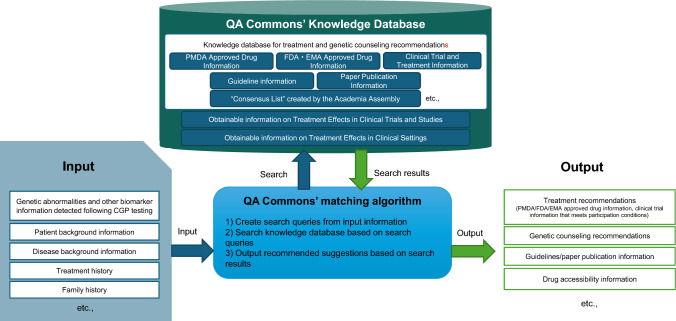
The implementation of cancer precision medicine in Japan is deeply intertwined with insurance reimbursement policies and requires case-by-case reviews by Molecular Tumor Boards (MTBs), which impose considerable operational burdens on healthcare facilities. The extensive preparation and review times required by MTBs hinder their ability to efficiently assess comprehensive genomic profiling (CGP) test results. Despite attempts to optimize MTB operations, significant challenges remain. This study aims to evaluate the effectiveness of QA Commons, an artificial intelligence-driven system designed to improve treatment planning using CGP analysis. QA Commons utilizes a comprehensive knowledge base of drugs, regulatory approvals, and clinical trials linked to genetic biomarkers, thereby enabling the delivery of consistent and standardized treatment recommendations. Initial assessments revealed that the QA Commons' recommendations closely matched the ideal treatment recommendations (consensus annotations), outperforming the average results of MTBs at Cancer Genomic Medicine Core Hospitals.
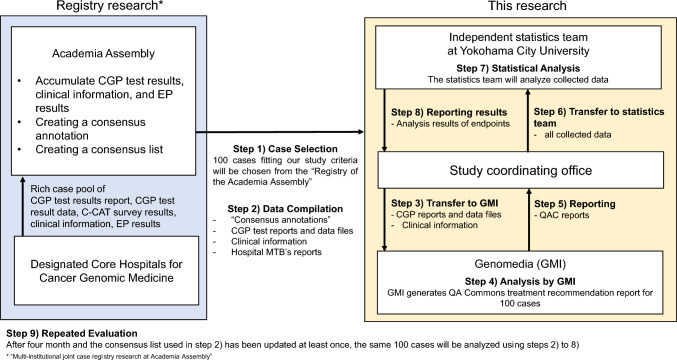
A clinical performance evaluation study will be conducted by comparing the QA Commons' treatment recommendations with those of the Academia Assembly, which includes medical professionals from the Cancer Genomic Medicine Core and Hub Hospitals. One hundred cases selected from the "Registry of the Academia Assembly," based on defined inclusion and exclusion criteria, will be analyzed to assess the concordance of recommendations.
The expected outcomes suggest that QA Commons could reduce the workload of MTB members, standardize the quality of MTB discussions, and provide consistent outcomes in repeated patient consultations. In addition, the global expansion of QA Commons could promote worldwide adoption of Japan's pioneering precision oncology system.
日本癌症精准医学的实施与保险报销政策紧密相连,需要分子肿瘤委员会(MTB)进行逐案审查,这给医疗机构带来了相当大的运营负担。MTB所需的大量准备和审查时间阻碍了其有效评估综合基因组分析(CGP)测试结果的能力。尽管试图优化MTB的运作,但重大挑战依然存在。本研究旨在评估QA Commons的有效性,这是一个由人工智能驱动的系统,旨在利用CGP分析改进治疗计划。QA Commons利用与基因生物标志物相关的药物、监管批准和临床试验的综合知识库,从而能够提供一致且标准化的治疗建议。初步评估显示,QA Commons的建议与理想治疗建议(共识注释)高度匹配,优于癌症基因组医学核心医院MTB的平均结果。
将通过比较QA Commons的治疗建议与学术大会(包括癌症基因组医学核心医院和枢纽医院的医学专业人员)的治疗建议来进行临床性能评估研究。将根据定义的纳入和排除标准,从“学术大会登记处”中选取100个病例进行分析,以评估建议的一致性。
预期结果表明,QA Commons可以减轻MTB成员的工作量,规范MTB讨论的质量,并在重复的患者咨询中提供一致的结果。此外,QA Commons在全球范围内的推广可以促进日本开创性的精准肿瘤学系统在全球的采用。