Chinique de Armas Yadira, Hernández Godoy Silvia Teresita, Viera Sanfiel Luis M, Buhay William M, Laffoon Jason E
Department of Anthropology, University of Winnipeg, Winnipeg R3B2E9, Canada.
Group for Research and Development of the Directorate of Culture of Matanzas, Matanzas 40100, Cuba.
Proc Natl Acad Sci U S A. 2025 Jan 7;122(1):e2413963121. doi: 10.1073/pnas.2413963121. Epub 2024 Dec 23.
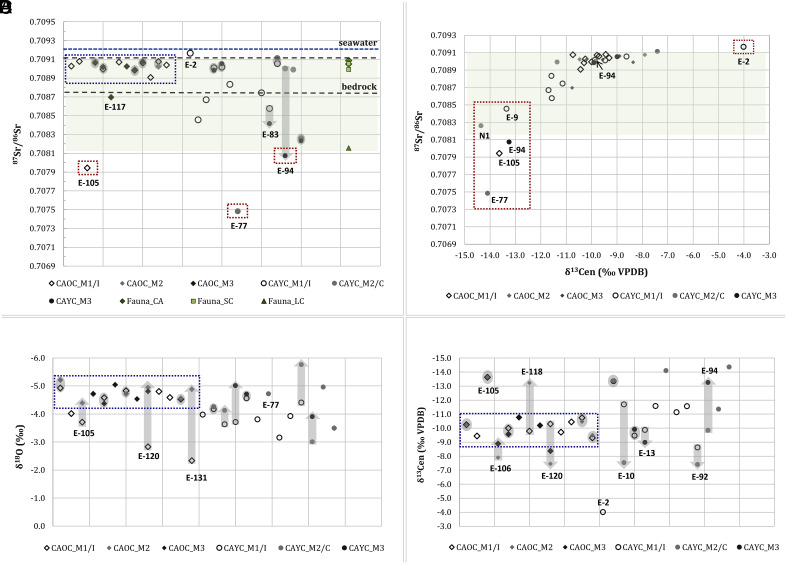
The early populations that inhabited the Antilles were traditionally understood as highly mobile groups of hunters/fishers and gatherers. Although more recent data have demonstrated that some populations engaged in the production of domestic plants and cultivars, questions remain about other aspects of their lifeways, including whether the adoption of domesticates was accompanied by a decrease in residential mobility. The level of sedentism in a population is an instrumental variable to understand community social relations and complexity, adaptations, and lifeways. Here, we combined enamel strontium (Sr/Sr), oxygen (δO), and carbon (δC) isotopes of 44 human teeth from the site of Canímar Abajo-where the oldest human remains from the insular Caribbean have been reported-to examine the mobility patterns of early Antillean groups. In contrast with traditional narratives, the homogeneous strontium isotope values observed in most individuals from the older funerary area of the site (cal. BC 2237-790) were consistent with the pattern expected for a sedentary population subsisting primarily on local resources obtained close to the coast. The isotopic evidence reveals that between cal. AD 403-1282, the mound was reused for funerary practices by both local communities and nonlocal individuals. The evidence suggests that this period saw higher population mobility, with influxes of individuals from more distant locations and diverse dietary and burial traditions. The isotope results from Canímar Abajo provide the earliest isotopic evidence of populations with low-level residential mobility in the Antilles.
传统上认为,居住在安的列斯群岛的早期居民是流动性很强的狩猎/捕鱼群体和采集者。尽管最近的数据表明,一些群体从事本地植物和栽培品种的生产,但关于他们生活方式的其他方面仍存在疑问,包括采用驯化作物是否伴随着居住流动性的降低。一个群体的定居程度是理解社区社会关系、复杂性、适应性和生活方式的一个重要变量。在这里,我们结合了来自卡尼马尔阿巴霍遗址的44颗人类牙齿的牙釉质锶(Sr/Sr)、氧(δO)和碳(δC)同位素——据报道,该遗址有来自加勒比岛屿最古老的人类遗骸——来研究早期安的列斯群体的流动模式。与传统说法相反,在该遗址较古老墓葬区(约公元前2237 - 790年)的大多数个体中观察到的锶同位素值均匀,这与主要依靠在海岸附近获取的当地资源为生的定居群体预期的模式一致。同位素证据表明,在公元403 - 1282年期间,该土丘被当地社区和非本地个体重新用于丧葬活动。证据表明,这一时期人口流动性更高,有来自更远地区的个体涌入,饮食和埋葬传统也多种多样。卡尼马尔阿巴霍的同位素结果提供了安的列斯群岛居民居住流动性较低的最早同位素证据。