Krell Verena, Porst Johanna, Hafermann Lorena, Kuhn Jessica, Greiß Franziska, Römer Claudia, Wolfarth Bernd
Department of Sports Medicine, Charité - Universitätsmedizin Berlin, Berlin, Germany.
Department of Sports Medicine, Institute of Sports Science, Humboldt-Universität zu Berlin, Berlin, Germany.
Sci Rep. 2024 Dec 23;14(1):30615. doi: 10.1038/s41598-024-83846-x.
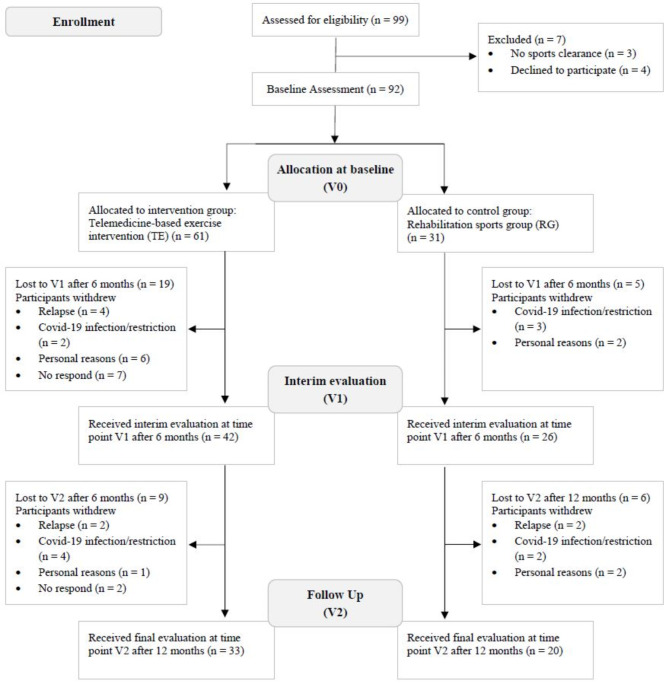
Cancer survivors (CS) often experience treatment-related side effects, such as fatigue, and have reduced physical function. Regular physical activity has been demonstrated to reduce these symptoms and improve cardiopulmonary fitness. Digital solutions are needed to optimize exercise options for CS in aftercare, especially given the significant limitations during the Covid-19 pandemic. This two-armed, non-randomized, controlled intervention study for CS aims to investigate whether a telemedicine-based exercise intervention is as effective as the current standard of care for oncological exercise therapy in aftercare. Patients in the intervention group (n = 61) performed a telemedicine-based exercise program (TE) and patients in the control group (n = 31) participated in an existing rehabilitation sports group (RG) over a six-month intervention period. The primary outcome was cardiopulmonary fitness measured by VOpeak; secondary outcomes included quality of life (QoL), fatigue, and physical activity. A non-inferiority analysis was performed with a predefined non-inferiority margin for relative VOpeak of -1.50 ml/min/kg. Although TE demonstrated a slight advantage in relative VOpeak compared to RG (adjusted mean difference of 0.55 ml/min/kg [95% CI: -2.74; 3.84]), the non-inferiority was not statistically significant. Nevertheless, the implementation of a telemedicine-based exercise intervention indicates that individual patients respond well to this type of exercise program and benefit from the intervention, particularly in terms of QoL. Finding an individualized program for each cancer survivor is the overarching goal. A telemedicine-based exercise intervention may be a promising option, particularly for younger patients.
癌症幸存者(CS)常常经历与治疗相关的副作用,比如疲劳,并且身体机能有所下降。有证据表明,规律的体育活动可减轻这些症状并改善心肺功能。需要数字化解决方案来优化癌症幸存者康复期的运动选择,尤其是考虑到在新冠疫情期间存在的显著限制。这项针对癌症幸存者的双臂、非随机对照干预研究旨在调查基于远程医疗的运动干预在康复期是否与当前肿瘤运动治疗的护理标准一样有效。干预组(n = 61)的患者进行了基于远程医疗的运动项目(TE),对照组(n = 31)的患者在为期六个月的干预期内参加了现有的康复运动小组(RG)。主要结局是通过峰值摄氧量(VOpeak)衡量的心肺功能;次要结局包括生活质量(QoL)、疲劳和身体活动。采用预先定义的相对VOpeak非劣效性界值-1.50 ml/min/kg进行非劣效性分析。尽管与RG相比,TE在相对VOpeak方面显示出轻微优势(调整后平均差值为0.55 ml/min/kg [95% CI:-2.74;3.84]),但非劣效性无统计学意义。尽管如此,基于远程医疗的运动干预的实施表明,个体患者对这类运动项目反应良好,并从干预中受益,尤其是在生活质量方面。为每位癌症幸存者找到个性化的项目是首要目标。基于远程医疗的运动干预可能是一个有前景的选择,特别是对于年轻患者。