Akimova Evelina T, Wolfram Tobias, Ding Xuejie, Tropf Felix C, Mills Melinda C
Department of Sociology, Purdue University, West Lafayette, IN, USA.
Leverhulme Centre for Demographic Science, Nuffield Department of Population Health and Nuffield College, University of Oxford, Oxford, UK.
Nat Hum Behav. 2025 Feb;9(2):391-405. doi: 10.1038/s41562-024-02076-3. Epub 2024 Dec 23.
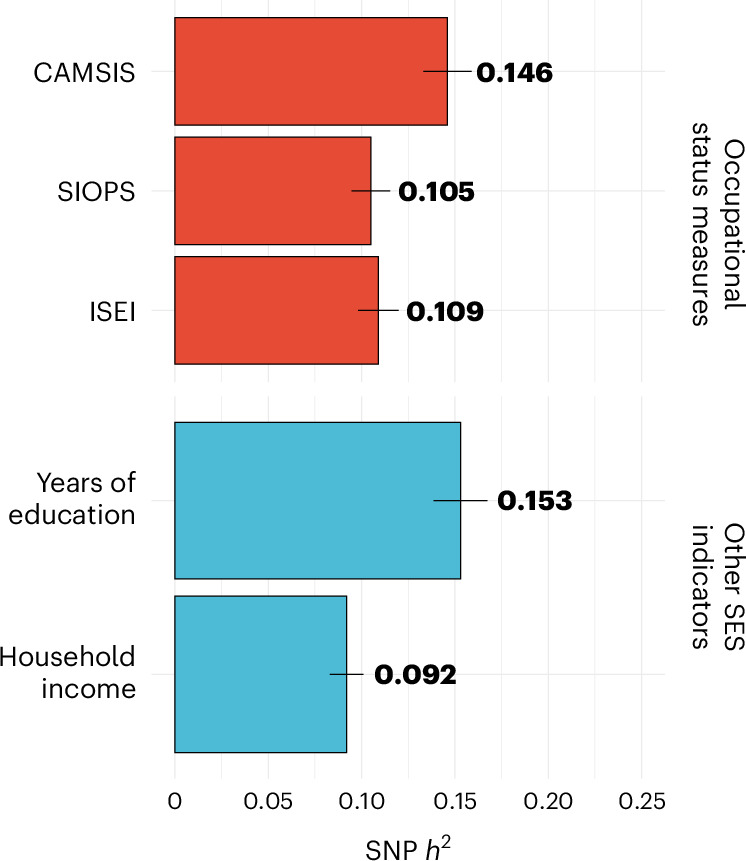
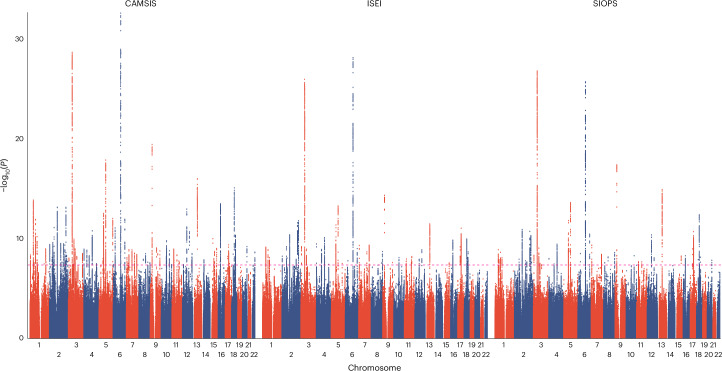
Socioeconomic status (SES) impacts health and life-course outcomes. This genome-wide association study (GWAS) of sociologically informed occupational status measures (ISEI, SIOPS, CAMSIS) using the UK Biobank (N = 273,157) identified 106 independent single-nucleotide polymorphisms of which 8 are novel to the study of SES. Genetic correlations with educational attainment (r = 0.96-0.97) and income (r = 0.81-0.91) point to a common genetic factor for SES. We observed a 54-57% reduction in within-family predictions compared with population-based predictions, attributed to indirect parental effects (22-27% attenuation) and assortative mating (21-27%) following our calculations. Using polygenic scores from population predictions of 5-10% (incremental R = 0.023-0.097 across different approaches and occupational status measures), we showed that (1) cognitive and non-cognitive traits, including scholastic and occupational motivation and aspiration, link polygenic scores to occupational status and (2) 62% of the intergenerational transmission of occupational status cannot be ascribed to genetic inheritance of common variants but other factors such as family environments. Finally, links between genetics, occupation, career trajectory and health are interrelated with parental occupational status.
社会经济地位(SES)会影响健康和人生历程的结果。这项使用英国生物银行(样本量N = 273,157)对具有社会学依据的职业地位指标(国际标准职业分类编码、社会经济指数职业地位评分、修正社会经济指数)进行的全基因组关联研究(GWAS),确定了106个独立单核苷酸多态性,其中8个是SES研究中的新发现。与受教育程度(r = 0.96 - 0.97)和收入(r = 0.81 - 0.91)的遗传相关性表明SES存在一个共同的遗传因素。经计算,我们观察到与基于人群的预测相比,家庭内部预测降低了54 - 57%,这归因于间接的父母效应(衰减22 - 27%)和选型交配(21 - 27%)。使用来自人群预测的5 - 10%的多基因分数(不同方法和职业地位指标的增量R = 0.023 - 0.097),我们发现:(1)认知和非认知特质,包括学业和职业动机与抱负,将多基因分数与职业地位联系起来;(2)62%的职业地位代际传递不能归因于常见变异的遗传继承,而是其他因素,如家庭环境。最后,基因、职业、职业轨迹和健康之间的联系与父母职业地位相互关联。