Kauppila Jussi, Iirola Timo, Nordquist Hilla
Emergency Medical Services, Turku University Hospital and University of Turku, PO Box 52, Turku, 20521, Finland.
Department of Healthcare and Emergency care, South-Eastern Finland University of Applied Sciences, Salakuljettajantie 4, Kotka, 48100, Finland.
BMC Emerg Med. 2024 Dec 23;24(1):239. doi: 10.1186/s12873-024-01157-w.
Chemical, biological, radiological, nuclear, and explosive (CBRNE) incidents present rare and complex challenges for Emergency Medical Services (EMS), necessitating effective incident command to manage occupational and patient safety risks. EMS incident commanders must make quick decisions under pressure, coordinating medical responses and ensuring personnel's safety. This study examined the perceived competence requirements of Finnish EMS field supervisors in managing C and E incidents.
This study was a qualitative interview study among EMS field supervisors (n = 12) in Southwest Finland. Individual interviews utilized fictional C and E case descriptions. The data was analyzed using inductive-deductive content analysis, with the Major Incident Medical Management and Support model as the theoretical framework.
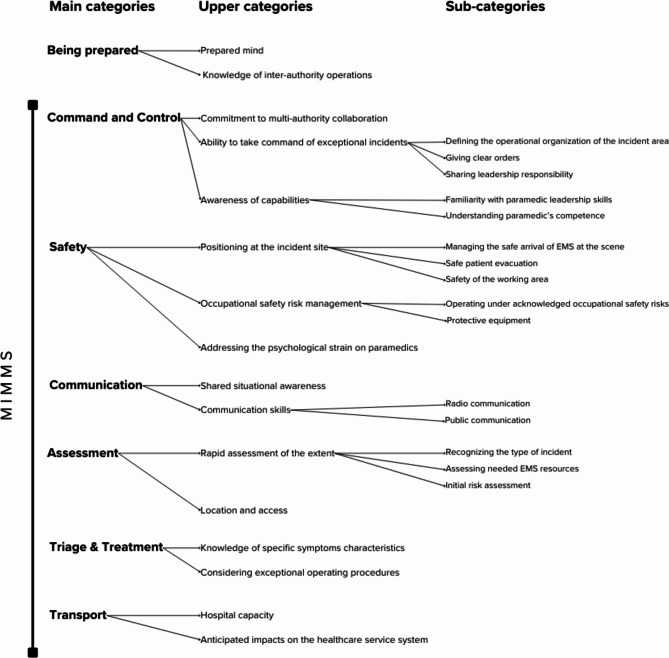
The results were grouped under one inductive main category, "Being Prepared," and six deductive main categories: "Command and Control," "Safety," "Communication," "Assessment," "Triage and Treatment," and "Transport." Under the main categories, there were a total of 16 upper categories and 15 subcategories. Broadly similar content emerged from the C and E cases, although some categories had specific areas of emphasis.
The perceived competence requirements of EMS field supervisors in managing C and E incidents align well with the Major Incident Medical Management and Support model. Also, EMS field supervisors should be mentally prepared and well-trained for handling C and E incidents. The results support the development of specific C and E training and guidelines beyond the "all hazards" approach. Further research should focus on assessing the current level and gaps in competence and optimizing training methods for different CBRNE situations.
化学、生物、放射、核和爆炸(CBRNE)事件给紧急医疗服务(EMS)带来了罕见且复杂的挑战,需要有效的事件指挥来管理职业和患者安全风险。EMS事件指挥官必须在压力下迅速做出决策,协调医疗响应并确保人员安全。本研究调查了芬兰EMS现场主管在管理化学和爆炸事件方面的感知能力要求。
本研究是对芬兰西南部的EMS现场主管(n = 12)进行的定性访谈研究。个人访谈采用虚构的化学和爆炸案例描述。数据采用归纳 - 演绎内容分析法进行分析,以重大事件医疗管理与支持模型作为理论框架。
结果分为一个归纳主类别“做好准备”和六个演绎主类别:“指挥与控制”、“安全”、“沟通”、“评估”、“分诊与治疗”以及“运输”。在这些主类别下,共有16个上位类别和15个子类别。化学和爆炸案例中出现了大致相似的内容,尽管有些类别有特定的重点领域。
EMS现场主管在管理化学和爆炸事件方面的感知能力要求与重大事件医疗管理与支持模型高度契合。此外,EMS现场主管应在心理上做好准备并接受充分培训以应对化学和爆炸事件。研究结果支持制定超越“全危害”方法的特定化学和爆炸培训及指南。进一步的研究应侧重于评估当前的能力水平和差距,并优化针对不同CBRNE情况的培训方法。