Hong Xuelian, Jiang Fengfeng
Department of Rheumatology and Immunology, Affiliated Jinhua Hospital, Zhejiang University School of Medicine, Jinhua City, Zhejiang Province, 321000, People's Republic of China.
Department of Neurosurgery, Affiliated Jinhua Hospital, Zhejiang University School of Medicine, Jinhua City, Zhejiang Province, 321000, People's Republic of China.
Int J Womens Health. 2024 Dec 19;16:2209-2219. doi: 10.2147/IJWH.S482294. eCollection 2024.
This study aimed to explore the association between dietary niacin intake and rheumatoid arthritis (RA) in American women through the National Health and Nutrition Examination Survey (NHANES) database.
A retrospective analysis was conducted based on NHANES 2003-2016 data. Dietary niacin intake was stratified using weighted quartiles and association of dietary niacin intake with RA was explored using weighted logistic regression models and restricted cubic splines (RCS). Subgroup analysis was conducted, adjusting for all confounding factors, and a likelihood ratio test was utilized to determine significant covariates for the interaction term. Stratified analysis was conducted on significant covariates to determine their impact on the association of dietary niacin intake with RA.
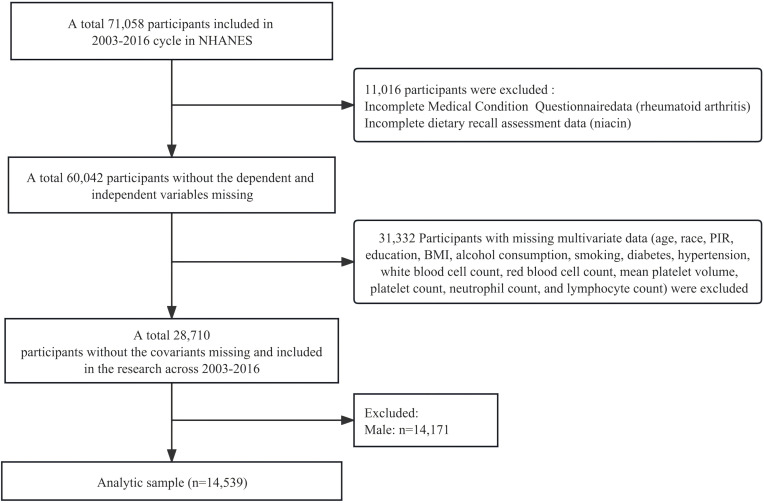
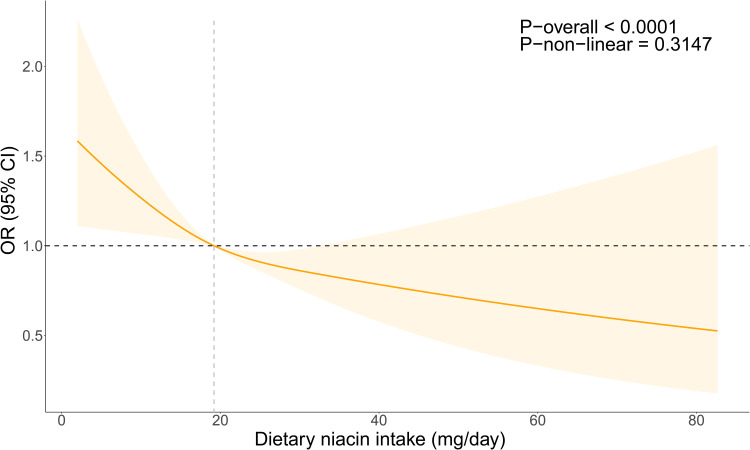
Fourteen thousand five hundred and thirty-nine American women were selected according to inclusion and exclusion criteria, among whom 845 (4.4%) had RA. Compared with American women without RA, American women with RA had significantly lower dietary niacin intake (18.90 vs 21.22, <0.001). Logistic regression models and RCS analysis reported a significant linear negative correlation between dietary niacin intake and prevalence of RA (Odds Ratio (OR) < 1, < 0.05, -non-linear >0.05). The interaction-term -values showed that this association was significantly influenced by poverty income ratio (PIR), education level, Body Mass Index (BMI), and smoking ( for interaction < 0.05). Stratified analysis unveiled that this association was particularly significant in individuals aged ≥ 40 years (OR: 0.98, 95% Confidence Interval (CI): 0.97-0.99, < 0.05), PIR > 3.5 (OR: 0.96, 95% CI: 0.93-0.99, < 0.05), with a college education or higher (OR: 0.97, 95% CI: 0.94-0.99, < 0.01), BMI ≥ 30kg/m² (OR: 0.98, 95% CI: 0.96-0.99, < 0.05), non-smokers (OR: 0.97, 95% CI: 0.95-0.99, < 0.01), or former smokers (OR: 0.95, 95% CI: 0.95-0.99, < 0.05).
Increased dietary niacin intake was associated with a reduced prevalence of RA, especially in women aged ≥40, PIR > 3.5, with at least a college education, BMI ≥ 30kg/m², and currently non-smokers.
本研究旨在通过美国国家健康与营养检查调查(NHANES)数据库,探究美国女性膳食烟酸摄入量与类风湿关节炎(RA)之间的关联。
基于2003 - 2016年NHANES数据进行回顾性分析。膳食烟酸摄入量采用加权四分位数分层,并使用加权逻辑回归模型和受限立方样条(RCS)探究膳食烟酸摄入量与RA的关联。进行亚组分析,对所有混杂因素进行调整,并利用似然比检验确定交互项的显著协变量。对显著协变量进行分层分析,以确定它们对膳食烟酸摄入量与RA关联的影响。
根据纳入和排除标准,选取了14539名美国女性,其中845名(4.4%)患有RA。与未患RA的美国女性相比,患RA的美国女性膳食烟酸摄入量显著更低(18.90对21.22,<0.001)。逻辑回归模型和RCS分析表明,膳食烟酸摄入量与RA患病率之间存在显著的线性负相关(优势比(OR)<1,<0.05,非线性>0.05)。交互项P值表明,这种关联受贫困收入比(PIR)、教育水平、体重指数(BMI)和吸烟的显著影响(交互作用P<0.05)。分层分析显示,这种关联在年龄≥40岁的个体中尤为显著(OR:0.98,95%置信区间(CI):0.97 - 0.99,<0.05),PIR>3.5(OR:0.96,95%CI:0.93 - 0.99,<0.05),具有大学及以上学历(OR:0.97,95%CI:0.94 - 0.99,<0.01),BMI≥30kg/m²(OR:0.98,95%CI:0.96 - 0.99,<0.05),非吸烟者(OR:0.97,95%CI:0.95 - 0.99,<0.01)或曾经吸烟者(OR:0.95,95%CI:0.95 - 0.99,<0.05)中尤为明显。
膳食烟酸摄入量增加与RA患病率降低相关,尤其是在年龄≥40岁、PIR>3.5、至少具有大学学历、BMI≥30kg/m²且目前不吸烟的女性中。