Tao Yiming, Wang Jianyun, Ma Jianchao, Peng Siqi, Chen Boxi, Deng Shuting, Yuan Ye, Jiang Nan, Wen Sichun, Li Bohou, Wu Qiong, Xu Lixia, Li Sijia, Lin Ting, Wen Feng, Fu Lei, Li Zhuo, Huang Renwei, He Chaosheng, Wang Wenjian, Ye Zhiming, Shi Wei, Feng Zhonglin, Liu Shuangxin
Department of Nephrology, Guangdong Provincial People's Hospital (Guangdong Academy of Medical Sciences), Southern Medical University, Guangzhou, China.
Department of Nephrology, Gaozhou People's Hospital, Gaozhou, China.
Front Cardiovasc Med. 2024 Dec 9;11:1405606. doi: 10.3389/fcvm.2024.1405606. eCollection 2024.
The number of people undergoing maintenance hemodialysis is increasing rapidly worldwide. Central vein stenosis (CVS) is a common vascular complication in undergoing hemodialysis, especially those with a history of catheterization. This study aimed to investigate the characteristics of CVS and the clinical effectiveness of percutaneous transluminal angioplasty (PTA) alone and sequential percutaneous transluminal stenting (PTS) in hemodialysis patients with CVS.
A retrospective analysis of 26 cases of endovascular intervention for CVS using PTA alone or sequential PTS was performed. The characteristics of CVS and the clinical effectiveness of these procedures were evaluated.
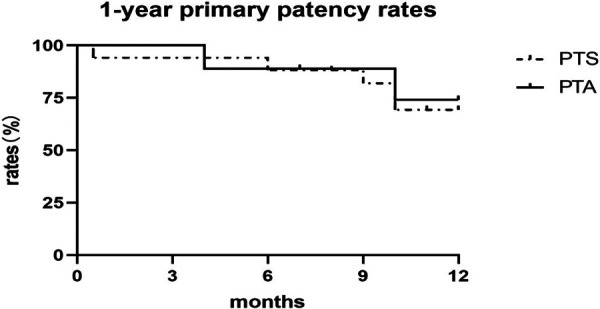
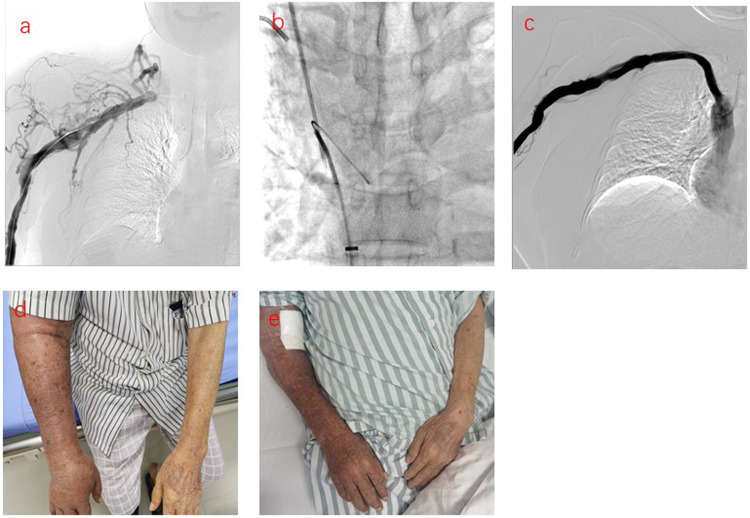
This study included 26 hemodialysis patients who presented with symptomatic CVS. Of these 26 patients, 53.85% were male, and their mean age was approximately 54.96 years. All the patients had a history of catheter placement or pacemaker implantation. The incidence of brachiocephalic vein stenosis was significantly higher than that of subclavian vein stenosis (46.16% vs. 26.92%). Based on the degree of stenosis and elastic retraction, these patients were administered PTA alone or sequential PTS. There was no difference in patient age, hemodialysis time, catheter retention time, or stenosis length between the PTA alone and sequential PTS groups. However, the degree of venous stenosis in the PTS group was more severe than that in the PTA alone group. The primary patency rates in the sequential PTS and PTA alone groups were 94.12% and 100% at 3 months; 88.24% and 88.89% at 6 months; 75.00% and 85.71% at 9 months; and 66.67% and 71.43% at 12 months, respectively. It is worth noting that for 7 patients with complete occlusion of the brachiocephalic vein, we used sharp recanalization technology and stenting placement, with patency rates of 85.71% and 71.43% at 6 and 12 months, respectively.
PTA alone is recommended for patients with less than 50% central venous elastic retraction, while sequential PTS is recommended for patients with ≥ 50% central venous elastic retraction. PTA and PTS are safe and effective methods for the treatment of CVS in patients undergoing hemodialysis.
在全球范围内,接受维持性血液透析的人数正在迅速增加。中心静脉狭窄(CVS)是血液透析患者常见的血管并发症,尤其是有导管置入史的患者。本研究旨在探讨CVS的特征以及单纯经皮腔内血管成形术(PTA)和序贯经皮腔内支架置入术(PTS)在患有CVS的血液透析患者中的临床疗效。
对26例采用单纯PTA或序贯PTS进行CVS血管内介入治疗的病例进行回顾性分析。评估CVS的特征以及这些治疗方法的临床疗效。
本研究纳入了26例出现症状性CVS的血液透析患者。在这26例患者中,53.85%为男性,平均年龄约为54.96岁。所有患者均有导管置入或起搏器植入史。头臂静脉狭窄的发生率显著高于锁骨下静脉狭窄(46.16%对26.92%)。根据狭窄程度和弹性回缩情况,对这些患者采用单纯PTA或序贯PTS治疗。单纯PTA组和序贯PTS组在患者年龄、血液透析时间、导管留置时间或狭窄长度方面无差异。然而,PTS组的静脉狭窄程度比单纯PTA组更严重。序贯PTS组和单纯PTA组在3个月时的主要通畅率分别为94.12%和100%;6个月时分别为88.24%和88.89%;9个月时分别为75.00%和85.71%;12个月时分别为66.67%和71.43%。值得注意的是,对于7例头臂静脉完全闭塞的患者,我们采用了锐性再通技术并置入支架,6个月和12个月时的通畅率分别为85.71%和71.43%。
对于中心静脉弹性回缩小于50%的患者,建议采用单纯PTA治疗;对于中心静脉弹性回缩≥50%的患者,建议采用序贯PTS治疗。PTA和PTS是治疗血液透析患者CVS的安全有效的方法。