Cui Jing, Dandan Yu R, Yang Bo, Jing Youping
School of Foreign Languages, Southeast University, Nanjing, China.
School of Psychological and Cognitive Sciences and Beijing Key Laboratory of Behavior and Mental Health, Peking University, Beijing, China.
Heliyon. 2024 Nov 9;10(23):e39796. doi: 10.1016/j.heliyon.2024.e39796. eCollection 2024 Dec 15.
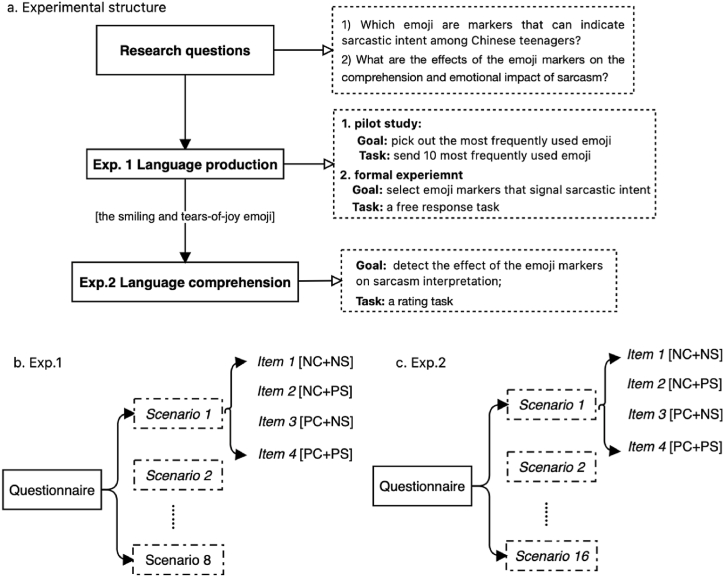
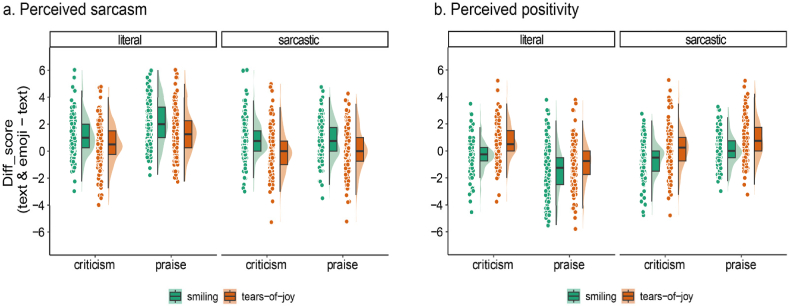
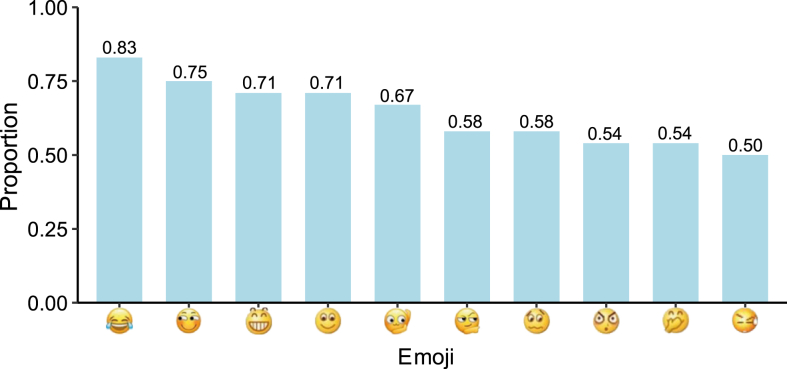
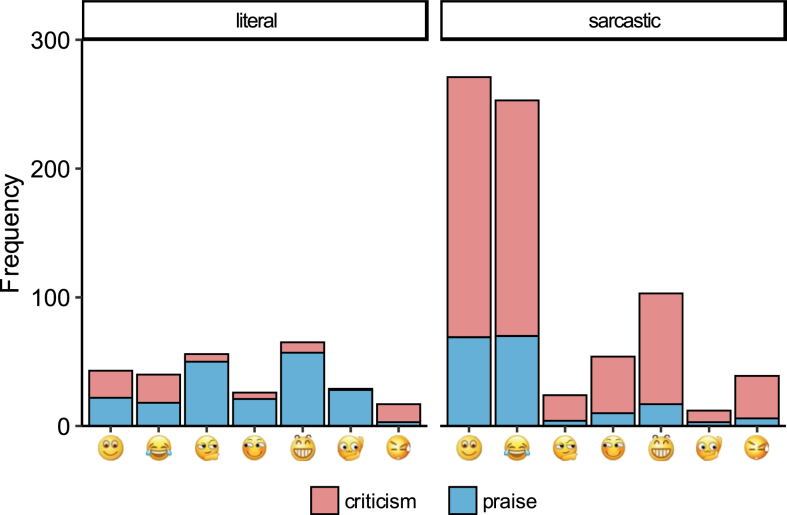
This study explored emoji-based sarcastic statements made by Chinese teenagers using the WeChat app. Two experiments ( = 597) were conducted to investigate both language production and comprehension. In Experiment 1 ( = 236), a free-response task was used to determine which emoji Chinese teenagers would use to signal their sarcastic intentions. The results showed that the smiling emoji (Image 1) and the tears-of-joy emoji (Image 2) were the most commonly used emoji to indicate sarcastic intent. Experiment 2 ( = 361) involved a rating task to investigate the role that two selected emoji played in the comprehension and emotional impact of WeChat messages (literal and sarcastic statements). Our findings revealed that both emoji generally increased the perceived sarcasm in literal comments; however, while the smiling emoji intensified the perceived sarcasm in sarcastic comments, the tears-of-joy emoji had no significant effect on such comments. Regarding emotional impact, the smiling emoji amplified the negativity of the statement, whereas the tears-of-joy emoji mitigated it. This indicates that both emoji and context are reliable cues for interpreting sarcasm, though their levels of reliability may differ. Specifically, the smiling emoji carries greater weight than context, while context is afforded stronger weight than the tears-of-joy emoji in the constraint-satisfaction process of sarcasm. Overall, the smiling emoji is perceived as more sarcastic and more negative than the tears-of-joy emoji.
本研究探讨了中国青少年在使用微信应用程序时基于表情符号的讽刺性言论。进行了两项实验(N = 597),以调查语言生成和理解情况。在实验1(N = 236)中,使用自由回答任务来确定中国青少年会用哪些表情符号来表达他们的讽刺意图。结果表明,微笑表情符号(图1)和喜极而泣表情符号(图2)是最常用于表示讽刺意图的表情符号。实验2(N = 361)涉及一项评分任务,以调查两个选定表情符号在微信消息(字面和讽刺性陈述)的理解和情感影响中所起的作用。我们的研究结果显示,这两种表情符号通常都会增加字面评论中被感知到的讽刺意味;然而,虽然微笑表情符号增强了讽刺评论中被感知到的讽刺意味,但喜极而泣表情符号对这类评论没有显著影响。关于情感影响,微笑表情符号放大了陈述的负面性,而喜极而泣表情符号则减轻了负面性。这表明表情符号和语境都是解释讽刺意味的可靠线索,尽管它们的可靠程度可能有所不同。具体而言,在讽刺的约束满足过程中,微笑表情符号比语境的权重更大,而语境比喜极而泣表情符号的权重更大。总体而言,微笑表情符号比喜极而泣表情符号被认为更具讽刺性和负面性。