Filik Ruth, Țurcan Alexandra, Thompson Dominic, Harvey Nicole, Davies Harriet, Turner Amelia
a School of Psychology , University of Nottingham , Nottingham , UK.
Q J Exp Psychol (Hove). 2016 Nov;69(11):2130-46. doi: 10.1080/17470218.2015.1106566. Epub 2015 Dec 11.
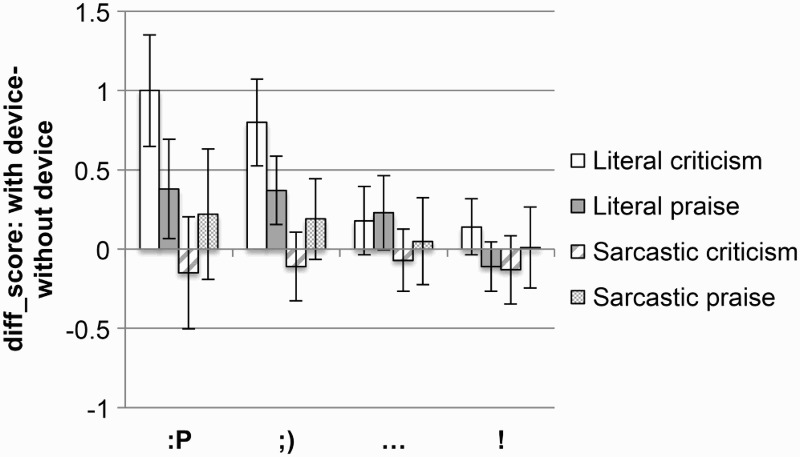
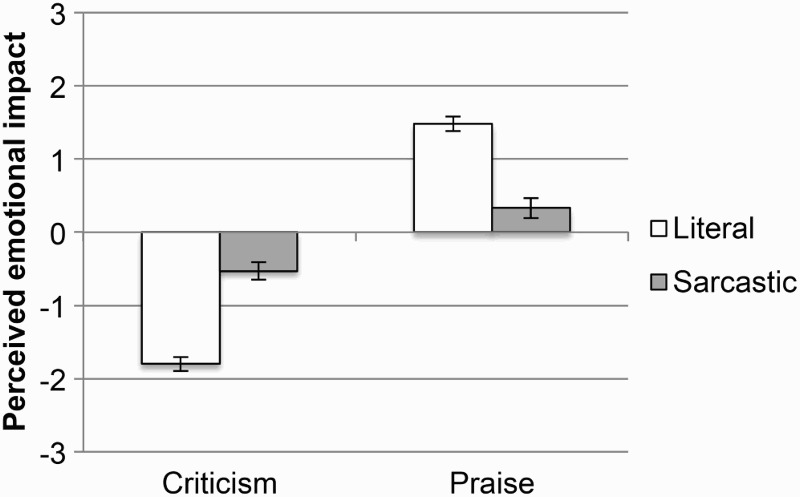
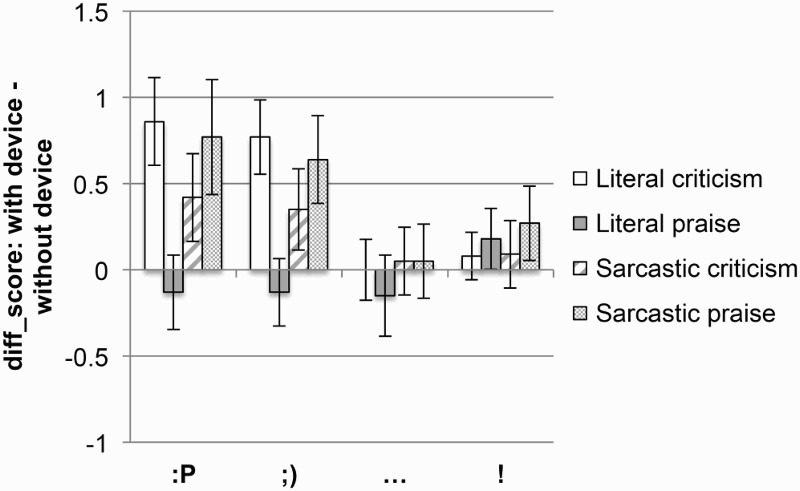
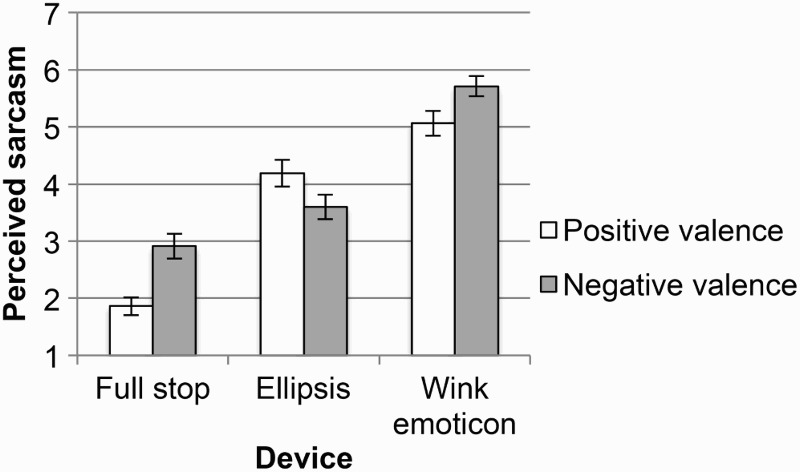
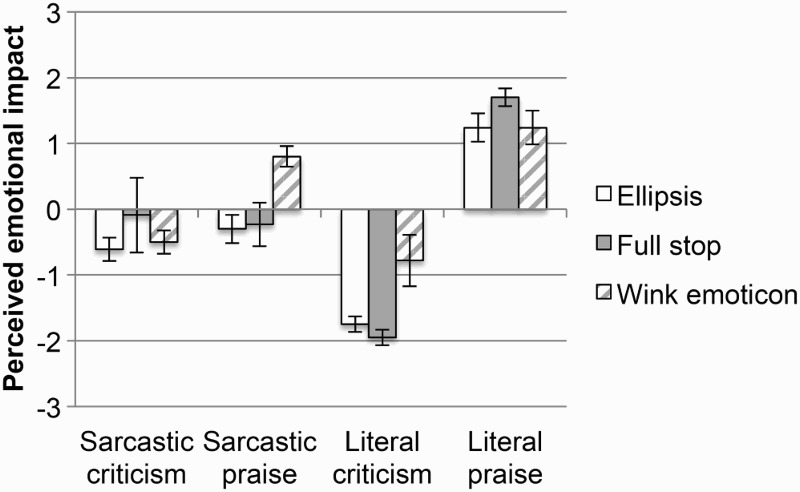
Most theorists agree that sarcasm serves some communicative function that would not be achieved by speaking directly, such as eliciting a particular emotional response in the recipient. One debate concerns whether this kind of language serves to enhance or mute the positive or negative nature of a message. The role of textual devices commonly used to accompany written sarcastic remarks is also unclear. The current research uses a rating task to investigate the influence of textual devices (emoticons and punctuation marks) on the comprehension of, and emotional responses to, sarcastic versus literal criticism and praise, for both unambiguous (Experiment 1) and ambiguous (Experiment 2) materials. Results showed that sarcastic criticism was rated as less negative than literal criticism, and sarcastic praise was rated as less positive than literal praise, suggesting that sarcasm serves to mute the positive or negative nature of the message. In terms of textual devices, results showed that emoticons had a larger influence on both comprehension and emotional impact than punctuation marks.
大多数理论家都认为,讽刺具有某种直接表达无法实现的交际功能,比如在接受者身上引发特定的情绪反应。一个争论点在于,这种语言是有助于增强还是削弱信息的积极或消极性质。常用于书面讽刺言论的文本手段的作用也不明确。当前的研究使用一项评分任务,来调查文本手段(表情符号和标点符号)对明确(实验1)和模糊(实验2)材料中讽刺性与字面性批评及赞扬的理解和情绪反应的影响。结果显示,讽刺性批评的负面程度被评定为低于字面性批评,讽刺性赞扬的正面程度被评定为低于字面性赞扬,这表明讽刺有助于削弱信息的积极或消极性质。在文本手段方面,结果显示,表情符号对理解和情绪影响的作用比标点符号更大。