Cui Jing
College of Foreign Languages and Cultures, Xiamen University, Xiamen, China.
Front Psychol. 2022 May 19;13:897153. doi: 10.3389/fpsyg.2022.897153. eCollection 2022.
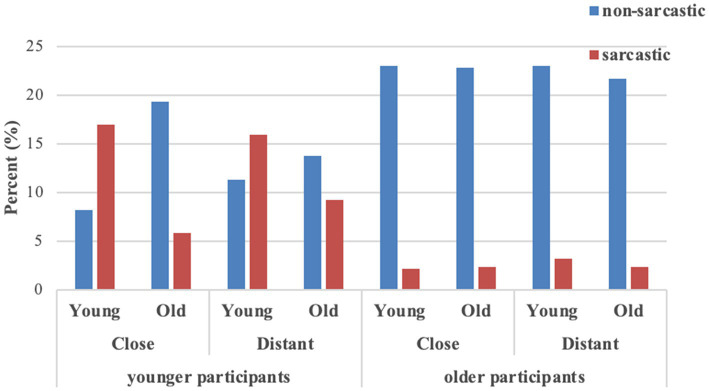
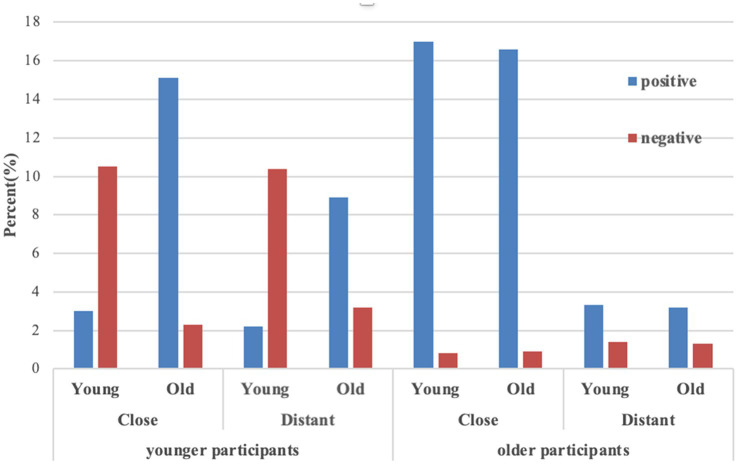
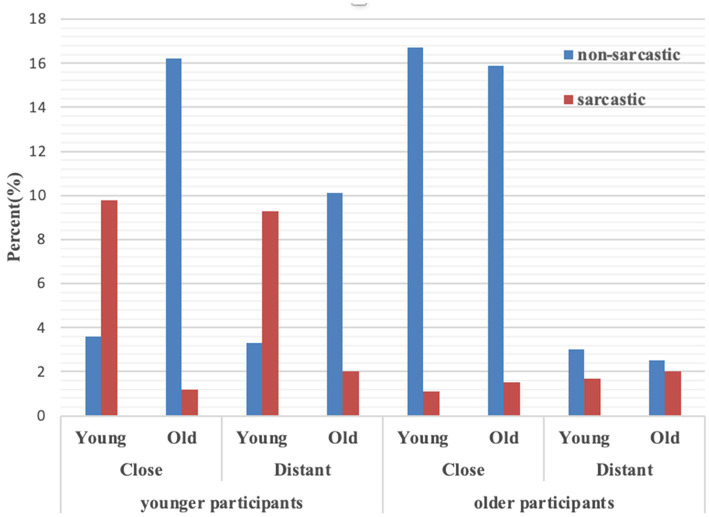
The interpretation of sarcasm relies on many cues and constraints. In computer-mediated communication (CMC), paralinguistic cues, such as emoticons and emoji, play an important role in signaling sarcastic intention. Smiling emoji have been claimed to be a marker of sarcasm among Chinese senders. Shared knowledge between the sender and the recipient, such as age and relationship, has a substantial effect on irony or sarcasm interpretation. However, hardly any research has been done to integrate the two factors to explore their joint effect on sarcasm interpretation. The present study investigated the interaction effect of these factors on the interpretation of ambiguous statements accompanied by a smiling emoji. Two experiments were conducted to investigate the differences between younger and older adults in making judgments about ambiguous statements accompanied by a smiling emoji. The results showed that sender age and sender-receiver relationship have disparate influences on younger and older adults' interpretation of emoji-based ambiguous statements. For younger adults, sender age and sender-receiver relationship were significantly associated with the perceived sarcasm of emoji-based ambiguous statements, whereas for older adults, sender age had a null effect on the sarcastic interpretation of emoji-based ambiguous statements, but relationship was an important cue that might impact their interpretation.
讽刺的解读依赖于许多线索和限制因素。在计算机媒介沟通(CMC)中,诸如表情符号和emoji等副语言线索在传达讽刺意图方面发挥着重要作用。在中国发送者中,微笑emoji被认为是讽刺的一个标志。发送者和接收者之间的共同知识,如年龄和关系,对反讽或讽刺的解读有重大影响。然而,几乎没有研究将这两个因素结合起来探讨它们对讽刺解读的共同影响。本研究调查了这些因素对伴有微笑emoji的歧义语句解读的交互作用。进行了两项实验来调查年轻人和老年人在判断伴有微笑emoji的歧义语句时的差异。结果表明,发送者年龄和发送者-接收者关系对年轻人和老年人对基于emoji的歧义语句的解读有不同的影响。对于年轻人来说,发送者年龄和发送者-接收者关系与基于emoji的歧义语句的感知讽刺显著相关,而对于老年人来说,发送者年龄对基于emoji的歧义语句的讽刺解读没有影响,但关系是一个可能影响他们解读的重要线索。