Chen Saijuan, Wang Qiuting, An Yunyi, Chen Ying, Liu Hua, Tan Weijie, Zhou Xinyun, Xing Dianguo, Zhang Yan
School of Public Health, Chongqing Medical University, Chongqing, China.
Office of Health Emergency, Chongqing Municipal Health Commission, Chongqing, China
BMJ Open. 2024 Dec 23;14(12):e077935. doi: 10.1136/bmjopen-2023-077935.
This study aimed to explore the spatial and temporal distribution of hepatitis C and its influencing factors in Chongqing, providing a scientific basis for the relevant departments to formulate targeted preventive measures for the high prevalence of hepatitis C in the region and population.
We collected data on hepatitis C cases in Chongqing (located in the southwest of China) from 2014 to 2020, and analysed the spatiotemporal heterogeneity of hepatitis C incidence in different populations and identified factors that might influence the incidence of hepatitis C by constructing a Bayesian spatiotemporal model.
The study subjects included clinically diagnosed cases and confirmed cases of hepatitis C with current address in Chongqing and onset date between 1 January 2014 and 31 December 2020.
The study used aggregated data, including 33 900 clinically diagnosed cases and confirmed cases of hepatitis C.
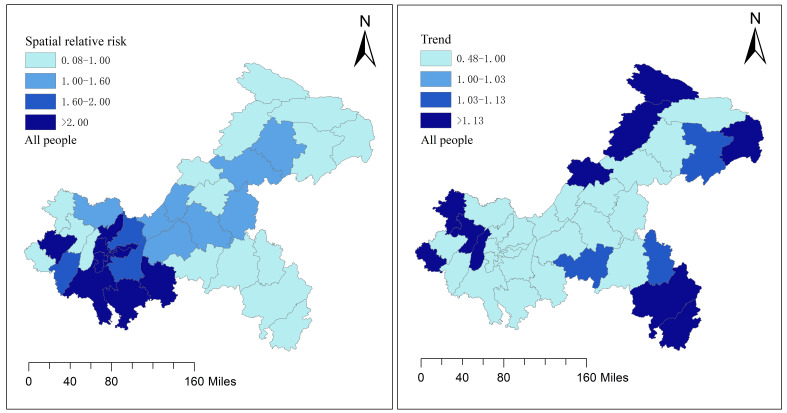
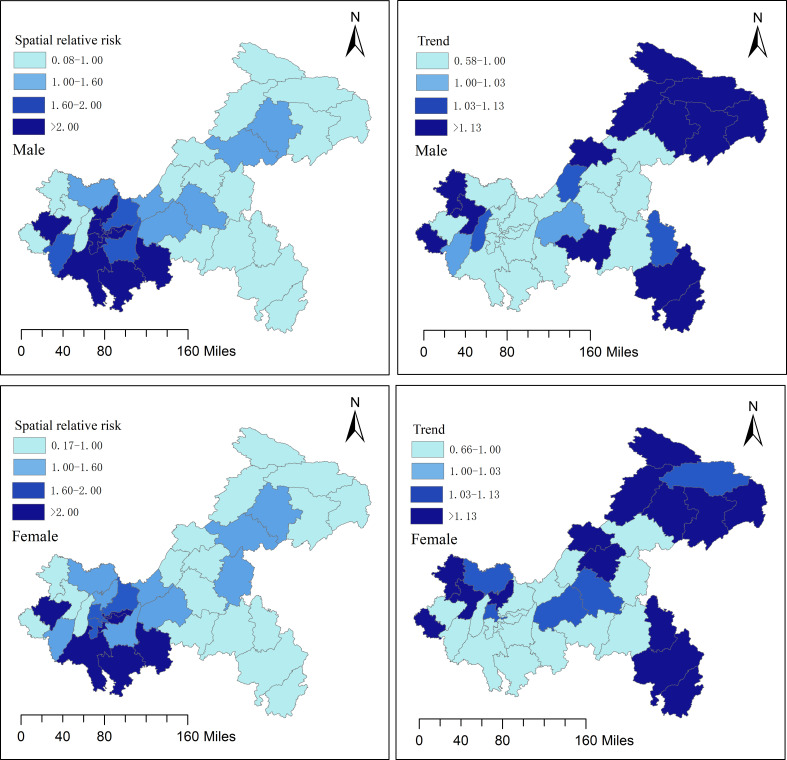
From 2014 to 2020, the high-risk areas of hepatitis C were primarily concentrated in the main and new urban areas of Chongqing. In contrast, the low-risk areas were mainly found in southeast and northeast Chongqing. There was also an increasing trend in the risk of incidence in the low-risk areas. Analysis of different populations revealed that men aged 45-59 years had a higher risk of developing hepatitis C in the main urban area compared with other age groups. Additionally, the risk for this population group showed an increasing trend in the southeast and northeast of Chongqing as well as the main urban area. Among women, the rising trend of hepatitis C risk was stronger for those aged 30-44 years in southeast Chongqing and for those aged 45-59 years in northeast Chongqing compared with other age groups. The analysis of influencing factors found that gross domestic product per capita, population density and the proportion of tertiary industry were associated with an increased risk of hepatitis C.
High-risk areas for hepatitis C virus were mainly located in the main and new urban areas of Chongqing, where the male prime-age population was the focus of prevention and treatment. In the future, the relevant authorities should concentrate on high-risk areas and at the same time strengthen screening and serological surveys for hepatitis C in low-risk areas and various populations, and raise public awareness of prevention, so as to reduce the incidence of hepatitis C.
本研究旨在探讨重庆市丙型肝炎的时空分布及其影响因素,为相关部门针对该地区和人群丙型肝炎高流行状况制定针对性预防措施提供科学依据。
收集重庆市(位于中国西南部)2014年至2020年丙型肝炎病例数据,通过构建贝叶斯时空模型分析不同人群丙型肝炎发病率的时空异质性,并确定可能影响丙型肝炎发病率的因素。
研究对象包括现住址在重庆、发病日期在2014年1月1日至2020年12月31日之间的临床诊断病例和丙型肝炎确诊病例。
本研究使用汇总数据,包括33900例临床诊断病例和丙型肝炎确诊病例。
2014年至2020年,丙型肝炎高危地区主要集中在重庆主城区和新城区。相比之下,低风险地区主要位于重庆东南部和东北部。低风险地区的发病风险也呈上升趋势。对不同人群的分析显示,与其他年龄组相比,45至59岁男性在主城区感染丙型肝炎的风险更高。此外,该人群组在重庆东南部、东北部以及主城区的风险呈上升趋势。在女性中,与其他年龄组相比,重庆东南部30至44岁女性以及重庆东北部45至59岁女性的丙型肝炎风险上升趋势更为明显。影响因素分析发现,人均国内生产总值、人口密度和第三产业比重与丙型肝炎风险增加有关。
丙型肝炎病毒高危地区主要位于重庆主城区和新城区,其中男性青壮年人群是防治重点。未来,相关部门应重点关注高危地区,同时加强对低风险地区和各类人群的丙型肝炎筛查及血清学调查,提高公众预防意识,以降低丙型肝炎发病率。