Gu Cheng, Luo Xuming, Liu Hailong, Yu Baoxi, Fu Ming, Luo Weiliang
Department of Joint Surgery, The First Affiliated Hospital, Sun Yat-sen University, Guangzhou 510080, China.
Jt Dis Relat Surg. 2025 Jan 2;36(1):3-14. doi: 10.52312/jdrs.2024.1836. Epub 2024 Nov 5.
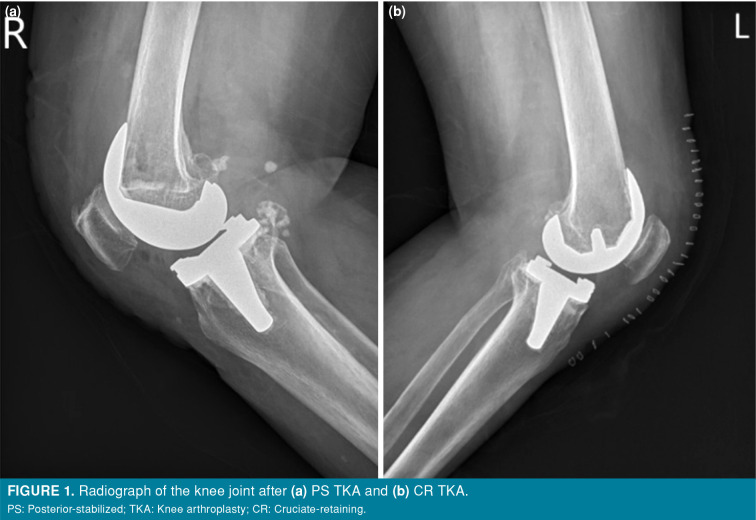
This study aimed to analyze the effects of posteriorstabilized (PS) and cruciate-retaining (CR) total knee arthroplasty (TKA) on early postoperative three-dimensional (3D) dynamic and kinematic characteristics in patients with unilateral knee osteoarthritis (OA).
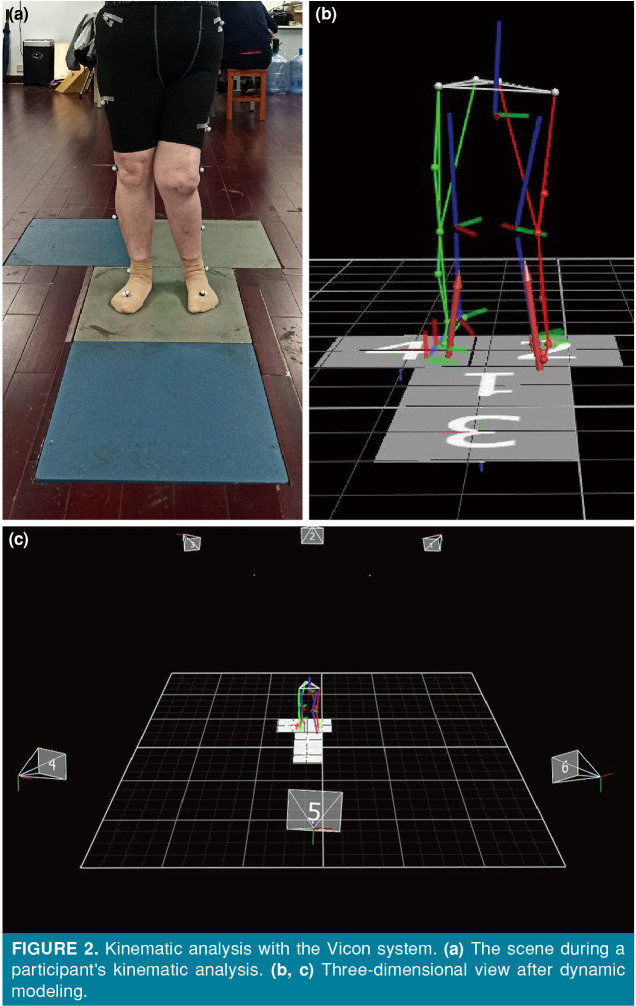
A retrospective analysis of prospectively collected data from 90 patients with unilateral TKA between February 2021 and September 2021 was conducted using a 3D kinematic analysis system before and six months after TKA. This patient group included 57 patients (10 males, 47 females; mean age: 69.5±7.5 years; range, 53 to 85 years) who underwent PS TKA and 33 patients (11 males, 22 females; mean age: 67.9±8.8 years; range, 45 to 86 years) who underwent CR TKA. The kinematic characteristics and clinical results of the two groups were compared. Clinical evaluation included the Hospital for Special Surgery knee score and range of motion (ROM). Twenty-eight healthy controls (9 males, 19 females; mean age: 64.5±2.9 years; range, 61 to 75 years) without knee OA matched for age, weight, height, and body mass index were recruited. The kinematic characteristics of the healthy control group were also evaluated.
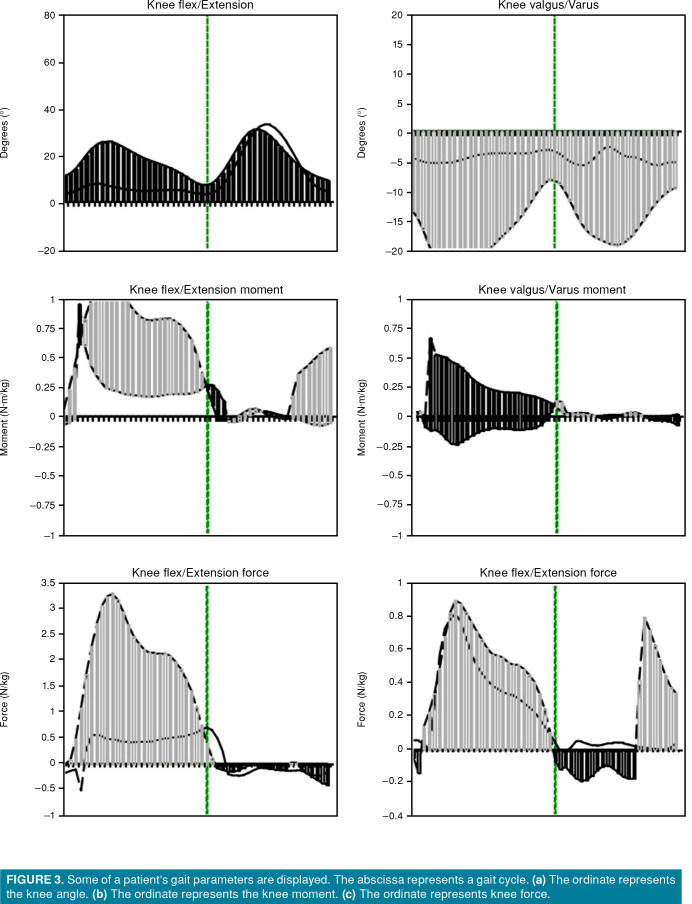
The PS group exhibited significant changes in basic gait parameters after TKA, including cadence (p=0.046), stride time (p=0.011), opposite foot off (p<0.001), opposite foot contact (p=0.038), step time (p=0.005), double support period (p<0.001), and foot off (p=0.004). No significant differences were observed in the kinematic parameters before and after TKA between the PS and CR groups, such as knee angle, moment, and force. The dynamic ROM of the CR group was greater than that of the PS group (p<0.001). Both the PS and CR groups showed significant deficiencies in flexion and extension function, including knee flexion moment, extension force, maximum flexion angle, and dynamic ROM, compared to healthy individuals. Throughout the gait cycle, both the PS and CR groups showed better knee joint stability compared to healthy individuals.
At six months postoperatively, both the PS and CR groups' gait patterns did not recover to a healthy state, and the CR group's gait pattern was more similar to OA. Compared to PS TKA, CR TKA allowed for greater dynamic ROM during gait. Despite exhibiting superior knee stability during gait, both implants' knee kinematics function remained inferior compared to healthy individuals.
本研究旨在分析后稳定型(PS)和保留交叉韧带型(CR)全膝关节置换术(TKA)对单侧膝关节骨关节炎(OA)患者术后早期三维(3D)动态和运动学特征的影响。
对2021年2月至2021年9月期间90例行单侧TKA患者的前瞻性收集数据进行回顾性分析,在TKA术前及术后6个月使用3D运动分析系统。该患者组包括57例行PS TKA的患者(10例男性,47例女性;平均年龄:69.5±7.5岁;范围,53至85岁)和33例行CR TKA的患者(11例男性,22例女性;平均年龄:67.9±8.8岁;范围,45至86岁)。比较两组的运动学特征和临床结果。临床评估包括特种外科医院膝关节评分和活动范围(ROM)。招募了28名年龄、体重、身高和体重指数相匹配的无膝关节OA的健康对照者(9例男性,19例女性;平均年龄:64.5±2.9岁;范围,61至75岁)。还评估了健康对照组的运动学特征。
PS组TKA术后基本步态参数有显著变化,包括步频(p = 0.046)、步幅时间(p = 0.011)、对侧足离地(p < 0.001)、对侧足着地(p = 好038)、步长时间(p = 0.005)、双支撑期(p < 0.001)和足离地(p = 0.004)。PS组和CR组TKA前后的运动学参数,如膝关节角度、力矩和力,未观察到显著差异。CR组的动态ROM大于PS组(p < 0.001)。与健康个体相比,PS组和CR组在屈伸功能方面均存在显著不足,包括膝关节屈曲力矩、伸展力、最大屈曲角度和动态ROM。在整个步态周期中,与健康个体相比,PS组和CR组的膝关节稳定性均更好。
术后6个月,PS组和CR组的步态模式均未恢复到健康状态,且CR组的步态模式与OA更相似。与PS TKA相比,CR TKA在步态期间允许更大的动态ROM。尽管在步态期间表现出更好的膝关节稳定性,但与健康个体相比,两种植入物的膝关节运动学功能仍然较差。