• 文献检索
  • 文档翻译
  • 深度研究
  • 学术资讯
  • Suppr Zotero 插件Zotero 插件
  • 邀请有礼
  • 套餐&价格
  • 历史记录
应用&插件
Suppr Zotero 插件Zotero 插件浏览器插件Mac 客户端Windows 客户端微信小程序
定价
高级版会员购买积分包购买API积分包
服务
文献检索文档翻译深度研究API 文档MCP 服务
关于我们
关于 Suppr公司介绍联系我们用户协议隐私条款
关注我们

Suppr 超能文献

核心技术专利:CN118964589B侵权必究
粤ICP备2023148730 号-1Suppr @ 2026

文献检索

告别复杂PubMed语法,用中文像聊天一样搜索,搜遍4000万医学文献。AI智能推荐,让科研检索更轻松。

立即免费搜索

文件翻译

保留排版,准确专业,支持PDF/Word/PPT等文件格式,支持 12+语言互译。

免费翻译文档

深度研究

AI帮你快速写综述,25分钟生成高质量综述,智能提取关键信息,辅助科研写作。

立即免费体验

用于术后感染早期检测的人工智能模型的开发与验证(PERISCOPE):一项使用电子健康记录数据的多中心研究

Development and validation of artificial intelligence models for early detection of postoperative infections (PERISCOPE): a multicentre study using electronic health record data.

作者信息

van der Meijden Siri L, van Boekel Anna M, Schinkelshoek Laurens J, van Goor Harry, Steyerberg Ewout W, Nelissen Rob G H H, Mesotten Dieter, Geerts Bart F, de Boer Mark G J, Arbous M Sesmu

机构信息

Intensive Care Unit, Leiden University Medical Centre, Leiden, the Netherlands.

Healthplus.ai B.V., Amsterdam, the Netherlands.

出版信息

Lancet Reg Health Eur. 2024 Dec 5;49:101163. doi: 10.1016/j.lanepe.2024.101163. eCollection 2025 Feb.

DOI:10.1016/j.lanepe.2024.101163
PMID:39720095
原文链接:https://pmc.ncbi.nlm.nih.gov/articles/PMC11667051/
Abstract

BACKGROUND

Postoperative infections significantly impact patient outcomes and costs, exacerbated by late diagnoses, yet early reliable predictors are scarce. Existing artificial intelligence (AI) models for postoperative infection prediction often lack external validation or perform poorly in local settings when validated. We aimed to develop locally valid models as part of the PERISCOPE AI system to enable early detection, safer discharge, and more timely treatment of patients.

METHODS

We developed and validated XGBoost models to predict postoperative infections within 7 and 30 days of surgery. Using retrospective pre-operative and intra-operative electronic health record data from 2014 to 2023 across various surgical specialities, the models were developed at Hospital A and validated and updated at Hospitals B and C in the Netherlands and Belgium. Model performance was evaluated before and after updating using the two most recent years of data as temporal validation datasets. Main outcome measures were model discrimination (area under the receiver operating characteristic curve (AUROC)), calibration (slope, intercept, and plots), and clinical utility (decision curve analysis with net benefit).

FINDINGS

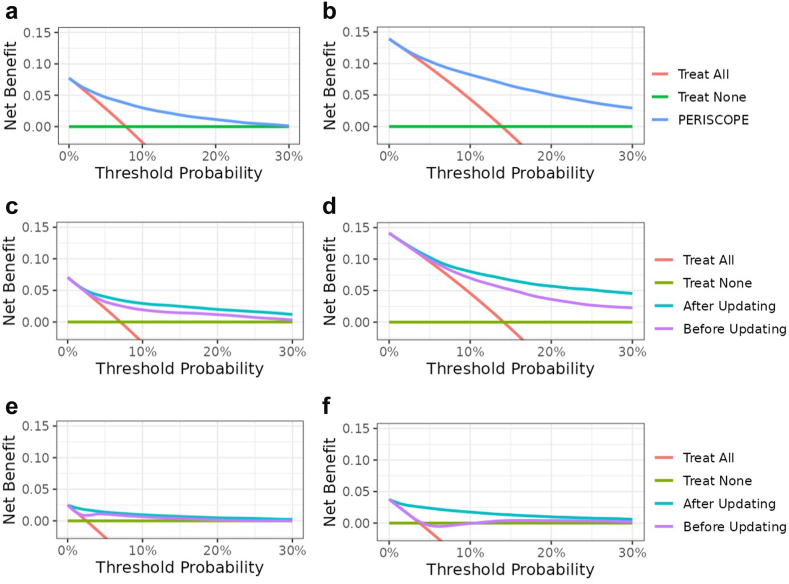
The study included 253,010 surgical procedures with 23,903 infections within 30-days. Discriminative performance, calibration properties, and clinical utility significantly improved after updating. Final AUROCs after updating for Hospitals A, B, and C were 0.82 (95% confidence interval (CI) 0.81-0.83), 0.82 (95% CI 0.81-0.83), and 0.91 (95% CI 0.90-0.91) respectively for 30-day predictions on the temporal validation datasets (2022-2023). Calibration plots demonstrated adequate correspondence between observed outcomes and predicted risk. All local models were deemed clinically useful as the net benefit was higher than default strategies (treat all and treat none) over a wide range of clinically relevant decision thresholds.

INTERPRETATION

PERISCOPE can accurately predict overall postoperative infections within 7- and 30-days post-surgery. The robust performance implies potential for improving clinical care in diverse clinical target populations. This study supports the need for approaches to local updating of AI models to account for domain shifts in patient populations and data distributions across different clinical settings.

FUNDING

This study was funded by a REACT EU grant from European Regional Development Fund (ERDF) and Kansen voor West.

摘要

背景

术后感染对患者的治疗结果和费用有重大影响,而延迟诊断会使情况恶化,但早期可靠的预测指标却很匮乏。现有的用于预测术后感染的人工智能(AI)模型往往缺乏外部验证,或者在本地环境中进行验证时表现不佳。我们旨在开发作为PERISCOPE AI系统一部分的本地有效模型,以便能够早期发现、更安全地让患者出院并更及时地进行治疗。

方法

我们开发并验证了XGBoost模型,以预测手术后7天和30天内的术后感染情况。利用2014年至2023年来自各个外科专科的术前和术中回顾性电子健康记录数据,这些模型在A医院开发,并在荷兰和比利时的B医院和C医院进行验证和更新。使用最近两年的数据作为时间验证数据集,在更新前后评估模型性能。主要结局指标包括模型辨别力(受试者工作特征曲线下面积(AUROC))、校准(斜率、截距和图表)以及临床实用性(通过净效益进行决策曲线分析)。

结果

该研究纳入了253,010例外科手术,其中30天内有23,903例感染。更新后,辨别性能、校准特性和临床实用性均有显著改善。在时间验证数据集(2022 - 2023年)上,更新后A医院、B医院和C医院对于30天预测的最终AUROC分别为0.82(95%置信区间(CI)0.81 - 0.83)、0.82(95% CI 0.81 - 0.83)和0.91(95% CI 0.90 - 0.91)。校准图显示观察到的结果与预测风险之间具有充分的一致性。所有本地模型在广泛的临床相关决策阈值范围内,因其净效益高于默认策略(全部治疗和全部不治疗)而被认为具有临床实用性。

解读

PERISCOPE能够准确预测手术后7天和30天内的总体术后感染情况。其强大的性能意味着在不同临床目标人群中改善临床护理的潜力。本研究支持需要采用对AI模型进行本地更新的方法,以应对不同临床环境中患者群体和数据分布的领域变化。

资金来源

本研究由欧洲区域发展基金(ERDF)的REACT EU资助以及Kansen voor West资助。

https://cdn.ncbi.nlm.nih.gov/pmc/blobs/517e/11667051/1228583449c9/gr3.jpg
https://cdn.ncbi.nlm.nih.gov/pmc/blobs/517e/11667051/862350f1fe27/gr1.jpg
https://cdn.ncbi.nlm.nih.gov/pmc/blobs/517e/11667051/c3c2272f98a1/gr2.jpg
https://cdn.ncbi.nlm.nih.gov/pmc/blobs/517e/11667051/1228583449c9/gr3.jpg
https://cdn.ncbi.nlm.nih.gov/pmc/blobs/517e/11667051/862350f1fe27/gr1.jpg
https://cdn.ncbi.nlm.nih.gov/pmc/blobs/517e/11667051/c3c2272f98a1/gr2.jpg
https://cdn.ncbi.nlm.nih.gov/pmc/blobs/517e/11667051/1228583449c9/gr3.jpg

相似文献

1
Development and validation of artificial intelligence models for early detection of postoperative infections (PERISCOPE): a multicentre study using electronic health record data.用于术后感染早期检测的人工智能模型的开发与验证(PERISCOPE):一项使用电子健康记录数据的多中心研究
Lancet Reg Health Eur. 2024 Dec 5;49:101163. doi: 10.1016/j.lanepe.2024.101163. eCollection 2025 Feb.
2
Comparison of Two Modern Survival Prediction Tools, SORG-MLA and METSSS, in Patients With Symptomatic Long-bone Metastases Who Underwent Local Treatment With Surgery Followed by Radiotherapy and With Radiotherapy Alone.两种现代生存预测工具 SORG-MLA 和 METSSS 在接受手术联合放疗和单纯放疗治疗有症状长骨转移患者中的比较。
Clin Orthop Relat Res. 2024 Dec 1;482(12):2193-2208. doi: 10.1097/CORR.0000000000003185. Epub 2024 Jul 23.
3
Machine-learning Models Predict 30-Day Mortality, Cardiovascular Complications, and Respiratory Complications After Aseptic Revision Total Joint Arthroplasty.机器学习模型预测无菌翻修全关节置换术后 30 天死亡率、心血管并发症和呼吸系统并发症。
Clin Orthop Relat Res. 2022 Nov 1;480(11):2137-2145. doi: 10.1097/CORR.0000000000002276. Epub 2022 Jun 20.
4
How Does the Skeletal Oncology Research Group Algorithm's Prediction of 5-year Survival in Patients with Chondrosarcoma Perform on International Validation?骨肿瘤研究组算法对软骨肉瘤患者 5 年生存率的预测在国际验证中的表现如何?
Clin Orthop Relat Res. 2020 Oct;478(10):2300-2308. doi: 10.1097/CORR.0000000000001305.
5
Validation and development of models using clinical, biochemical and ultrasound markers for predicting pre-eclampsia: an individual participant data meta-analysis.利用临床、生化和超声标志物预测子痫前期的模型的验证和建立:一项个体参与者数据荟萃分析。
Health Technol Assess. 2020 Dec;24(72):1-252. doi: 10.3310/hta24720.
6
Development and validation of prediction models for fetal growth restriction and birthweight: an individual participant data meta-analysis.胎儿生长受限和出生体重预测模型的建立与验证:个体参与者数据的荟萃分析。
Health Technol Assess. 2024 Aug;28(47):1-119. doi: 10.3310/DABW4814.
7
Illness severity assessment of older adults in critical illness using machine learning (ELDER-ICU): an international multicentre study with subgroup bias evaluation.使用机器学习评估危重症老年患者的疾病严重程度(ELDER-ICU):一项具有亚组偏倚评估的国际多中心研究。
Lancet Digit Health. 2023 Oct;5(10):e657-e667. doi: 10.1016/S2589-7500(23)00128-0. Epub 2023 Aug 18.
8
Postpartum readmission for hypertension and pre-eclampsia: development and validation of a predictive model.产后因高血压和子痫前期再次入院:预测模型的建立与验证。
BJOG. 2023 Nov;130(12):1531-1540. doi: 10.1111/1471-0528.17572. Epub 2023 Jun 14.
9
Prognostic models for identifying risk of poor outcome in people with acute ankle sprains: the SPRAINED development and external validation study.用于识别急性踝关节扭伤患者不良结局风险的预测模型:SPRAINED 研究的开发和外部验证。
Health Technol Assess. 2018 Nov;22(64):1-112. doi: 10.3310/hta22640.
10
External validation of models for predicting cumulative live birth over multiple complete cycles of IVF treatment.预测多次完整 IVF 治疗周期中累积活产的模型的外部验证。
Hum Reprod. 2023 Oct 3;38(10):1998-2010. doi: 10.1093/humrep/dead165.

本文引用的文献

1
TRIPOD+AI statement: updated guidance for reporting clinical prediction models that use regression or machine learning methods.TRIPOD+AI 声明:报告使用回归或机器学习方法的临床预测模型的更新指南。
BMJ. 2024 Apr 16;385:e078378. doi: 10.1136/bmj-2023-078378.
2
Why do probabilistic clinical models fail to transport between sites.为什么概率性临床模型无法在不同地点之间进行迁移?
NPJ Digit Med. 2024 Mar 1;7(1):53. doi: 10.1038/s41746-024-01037-4.
3
Assessing the utility of deep neural networks in detecting superficial surgical site infections from free text electronic health record data.
评估深度神经网络从自由文本电子健康记录数据中检测浅表手术部位感染的效用。
Front Digit Health. 2024 Jan 8;5:1249835. doi: 10.3389/fdgth.2023.1249835. eCollection 2023.
4
A Nationwide Network of Health AI Assurance Laboratories.全国性的健康人工智能保障实验室网络。
JAMA. 2024 Jan 16;331(3):245-249. doi: 10.1001/jama.2023.26930.
5
Validation framework for the use of AI in healthcare: overview of the new British standard BS30440.医疗保健领域人工智能应用的验证框架:英国新国家标准BS30440概述
BMJ Health Care Inform. 2023 Jun;30(1). doi: 10.1136/bmjhci-2023-100749.
6
Guiding principles for the responsible development of artificial intelligence tools for healthcare.医疗保健领域人工智能工具负责任开发的指导原则。
Commun Med (Lond). 2023 Apr 1;3(1):47. doi: 10.1038/s43856-023-00279-9.
7
Artificial Intelligence-enabled Decision Support in Surgery: State-of-the-art and Future Directions.人工智能支持的手术决策支持:现状与未来方向。
Ann Surg. 2023 Jul 1;278(1):51-58. doi: 10.1097/SLA.0000000000005853. Epub 2023 Mar 21.
8
A Clinician's Guide to Running Custom Machine-Learning Models in an Electronic Health Record Environment.临床医生在电子健康记录环境中运行定制机器学习模型指南。
Mayo Clin Proc. 2023 Mar;98(3):445-450. doi: 10.1016/j.mayocp.2022.11.019.
9
There is no such thing as a validated prediction model.没有经过验证的预测模型这种东西。
BMC Med. 2023 Feb 24;21(1):70. doi: 10.1186/s12916-023-02779-w.
10
Surgical Site Infection Prevention: A Review.手术部位感染的预防:综述
JAMA. 2023 Jan 17;329(3):244-252. doi: 10.1001/jama.2022.24075.