Zhang Yan, Apostol Petru, Rambabu Darsi, Guo Xiaolong, Liu Xuelian, Lin Xiaodong, Xie Haijiao, Chen Xiaohua, Robeyns Koen, Wang Jiande, Wang Junzhong, Vlad Alexandru
School of Materials Science and Engineering, Anhui Graphene Carbon Fiber Research Center, Anhui University Hefei 230601 P. R. China
Institute of Condensed Matter and Nanosciences, Molecular Chemistry, Materials and Catalysis, Université Catholique de Louvain Louvain-la-Neuve Belgium
Chem Sci. 2024 Dec 23;16(4):1819-1825. doi: 10.1039/d4sc07732f. eCollection 2025 Jan 22.
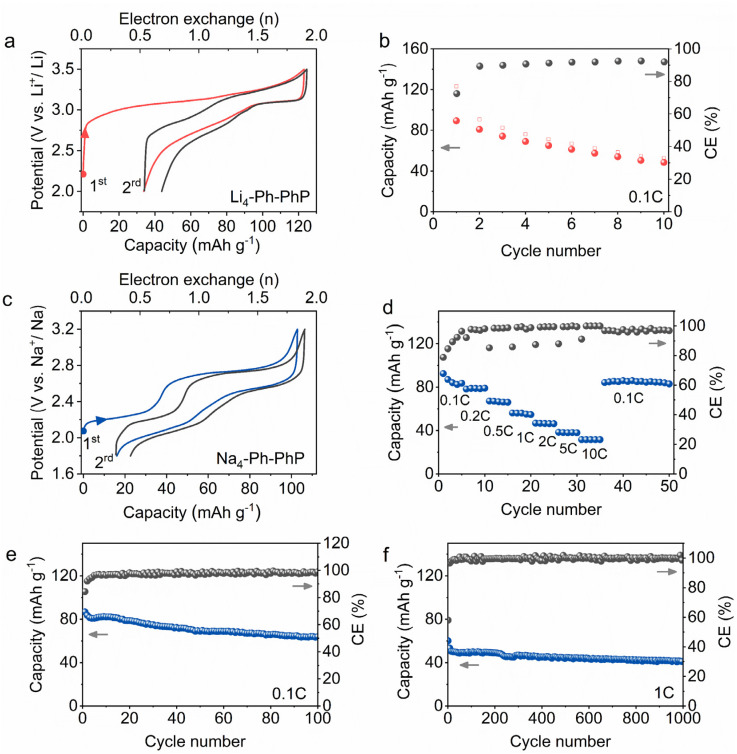
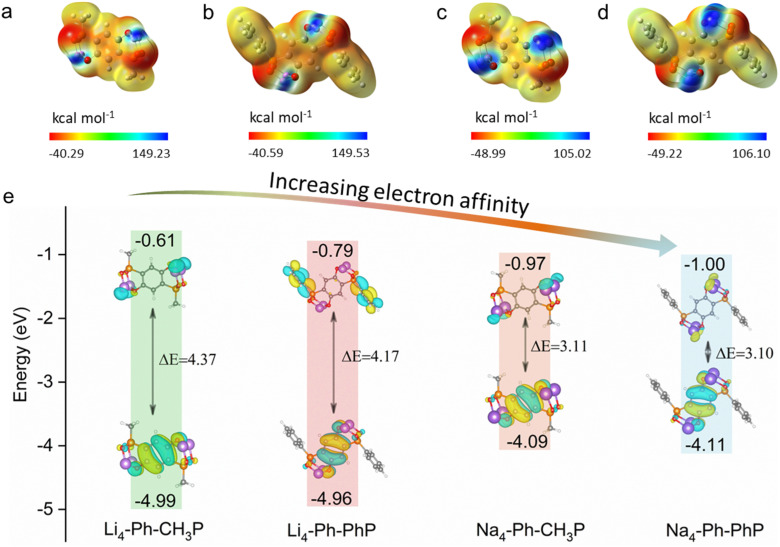
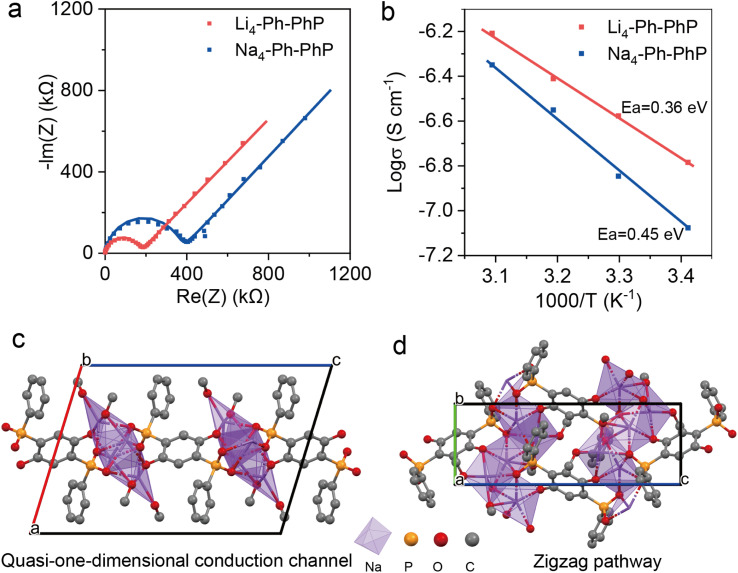
Facilitating rapid charge transfer in electrode materials necessitates the optimization of their ionic transport properties. Currently, only a limited number of Li/Na-ion organic cathode materials have been identified, and those exhibiting intrinsic solid-phase ionic conductivity are even rarer. In this study, we present tetra-lithium and sodium salts with the generic formulae: A-Ph-CHP and A-Ph-PhP, wherein A = Li, Na; Ph-CHP = 2,5-dioxido-1,4-phenylene bis(methylphosphinate); Ph-PhP = 2,5-dioxido-1,4-phenylene bis(phenylphosphinate), as novel alkali-ion reservoir cathode materials. Notably, A-Ph-PhP exhibits impressive Li-ion and Na-ion conductivities, measured at 2.6 × 10 and 1.4 × 10 S cm, respectively, in a dry state at 30 °C. To the best of our knowledge, these represent the first example of small-molecule organic cathode materials with intrinsic Li and Na conductivity. Theoretical calculations provide further insight into the electrochemical activity of the Li/Na-phenolate groups, as well as the enhanced electron affinity resulting from -phenyl and -Na substitutions. Additionally, Na-Ph-PhP displays two distinct charge-discharge plateaus at approximately 2.2 V and 2.7 V, and 2.0 V and 2.5 V Na/Na, respectively, and demonstrates stable cycling performance, with 100 cycles at a rate of 0.1C and an impressive 1000 cycles at 1C. This study not only expands the portfolio of phenolate-based organic salts for use in metal-ion batteries but also underscores the potential of phosphonate-based organic materials in advancing energy storage technologies.
促进电极材料中的快速电荷转移需要优化其离子传输特性。目前,仅鉴定出有限数量的锂/钠离子有机阴极材料,而具有本征固相离子电导率的材料更为罕见。在本研究中,我们展示了通式为A-Ph-CHP和A-Ph-PhP的四锂盐和钠盐,其中A = Li、Na;Ph-CHP = 2,5-二氧化-1,4-亚苯基双(甲基次膦酸酯);Ph-PhP = 2,5-二氧化-1,4-亚苯基双(苯基次膦酸酯),作为新型碱金属离子储存阴极材料。值得注意的是,A-Ph-PhP在30°C干燥状态下分别测得锂离子和钠离子电导率令人印象深刻,分别为2.6×10和1.4×10 S cm。据我们所知,这些代表了具有本征锂和钠电导率的小分子有机阴极材料的首个实例。理论计算进一步深入了解了锂/钠酚盐基团的电化学活性,以及由-苯基和-Na取代导致的增强电子亲和力。此外,Na-Ph-PhP在大约2.2 V和2.7 V以及2.0 V和2.5 V(相对于Na/Na)分别显示出两个不同的充放电平台,并展示出稳定的循环性能,在0.1C倍率下循环100次,在1C倍率下令人印象深刻地循环1000次。这项研究不仅扩展了用于金属离子电池的酚盐基有机盐的种类,还强调了基于膦酸酯的有机材料在推进储能技术方面的潜力。