Binder Nicholas R, Bloom Jeffrey M, Balushian Haftevani Mineh, Duncan Stephen, Lowry Nathan Christopher, Chang Tom S
Vitreoretinal Surgery, Acuity Eye Group, Los Angeles, CA, USA.
Intelligent DX, Los Angeles, CA, USA.
Clin Ophthalmol. 2024 Dec 19;18:3853-3859. doi: 10.2147/OPTH.S476868. eCollection 2024.
Our aim is to evaluate the sensitivity and specificity of Acuity 360 telemedicine system, as compared to in-person clinic examination, in identifying clinically significant eye disease. Acuity 360 is a combination of commercially available ocular imaging devices used together to provide a comprehensive evaluation of the structures and diseases of the eye.
Observational cross-sectional study of consecutively examined patients where 19 remote examiners analyzed 80 patients using Acuity 360 images. The examiners' diagnoses were compared to the diagnosis obtained from in-person clinic examination of all the patients. The sensitivity, specificity, positive predictive value (PPV), negative predictive value (NPV), false-negative rate, and inter-rater agreement were calculated.
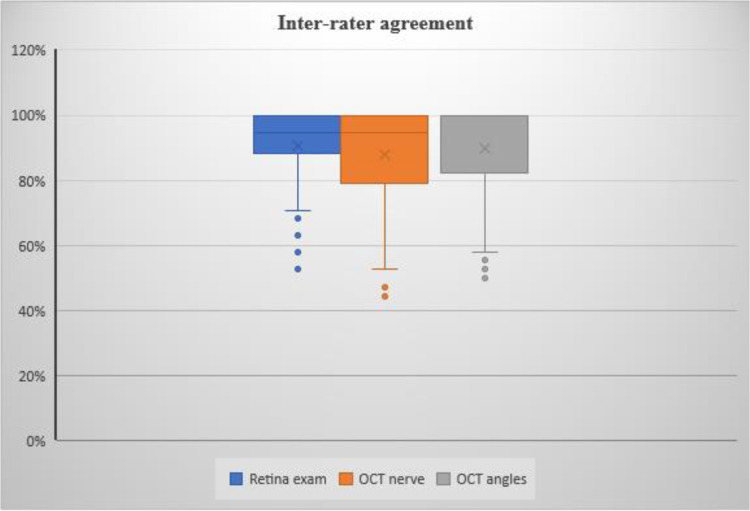
Compared to in-person clinic examination, the sensitivity, specificity, PPV, NPV, and false-negative rate for the optical coherence tomography (OCT) of optic nerve were 95.8%, 98.5%, 86.8%, 99.6%, 0.39% and for the combined retina examination (OCT of the macula and widefield fundus photography) were 93.4%, 88.5%, 80.2%, 96.4%, 2.19%, respectively. The median inter-rater agreement the OCT of optic nerve and the combined retina examination were each 95%.
The Acuity 360 telemedicine system has a low false-negative rate and is highly sensitive and specific when compared to an in-person clinic examination. It can determine the necessity for specialist referral and triage the patients that require urgent treatment. High inter-rater agreement shows that it is effective with minimal variability in analyzing the Acuity 360 images by remote examiners.
我们的目的是评估Acuity 360远程医疗系统在识别具有临床意义的眼部疾病方面的敏感性和特异性,并与面对面的诊所检查进行比较。Acuity 360是将市售的眼部成像设备组合在一起,用于对眼睛的结构和疾病进行全面评估。
对连续接受检查的患者进行观察性横断面研究,19名远程检查人员使用Acuity 360图像分析了80名患者。将检查人员的诊断结果与所有患者面对面诊所检查获得的诊断结果进行比较。计算敏感性、特异性、阳性预测值(PPV)、阴性预测值(NPV)、假阴性率和检查者间一致性。
与面对面诊所检查相比,视神经光学相干断层扫描(OCT)的敏感性、特异性、PPV、NPV和假阴性率分别为95.8%、98.5%、86.8%、99.6%、0.39%,联合视网膜检查(黄斑OCT和广角眼底摄影)的敏感性、特异性、PPV、NPV和假阴性率分别为93.4%、88.5%、80.2%、96.4%、2.19%。视神经OCT和联合视网膜检查的检查者间一致性中位数均为95%。
与面对面诊所检查相比,Acuity 360远程医疗系统的假阴性率较低,具有高度的敏感性和特异性。它可以确定专科转诊的必要性,并对需要紧急治疗的患者进行分诊。较高的检查者间一致性表明,远程检查人员在分析Acuity 360图像时,该系统有效且变异性最小。