Chen Jiangzhuo, Hoops Stefan, Mortveit Henning S, Lewis Bryan L, Machi Dustin, Bhattacharya Parantapa, Venkatramanan Srinivasan, Wilson Mandy L, Barrett Chris L, Marathe Madhav V
Biocomplexity Institute, University of Virginia, Charlottesville, VA, USA.
Department of Systems and Information Engineering, University of Virginia, Charlottesville, VA, USA.
PNAS Nexus. 2024 Dec 11;4(1):pgae557. doi: 10.1093/pnasnexus/pgae557. eCollection 2025 Jan.
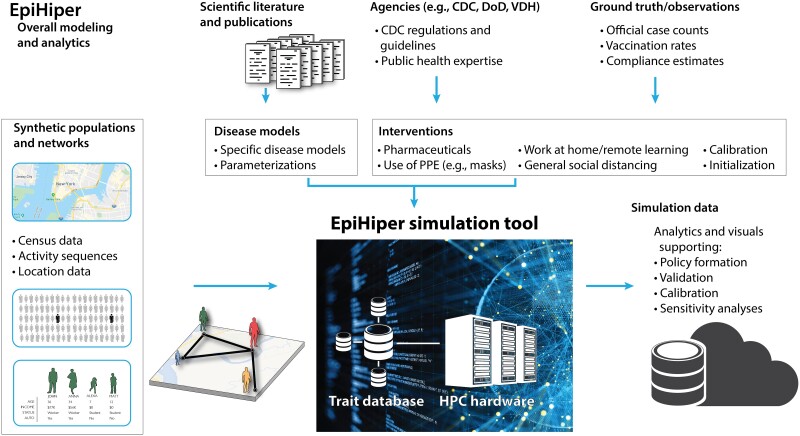
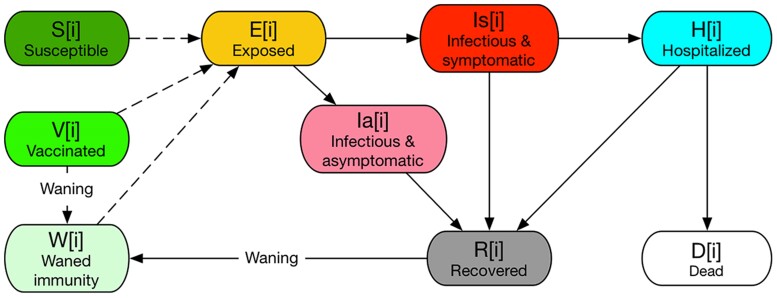
This paper describes Epihiper, a state-of-the-art, high performance computational modeling framework for epidemic science. The Epihiper modeling framework supports custom disease models, and can simulate epidemics over dynamic, large-scale networks while supporting modulation of the epidemic evolution through a set of user-programmable interventions. The nodes and edges of the social-contact network have customizable sets of static and dynamic attributes which allow the user to specify intervention target sets at a very fine-grained level; these also permit the network to be updated in response to nonpharmaceutical interventions, such as school closures. The execution of interventions is governed by trigger conditions, which are Boolean expressions formed using any of Epihiper's primitives (e.g. the current time, transmissibility) and user-defined sets (e.g. people with work activities). Rich expressiveness, extensibility, and high-performance computing responsiveness were central design goals to ensure that the framework could effectively target realistic scenarios at the scale and detail required to support the large computational designs needed by state and federal public health policymakers in their efforts to plan and respond in the event of epidemics. The modeling framework has been used to support the CDC Scenario Modeling Hub for COVID-19 response, and was a part of a hybrid high-performance cloud system that was nominated as a finalist for the 2021 ACM Gordon Bell Special Prize for high performance computing-based COVID-19 Research.
本文介绍了Epihiper,这是一个用于流行病学的先进的高性能计算建模框架。Epihiper建模框架支持自定义疾病模型,能够在动态大规模网络上模拟疫情,同时支持通过一组用户可编程干预措施来调节疫情演变。社交接触网络的节点和边具有可定制的静态和动态属性集,这允许用户在非常细粒度的级别指定干预目标集;这些属性还允许网络根据诸如学校关闭等非药物干预措施进行更新。干预措施的执行由触发条件控制,触发条件是使用Epihiper的任何原语(如当前时间、传播性)和用户定义集(如有工作活动的人)形成的布尔表达式。丰富的表现力、可扩展性和高性能计算响应能力是核心设计目标,以确保该框架能够在州和联邦公共卫生政策制定者为应对疫情而进行规划和响应所需的大规模计算设计所要求的规模和细节上有效地针对现实场景。该建模框架已被用于支持疾病控制与预防中心(CDC)的COVID-19应对情景建模中心,并且是一个混合高性能云系统的一部分,该系统被提名为2021年美国计算机协会(ACM)戈登·贝尔高性能计算COVID-19研究特别奖的决赛入围者。