Roddan Alfie, Czempiel Tobias, Elson Daniel S, Giannarou Stamatia
The Hamlyn Centre for Robotic Surgery Department of Surgery and Cancer Imperial College London London UK.
Healthc Technol Lett. 2024 Nov 29;11(6):345-354. doi: 10.1049/htl2.12102. eCollection 2024 Dec.
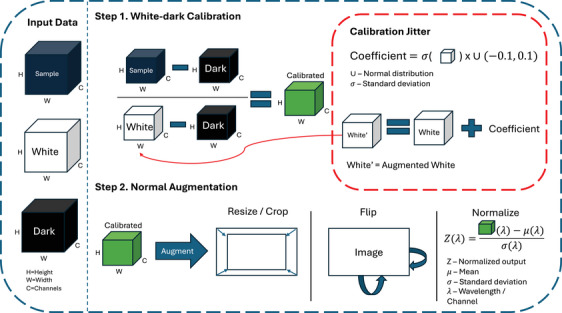
Semantic surgical scene segmentation is crucial for accurately identifying and delineating different tissue types during surgery, enhancing outcomes and reducing complications. Hyperspectral imaging provides detailed information beyond visible color filters, offering an enhanced view of tissue characteristics. Combined with machine learning, it supports critical tumor resection decisions. Traditional augmentations fail to effectively train machine learning models on illumination and sensor sensitivity variations. Learning to handle these variations is crucial to enable models to better generalize, ultimately enhancing their reliability in deployment. In this article, is introduced, a spectral augmentation technique that leverages hyperspectral calibration variations to improve predictive performance. Evaluated on scene segmentation on a neurosurgical dataset, achieved a F1-score of 74.35% with SegFormer, surpassing the previous best of 70.2%. This advancement addresses limitations of traditional augmentations, improving hyperspectral imaging segmentation performance.
语义手术场景分割对于在手术过程中准确识别和描绘不同组织类型、改善手术结果和减少并发症至关重要。高光谱成像提供了超越可见颜色滤镜的详细信息,能增强对组织特征的观察。与机器学习相结合,它支持关键的肿瘤切除决策。传统的数据增强方法无法有效地在光照和传感器灵敏度变化的情况下训练机器学习模型。学会处理这些变化对于使模型能够更好地泛化至关重要,最终提高它们在部署中的可靠性。在本文中,介绍了一种光谱增强技术,该技术利用高光谱校准变化来提高预测性能。在一个神经外科数据集上进行场景分割评估时,该技术与SegFormer模型一起实现了74.35%的F1分数,超过了之前70.2%的最佳成绩。这一进展解决了传统增强方法的局限性,提高了高光谱成像分割性能。