Batais Waleed T, Taher Nada O, Alhindi Abeer K, Ghaddaf Abdullah A, Alamoudi Anas, Al-Ghamdi Sarah A, Homsi Jumanah J, Almarzouki Hashem S, Qurashi Mansour A
College of Medicine, King Saud bin Abdulaziz University for Health Sciences, Jeddah, Saudi Arabia.
King Abdullah International Medical Research Center, Jeddah, Saudi Arabia.
BMJ Open Ophthalmol. 2024 Dec 25;9(1):e001910. doi: 10.1136/bmjophth-2024-001910.
Retinopathy of prematurity (ROP) is a leading cause of preventable childhood blindness in preterm infants with low birth weight. The efficacy and safety of prophylactic agents, including vitamin A, propranolol and lipids, in reducing ROP incidence remain unclear. This systematic review and meta-analysis evaluated the effectiveness and safety of these agents in preventing ROP.
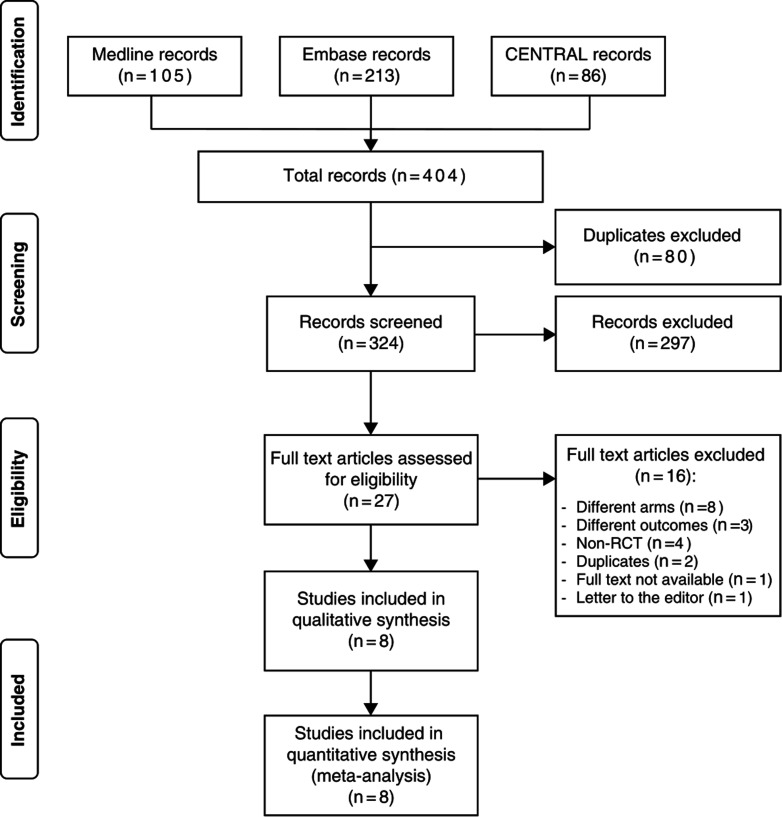
A systematic search was conducted in Embase, MEDLINE and CENTRAL databases. Eight randomised controlled trials involving 1101 preterm infants were included. We assessed the incidence of ROP at any stage, severe ROP, adverse events and mortality. Subgroup analyses were performed for each prophylactic agent. Data were pooled using the inverse variance weighting method and reported as risk ratios (RRs) with 95% CI.
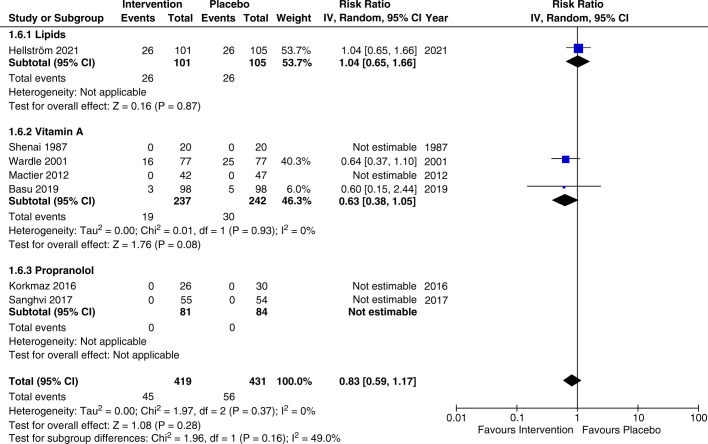
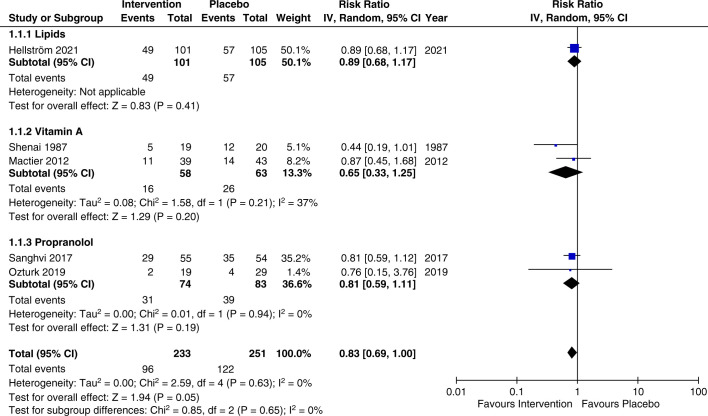
No significant reduction in ROP incidence at any stage was found in the intervention groups compared with placebo (RR=0.83; 95% CI= (0.69 to 1.00); p=0.05; I²=0%). Lipids significantly reduced severe ROP incidence (RR=0.48; 95% CI= (0.28 to 0.80); p=0.005), while vitamin A (RR=1.14; 95% CI= (0.51 to 2.54); p=0.75) and propranolol (RR=0.69; 95% CI= (0.29 to 1.65); p=0.41) did not. There were no significant differences in adverse events (RR=0.83; 95% CI= (0.59 to 1.17); p=0.28) or mortality (RR=0.93; 95% CI= (0.67 to 1.30); p=0.68) across all groups.
Lipids show promise in reducing severe ROP in preterm infants, while vitamin A and propranolol were not effective. Further research is needed to confirm these findings and explore the potential role of lipids in clinical practice.
早产儿视网膜病变(ROP)是低出生体重早产儿可预防的儿童失明的主要原因。包括维生素A、普萘洛尔和脂质在内的预防药物在降低ROP发病率方面的有效性和安全性尚不清楚。本系统评价和荟萃分析评估了这些药物预防ROP的有效性和安全性。
在Embase、MEDLINE和CENTRAL数据库中进行系统检索。纳入了八项涉及1101名早产儿的随机对照试验。我们评估了任何阶段ROP的发病率、严重ROP、不良事件和死亡率。对每种预防药物进行亚组分析。使用逆方差加权法汇总数据,并报告为风险比(RRs)及95%置信区间。
与安慰剂相比,干预组在任何阶段的ROP发病率均未显著降低(RR = 0.83;95%置信区间=(0.69至1.00);p = 0.05;I² = 0%)。脂质显著降低了严重ROP的发病率(RR = 0.48;95%置信区间=(0.28至0.80);p = 0.005),而维生素A(RR = 1.14;95%置信区间=(0.51至2.5);p = 0.75)和普萘洛尔(RR = 0.69;95%置信区间=(0.29至1.65);p = 0.41)则没有。所有组在不良事件(RR = 0.83;95%置信区间=(0.59至1.17);p = 0.28)或死亡率(RR = 0.93;95%置信区间=(0.67至1.30);p = 0.68)方面均无显著差异。
脂质在降低早产儿严重ROP方面显示出前景,而维生素A和普萘洛尔无效。需要进一步研究以证实这些发现,并探索脂质在临床实践中的潜在作用。