Dang My T, Le Yen N, Naz-McLean Sarah, Vo Nhung T T, Do Phuong T, Doan Linh T T, Do Nhan T, Nguyen Mai T, Phan An H, Dziuban Eric J, Bhatia Ramona, Cosimi Lisa, Phan Huong T T, Pollack Todd M
Department of Medicine, Beth Israel Deaconess Medical Center, Boston, USA.
The Partnership for Health Advancement in Vietnam, Hanoi, Vietnam.
BMC Infect Dis. 2024 Dec 25;24(1):1462. doi: 10.1186/s12879-024-10352-w.
Long-acting injectable antiretrovirals (LAI-ARVs) for HIV prevention and treatment have been demonstrated in clinical trials to be non-inferior to daily oral medications, providing an additional option to help users overcome the challenges of daily adherence. Approval and implementation of these regimens in low- and middle-income settings have been limited.
This study describes the anticipated barriers and facilitators to implementing LAI-ARVs in Vietnam to inform future roll-out. From July to August 2022, we conducted 27 in-depth interviews with healthcare workers and public health stakeholders involved in HIV programs at national, provincial, and clinic levels across four provinces in Vietnam. The interviews followed a semi-structured questionnaire and were audio recorded. Data were analyzed using a rapid thematic analysis approach to identify facilitators and barriers to the adoption of LAI-ARVs.
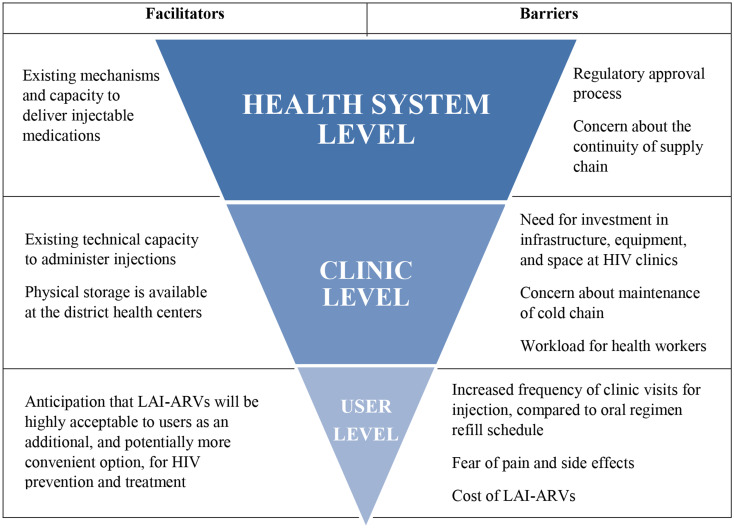
In total, 27 participants from 4 provinces were interviewed including 14 (52%) men and 13 (48%) women. Participants median age was 48 years and they had 11.5 years of experience with HIV services and programs. Perceived user-level facilitators included the greater convenience of injectables in comparison to oral regimens, while barriers included the increased frequency of visits, fear of pain and side effects, and cost. Clinic-level facilitators included existing technical capacity to administer injections and physical storage availability in district health centers, while barriers included lack of space and equipment for administering injections for HIV-related services, concerns about cold chain maintenance for LAI-ART, and workload for healthcare workers. Health system-level facilitators included existing mechanisms for medication distribution, while barriers included regulatory approval processes and concerns about supply chain continuity.
Overall, participants were optimistic about the potential impact of LAI-ARVs but highlighted important considerations at multiple levels needed to ensure successful implementation in Vietnam.
Not applicable.
用于预防和治疗艾滋病毒的长效注射用抗逆转录病毒药物(LAI-ARVs)在临床试验中已被证明不劣于每日口服药物,为帮助使用者克服每日坚持服药的挑战提供了另一种选择。这些治疗方案在低收入和中等收入环境中的批准和实施一直有限。
本研究描述了在越南实施LAI-ARVs预计会遇到的障碍和促进因素,以为未来的推广提供参考。2022年7月至8月,我们对越南四个省份参与国家、省级和诊所层面艾滋病毒项目的医护人员和公共卫生利益相关者进行了27次深入访谈。访谈采用半结构化问卷,并进行了录音。使用快速主题分析方法对数据进行分析,以确定采用LAI-ARVs的促进因素和障碍。
总共采访了来自4个省份的27名参与者,其中14名(52%)为男性,13名(48%)为女性。参与者的年龄中位数为48岁,他们在艾滋病毒服务和项目方面有11.5年的经验。使用者层面的促进因素包括与口服治疗方案相比,注射剂更方便,而障碍包括就诊频率增加、对疼痛和副作用的恐惧以及成本。诊所层面的促进因素包括现有的注射给药技术能力和地区卫生中心的实际储存条件,而障碍包括缺乏用于艾滋病毒相关服务注射给药的空间和设备、对LAI-ART冷链维护的担忧以及医护人员的工作量。卫生系统层面的促进因素包括现有的药物分发机制,而障碍包括监管审批程序以及对供应链连续性的担忧。
总体而言,参与者对LAI-ARVs的潜在影响持乐观态度,但强调了在越南确保成功实施所需的多个层面的重要考虑因素。
不适用。