Ding Jinzhen, Zhang Yixiang, Chen Xiaoyang
Department of Pulmonary and Critical Care Medicine, The Second Affiliated Hospital of Fujian, Quanzhou, Fujian, China.
Respirology Medicine Centre of Fujian Province, Medical University, Quanzhou, China.
Front Med (Lausanne). 2024 Dec 11;11:1493463. doi: 10.3389/fmed.2024.1493463. eCollection 2024.
The red cell distribution width to albumin ratio (RAR), a newly identified biomarker of inflammation, has been linked to a variety of inflammatory diseases. Asthma, a major burden on global health, is an inflammatory airway disease that is profoundly affected by inflammation. This study primarily sought to examine the influence of RAR on the risk of developing asthma.
Data from 1999 to 2020 was gathered from the NHANES database. The impact of RAR on asthma risk and their non-linear relationship were clarified by multivariate logit and restricted cubic spline (RCS) analyses. Subgroup and interaction analyses collectively formed the sensitivity analysis for this study.
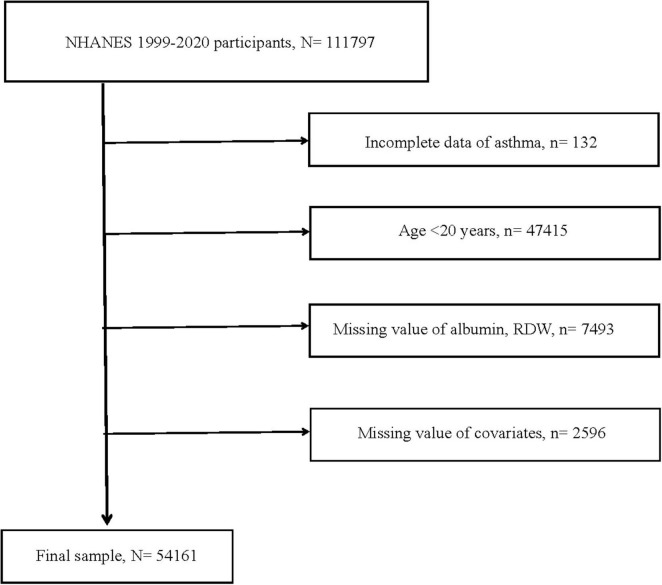
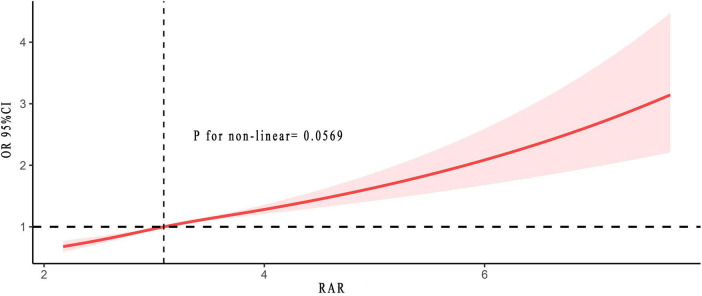
This study was based on an analysis of 54,161 individuals. RAR has been identified as an independent risk factor for asthma, according to logit analysis. The moderate and high RAR groups had a 16% [95% confidence interval (CI): 1.06-1.27] and 43% (95% CI: 1.30-1.58) higher risk, respectively, compared to the lowest group. Every 0.5 unit increase in RAR almost doubled the risk of asthma [odds ratio (OR): 1.82, 95% CI: 1.55-2.12]. There was no non-linear relationship between RAR and asthma risk, based on RCS analysis. Combining subgroup and interaction analyses results, all subgroups in this study showed consistent trends with the overall population.
Notably, this article, the first to examine the relationship between RAR and asthma risk, unveiled a positive linear correlation between them. With an increase in RAR, whether analyzed as a categorical or continuous variable, asthma risk significantly increases. This finding was beneficial for clinicians to anticipate and assess the onset of asthma through stratified or dynamic management. Given RAR's numerous advantages, its application in clinical settings held considerable promise.
红细胞分布宽度与白蛋白比值(RAR)是一种新发现的炎症生物标志物,与多种炎症性疾病有关。哮喘是全球健康的重大负担,是一种受炎症严重影响的气道炎症性疾病。本研究主要旨在探讨RAR对哮喘发病风险的影响。
从美国国家健康与营养检查调查(NHANES)数据库收集1999年至2020年的数据。通过多变量逻辑回归和受限立方样条(RCS)分析阐明RAR对哮喘风险的影响及其非线性关系。亚组分析和交互分析共同构成了本研究的敏感性分析。
本研究基于对54161名个体的分析。根据逻辑回归分析,RAR已被确定为哮喘的独立危险因素。与最低组相比,中度和高度RAR组的风险分别高出16%[95%置信区间(CI):1.06-1.27]和43%(95%CI:1.30-1.58)。RAR每增加0.5个单位,哮喘风险几乎增加一倍[比值比(OR):1.82,95%CI:1.55-2.12]。基于RCS分析,RAR与哮喘风险之间不存在非线性关系。结合亚组分析和交互分析结果,本研究中的所有亚组均显示出与总体人群一致的趋势。
值得注意的是,本文首次研究了RAR与哮喘风险之间的关系,揭示了它们之间存在正线性相关性。随着RAR的增加,无论作为分类变量还是连续变量进行分析,哮喘风险都会显著增加。这一发现有助于临床医生通过分层或动态管理来预测和评估哮喘的发作。鉴于RAR的诸多优势,其在临床环境中的应用具有很大的前景。