Liu James Y, Peeples Joshua, Sayes Christie M
Department of Environmental Science, Baylor University, Waco, Texas 76798-7266, United States.
Department of Electrical & Computer Engineering, Texas A&M University, College Station, Texas 77845, United States.
Environ Health (Wash). 2024 Sep 20;2(12):912-917. doi: 10.1021/envhealth.4c00118. eCollection 2024 Dec 20.
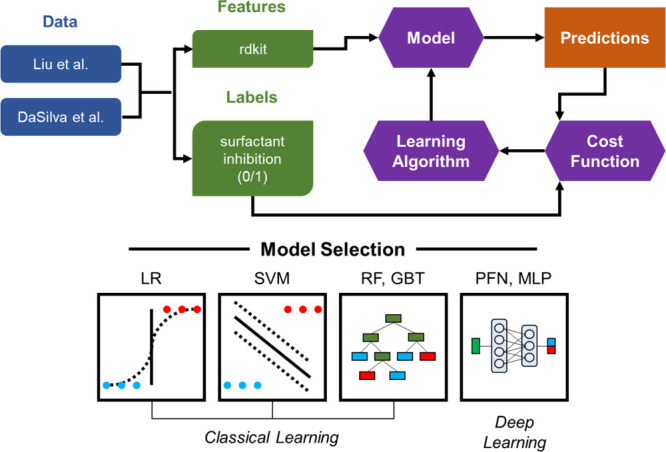
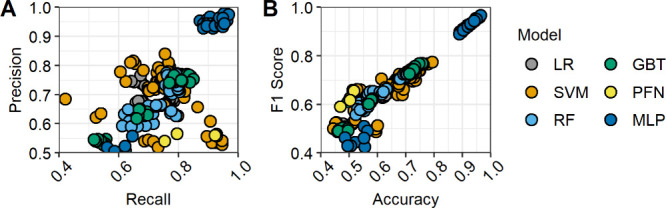
Inhaled chemicals can cause dysfunction in the lung surfactant, a protein-lipid complex with critical biophysical and biochemical functions. This inhibition has many structure-related and dose-dependent mechanisms, making hazard identification challenging. We developed quantitative structure-activity relationships for predicting lung surfactant inhibition using machine learning. Logistic regression, support vector machines, random forest, gradient-boosted trees, prior-data-fitted networks, and multilayer perceptron were evaluated as methods. Multilayer perceptron had the strongest performance with 96% accuracy and an F1 score of 0.97. Support vector machines and logistic regression also performed well with lower computation costs. This serves as a proof-of-concept for efficient hazard screening in the emerging area of lung surfactant inhibition.
吸入性化学物质可导致肺表面活性物质功能失调,肺表面活性物质是一种具有关键生物物理和生化功能的蛋白质-脂质复合物。这种抑制作用有许多与结构相关和剂量依赖性的机制,这使得危害识别具有挑战性。我们利用机器学习开发了用于预测肺表面活性物质抑制作用的定量构效关系。评估了逻辑回归、支持向量机、随机森林、梯度提升树、先验数据拟合网络和多层感知器等方法。多层感知器表现最强,准确率达96%,F1分数为0.97。支持向量机和逻辑回归也表现良好,且计算成本较低。这为肺表面活性物质抑制这一新兴领域的高效危害筛查提供了概念验证。