Das Sakthi, Shukla Arvind Kumar, Galhotra Abhiruchi
Department of Community and Family Medicine, AIIMS Raipur, Chhattisgarh, India.
J Family Med Prim Care. 2024 Nov;13(11):5231-5239. doi: 10.4103/jfmpc.jfmpc_1026_24. Epub 2024 Nov 18.
Adolescent girls suffer the brunt of malnutrition due to increased nutritional needs to facilitate rapid growth spurt including menstruation and increased physical activity. This vulnerable group has low social power and is subjected to peer and social pressures related to body image and weight. All these factors along with the sociocultural milieu may lead to a spectrum of nutritional problems in them.
To determine factors associated with malnourishment among adolescent females of age 15-19 years in an urban slum of Raipur City.
The study setting was the urban field practice area of the institute in Raipur. The study was an analytical cross-sectional study done from January 2022 to June 2023 among 401 adolescent girls of age 15-19 years.
The sampling was done using the consecutive sampling method. The study tools used were a semi-structured questionnaire on sociodemographic variables and details of the respondents, anthropometric measurements, dietary assessment using the 24-hour food recall method, and food consumption patterns using a food frequency questionnaire.
The Chi-square test of significance was applied to find the association between malnourishment with the input variables. For calculating the strength of the association, the odds ratio was estimated for those variables with value < 0.2 in the Chi-square test, and later the odds ratio was adjusted for confounding with the same variables, using multivariable logistic regression.
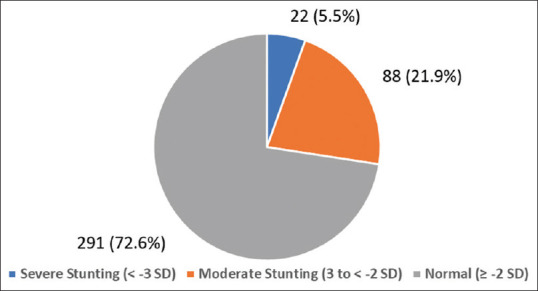
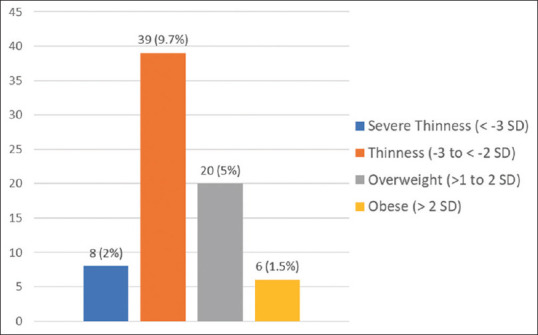
According to BMI-for-age Z scores, 2% were severely thin (< -3 SD), 9.7% were thin (-3 to - 2 SD), 5% were overweight (1 to 2 SD), and 1.5% were obese (>2SD). While measuring the height-for-age Z scores, 5.5% had severe stunting and 21.9% had moderate stunting. Those respondents with educational status of high school or below [AOR 3.5 (1.8-6.8), < 0.001] and those who did not consume a non-vegetarian diet [AOR 2.1 (1.1-4.1), = 0.02] had significantly higher adjusted odds of being undernourished (severely thin or thin) as compared to those with educational status above high school and those who consumed a mixed diet, respectively. The respondents who are currently not going to school/college had significantly higher adjusted odds [AOR 2.2 (1.2-3.8), = 0.007] of being stunted when compared to those who are attending school/college.
The significant levels of malnutrition observed in this study among late adolescent girls aged 15-19 years-11.7% undernourishment, 6.5% overnourishment, and 27.4% stunting-highlight the concerning vulnerability of this population. The higher prevalence of stunting throws light onto the chronicity of malnutrition. As seen from the significant associations, proper education, and a mixed diet will help nurture a healthy female adolescent population.
青春期女孩因营养需求增加而首当其冲遭受营养不良问题,这些需求包括促进快速生长突增(包括月经和增加身体活动)。这个弱势群体社会权力较低,面临与身体形象和体重相关的同伴及社会压力。所有这些因素连同社会文化环境可能导致她们出现一系列营养问题。
确定赖布尔市一个城市贫民窟中15至19岁青春期女性营养不良的相关因素。
研究地点为该机构在赖布尔的城市实地实践区域。该研究是一项分析性横断面研究,于2022年1月至2023年6月期间对401名15至19岁的青春期女孩进行。
采用连续抽样方法进行抽样。使用的研究工具包括一份关于社会人口统计学变量和受访者详细信息的半结构化问卷、人体测量、采用24小时食物回忆法进行饮食评估以及使用食物频率问卷进行食物消费模式调查。
应用卡方显著性检验来找出营养不良与输入变量之间的关联。为计算关联强度,对卡方检验中p值<0.2的那些变量估计比值比,随后使用多变量逻辑回归对相同变量进行混杂因素调整后的比值比。
根据年龄别BMI Z评分,2%为严重消瘦(<-3 SD),9.7%为消瘦(-3至-2 SD),5%为超重(1至2 SD),1.5%为肥胖(>2 SD)。在测量年龄别身高Z评分时,5.5%有严重发育迟缓,21.9%有中度发育迟缓。与高中及以上教育程度的受访者相比,教育程度为高中或以下的受访者[AOR 3.5(1.8 - 6.8),p<0.001]以及与食用混合饮食的受访者相比,不食用非素食饮食的受访者[AOR 2.1(1.1 - 4.1),p = 0.02]营养不良(严重消瘦或消瘦)的调整后比值比显著更高。与上学/上大学的受访者相比,目前未上学/上大学的受访者发育迟缓的调整后比值比显著更高[AOR 2.2(1.2 - 3.8),p = 0.007]。
本研究中观察到15至19岁青春期晚期女孩中存在显著水平的营养不良——11.7%营养不良、6.5%营养过剩以及27.4%发育迟缓——突出了这一人群令人担忧的脆弱性。发育迟缓的较高患病率揭示了营养不良的长期性。从显著关联中可以看出,适当的教育和混合饮食将有助于培育健康的女性青少年群体。