Faculty of Public Health, Thammasat University, Bangkok 12120, Pathum Thani, Thailand.
Nutrients. 2023 Mar 30;15(7):1699. doi: 10.3390/nu15071699.
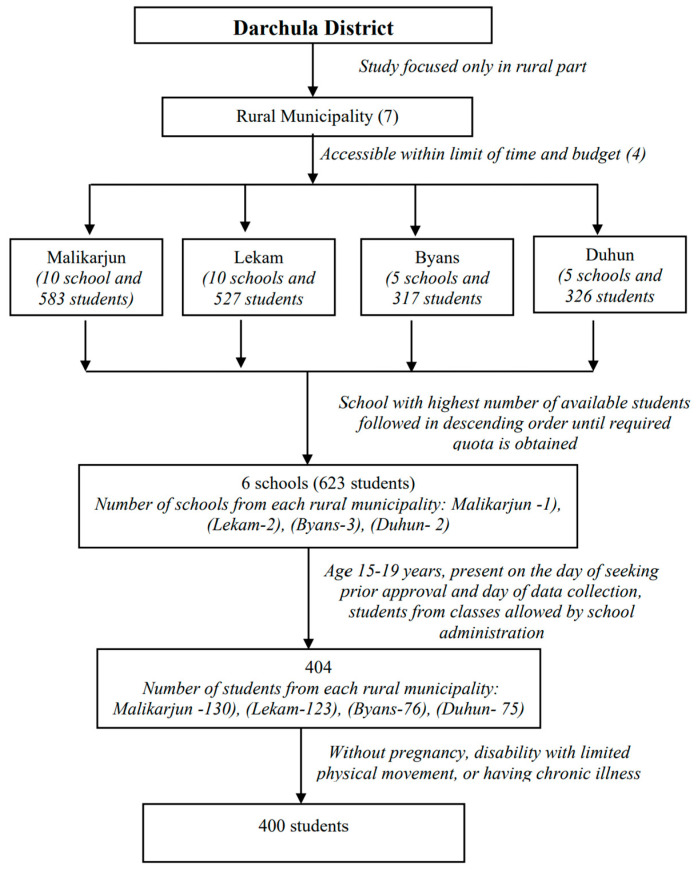
Failure to understand and address the problem of malnutrition and its associated factors among female adolescents could lead to a vicious cycle of intergenerational malnutrition. A cross-sectional study was conducted in six secondary schools of four rural municipalities in Darchula District, Nepal. Data collection for the study was conducted from November 2021 to February 2022. Four hundred female adolescent students aged 15 to 19 years old were selected using quota sampling. The study aims to examine the prevalence of malnutrition by assessing different levels of body mass index (BMI) that is thinness (BMI less than 18.5 kg/m), normal (18.5 kg/m to 24.9 kg/m), overweight (25 kg/m to 29.9 kg/m) and obese (BMI more than or equal to 30 kg/m). Along with BMI, factors associated with undernutrition, here identified as thinness, are assessed using a structured questionnaire. Additionally, key informant interviews and review of interventions was performed to understand the gaps in nutrition-related policies and programs of school going adolescents in the study district. Quantitative data analysis included a prevalence study and chi-square test along with simple and multiple logistic regression to obtain crude and adjusted odds ratio at 95% confidence interval for the significant factors with < 0.05 identified in the chi-square test. Thematic analysis and reviews were used for the synthesis of qualitative data. The results show a 24.7% prevalence of thinness in the study participants. Pre-mensuration status (OR = 5.015, CI = 1.257-20.011, < 0.022), father having a monthly paying job (OR = 4.384, CI = 1.135-16.928, < 0.032), father's foreign employment (OR = 6.96, CI = 1.649-29.377, < 0.008), household (HH) food insecurity status (OR = 2.079, CI = 1.182-3.658, < 0.011) and grain/roots/tuber as most commonly bought food (OR = 9.487, CI = 1.182-76.138, < 0.034) were found to be significantly associated with thinness. Information from the qualitative part identified gaps in existing interventions for an improved nutritional outcome among school going adolescent females. Further studies to understand the nutritional practices and its contributory factors in relation to thinness is encouraged. Stakeholders are urged to effectively address the shortcomings in existing interventions and adopt a more adolescent-centered approach to enhance the nutritional status of female adolescents.
未能理解和解决少女营养不良及其相关因素问题可能导致代际营养不良的恶性循环。本研究在尼泊尔达拉库拉区的四个农村市的六所中学进行了一项横断面研究。研究数据收集于 2021 年 11 月至 2022 年 2 月进行。使用配额抽样选择了 400 名年龄在 15 至 19 岁的女青少年。本研究旨在通过评估不同身体质量指数(BMI)水平来检查营养不良的流行程度,BMI 水平分别为消瘦(BMI 小于 18.5kg/m)、正常(18.5kg/m 至 24.9kg/m)、超重(25kg/m 至 29.9kg/m)和肥胖(BMI 大于或等于 30kg/m)。除了 BMI,还使用结构问卷评估与营养不良相关的因素,这里将消瘦定义为与营养不良相关的因素。此外,还进行了利益相关者访谈和干预措施审查,以了解研究地区在校青少年营养相关政策和方案方面的差距。定量数据分析包括患病率研究和卡方检验,以及简单和多变量逻辑回归,以获得 95%置信区间内有意义因素的粗和调整比值比,卡方检验中 < 0.05 的因素被认为是显著的。主题分析和审查用于综合定性数据。结果显示,研究参与者中消瘦的患病率为 24.7%。预测量表状态(OR = 5.015,CI = 1.257-20.011, < 0.022)、父亲有月薪工作(OR = 4.384,CI = 1.135-16.928, < 0.032)、父亲在国外就业(OR = 6.96,CI = 1.649-29.377, < 0.008)、家庭(HH)粮食不安全状况(OR = 2.079,CI = 1.182-3.658, < 0.011)和最常购买的粮食(OR = 9.487,CI = 1.182-76.138, < 0.034)与消瘦显著相关。定性部分的信息确定了现有干预措施在改善在校少女营养状况方面的差距。鼓励进一步研究以了解与消瘦有关的营养实践及其促成因素。敦促利益相关者有效解决现有干预措施的不足,并采取以青少年为中心的方法,以提高少女的营养状况。