Jaisal Shashikant, Singh Amit, Verma Rajesh K, Ram Vidya Sagar, Verma Shesh Kumar, Yadav Himanshi, Prakash Vijay
Department of Microbiology, UPUMS, Saifai, Etawah, Uttar Pradesh, India.
Department of Medicine, UPUMS, Saifai, Etawah, Uttar Pradesh, India.
J Family Med Prim Care. 2024 Nov;13(11):4894-4900. doi: 10.4103/jfmpc.jfmpc_1178_23. Epub 2024 Nov 18.
commonly causes healthcare-associated infections and shows multidrug resistance. can produce biofilm. Carbapenem resistance in is due to the production of carbapenemases mainly. This study was done to evaluate the formation of biofilm and carbapenemase resistance in isolates.
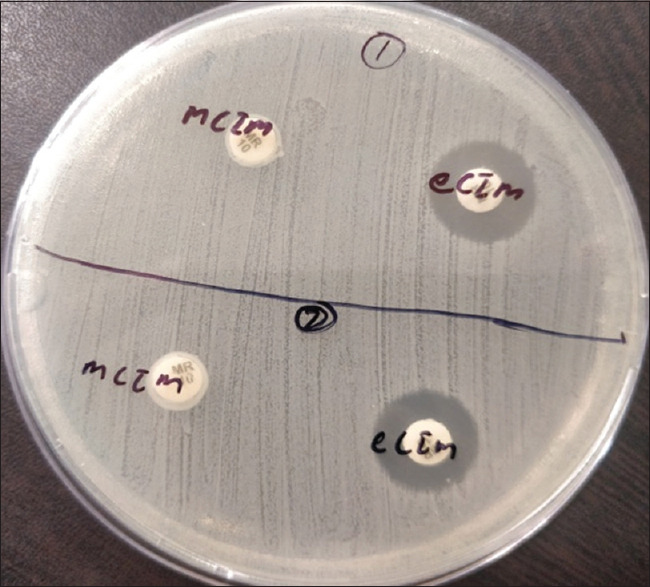
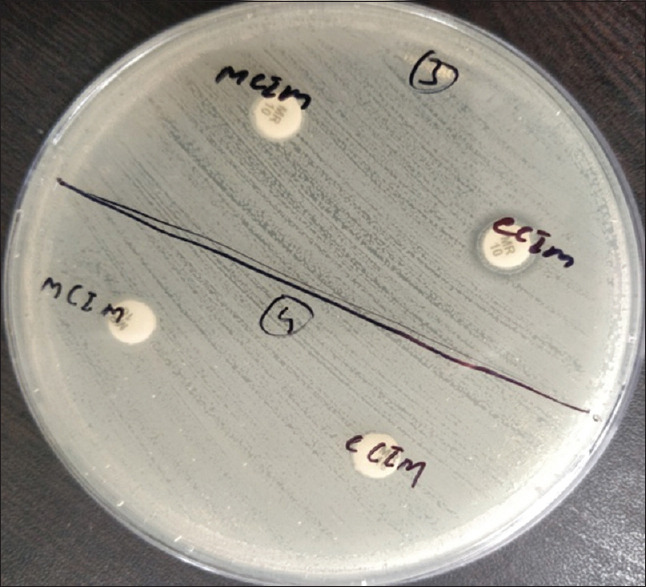
A total of 110 isolated from various clinical samples were taken, the antibiotic susceptibility test was done by the Kirby disk diffusion method, and biofilm detection was done by the tissue culture plate method. All the carbapenem-resistant isolates were confirmed by multiplex real-time PCR (mPCR). Those found positive for any of the carbapenemase genes were tested by the modified Hodge test (MHT), modified carbapenem inactivation method (mCIM), and ethylenediamine tetraacetic acid (EDTA)-modified carbapenem inactivation method (eCIM).
Out of 110 isolates, 66% (72/110) were carbapenem-resistant (suggestive of carbapenemase producers) by Kirby-Bauer disk diffusion but 58% (42/72) of isolates were confirmed for carbapenemase production by mPCR. Maximum number of carbapenemase gene were New Delhi metallo-β-lactamase (NDM) 52% (N = 22), 29% (N = 12) coproducers (NDM+OXA-48), and lowest in oxacillinase (OXA-48), 19% (N = 8). The overall sensitivity of MHT and mCIM+eCIM was 62% and 93%, and specificity was 88% and 97%, respectively. Our study showed that moderate biofilm producers were 51% (N = 56) isolates, strong biofilm producers 27% (N = 30), and 22% (N = 30) were weak/non-biofilm producers. We also found the correlation between biofilm formation and carbapenem-resistant (CR-KP) genes was statistically significant with a value of 0.01*<0.05.
Most isolates of demonstrated a wide range of antibiotic resistance and were biofilm producers. Our results indicated that the combination of mCIM with eCIM showed high sensitivity and specificity to detect CR-KP compared with MHT.
通常会引发医疗保健相关感染并表现出多重耐药性。可产生生物膜。[具体细菌名称]对碳青霉烯类抗生素的耐药性主要归因于碳青霉烯酶的产生。本研究旨在评估[具体细菌名称]分离株中生物膜的形成及对碳青霉烯类抗生素的耐药性。
共采集了110株从各种临床样本中分离出的[具体细菌名称],采用 Kirby 纸片扩散法进行药敏试验,采用组织培养板法进行生物膜检测。所有对碳青霉烯类抗生素耐药的分离株均通过多重实时聚合酶链反应(mPCR)进行确认。对任何碳青霉烯酶基因检测呈阳性的菌株,采用改良 Hodge 试验(MHT)、改良碳青霉烯灭活法(mCIM)和乙二胺四乙酸(EDTA)改良碳青霉烯灭活法(eCIM)进行检测。
在110株分离株中,通过 Kirby - Bauer 纸片扩散法检测,66%(72/110)对碳青霉烯类抗生素耐药(提示为碳青霉烯酶产生菌),但通过 mPCR 确认有58%(42/72)的[具体细菌名称]分离株产生碳青霉烯酶。碳青霉烯酶基因数量最多的是新德里金属β - 内酰胺酶(NDM),占52%(N = 22),29%(N = 12)为联合产生菌(NDM + OXA - 48),产氧西林酶(OXA - 48)的比例最低,为19%(N = 8)。MHT 和 mCIM + eCIM 的总体敏感性分别为62%和93%,特异性分别为88%和97%。我们的研究表明,51%(N = 56)的[具体细菌名称]分离株为中度生物膜产生菌,27%(N = 30)为强生物膜产生菌,22%(N = 30)为弱/非生物膜产生菌。我们还发现生物膜形成与耐碳青霉烯类[具体细菌名称](CR - KP)基因之间的相关性具有统计学意义,P值为0.01*<0.05。
大多数[具体细菌名称]分离株表现出广泛的抗生素耐药性且为生物膜产生菌。我们的结果表明,与 MHT 相比,mCIM 与 eCIM 联合使用对检测 CR - KP 具有更高的敏感性和特异性。