Zhang Shuai, Zuo Yuzhu, Gu Wenyuan, Zhao Yunhuan, Liu Ying, Fan Jinghui
College of Veterinary Medicine, Hebei Agricultural University, Baoding, China.
Hebei Animal Disease Control Center, Shijiazhuang, China.
Front Vet Sci. 2024 Dec 11;11:1489483. doi: 10.3389/fvets.2024.1489483. eCollection 2024.
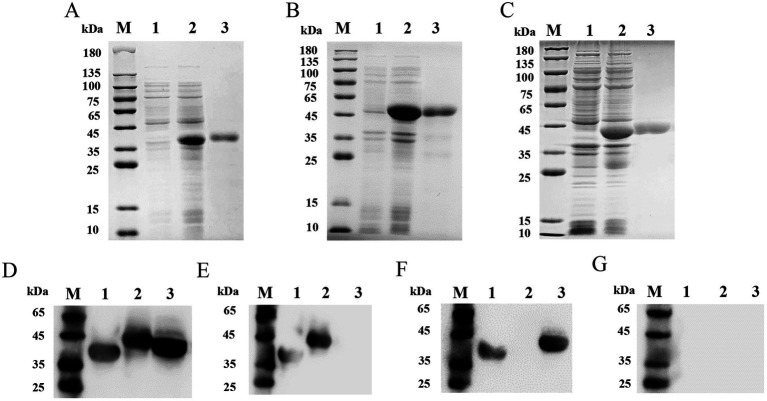
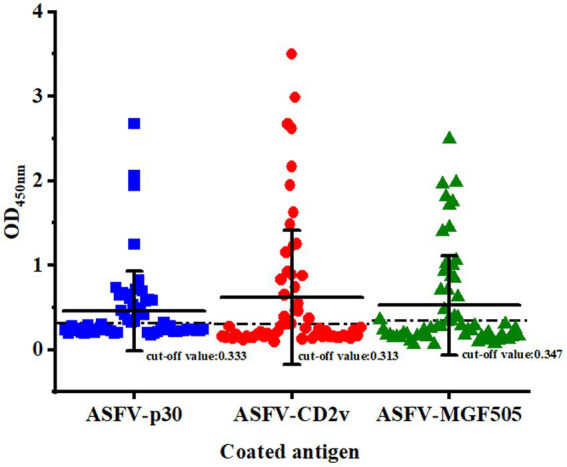
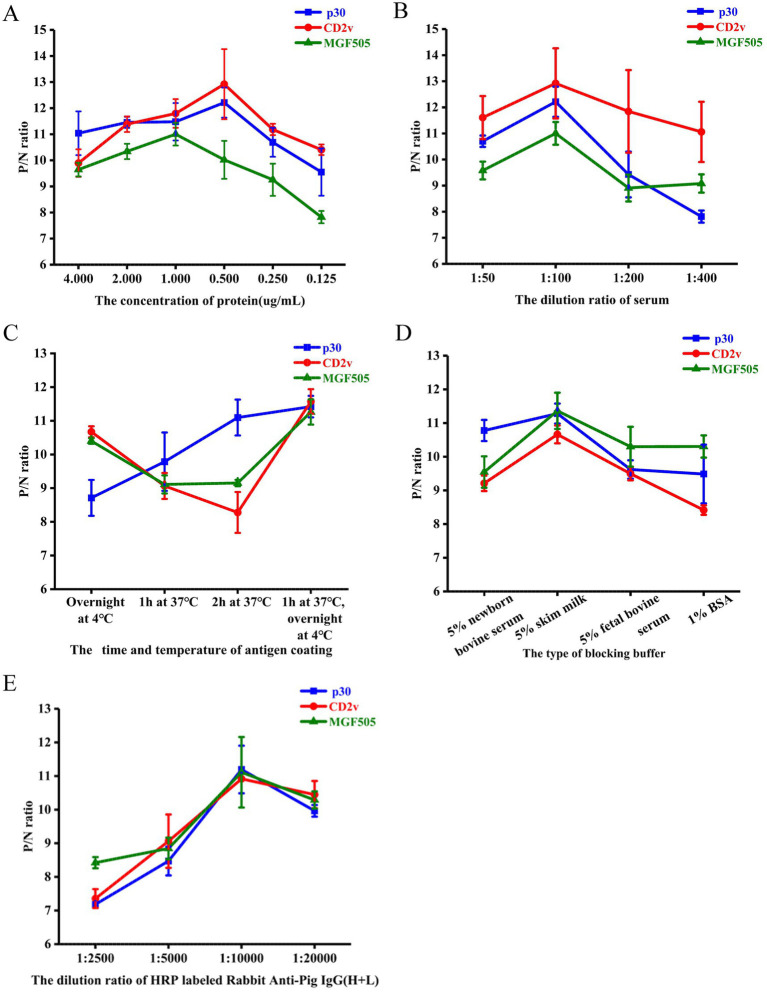
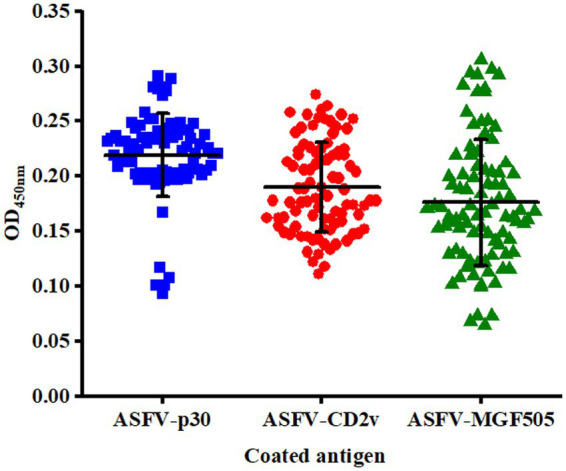
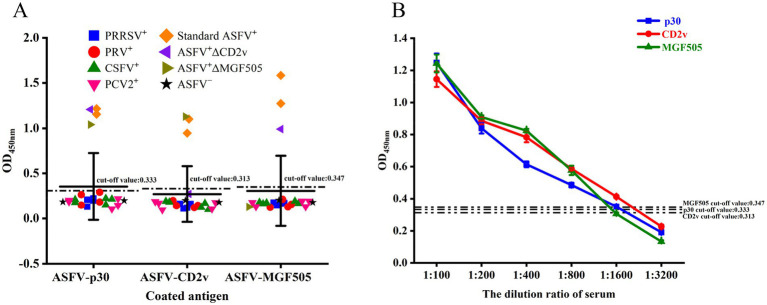
African swine fever (ASF) caused by the ASF virus (ASFV) is a severe and highly contagious viral disease that poses a significant threat to the global pig industry. As no vaccines or effective drugs are available to aid prevention and control, early detection is crucial. The emergence of the low-virulence ASFV strain not expressing CD2v/MGFs (ASFVΔCD2v/ΔMGFs) has been identified domestically and internationally and has even become an epidemic in China, resulting in a complex epidemic. The commercialized ASFV ELISA kits available can detect the presence of ASFV infection in pigs, but they are unable to distinguish wild-type ASFV from gene-deleted strains. The current published ELISA assays can distinguish between the wild-type and CD2v gene-deleted ASFV but cannot differentiate wild-type and MGF505 gene-deleted ASFV or CD2v and MGF505 double-gene deleted ASFV infection, posing new challenges for an effective prevention and control of ASFV. In this study, the ASFV-p30, ASFV-CD2v, and ASFV-MGF505 proteins were expressed using a prokaryotic expression system, and a triple protein-based ELISA antibody detection method based on these proteins was successfully established to effectively differentiate between wild-type ASFV and ASFVΔCD2v and/or ASFVΔMGF505 virus infection. This triple protein-based ELISA showed good analytical specificity without cross-reactivity with antibodies against PRRSV, CSFV, PRV, and PCV2. Moreover, it demonstrates remarkable analytical sensitivity by allowing the identification of clinical samples even at dilutions as high as 1:800. The coefficient of variation the intra-assay and inter-assay were below 5%, indicating strong repeatability and reproducibility. To evaluate the performance of the triple protein-based ELISA, a total of 59 clinical serum samples were detected using the triple protein-based ELISA. The results showed that 22 samples were positive for ASFV, of which 19 were ASFV wild-type, one was ASFVΔCD2v, and two were ASFVΔMGF505. Compared with the commercialized triplex qPCR kit, the triple protein-based ELISA exhibited high diagnostic sensitivity and diagnostic specificity. The test accuracy with the commercialized triplex qPCR kit was 98.31% (58/59), and the test accuracy with the commercialized ELISA kit was 96.61% (57/59). These results indicated that the developed triple protein-based ELISA performs well in detection and differentiation. Therefore, it will be useful for the ASFV serological differential diagnosis and epidemiology study.
由非洲猪瘟病毒(ASFV)引起的非洲猪瘟(ASF)是一种严重且高度传染性的病毒性疾病,对全球养猪业构成重大威胁。由于没有可用的疫苗或有效药物来辅助预防和控制,早期检测至关重要。低毒力ASFV毒株(不表达CD2v/MGFs,即ASFVΔCD2v/ΔMGFs)已在国内外被发现,甚至在中国已成为一种流行病,导致疫情复杂。现有的商业化ASFV ELISA试剂盒可以检测猪体内ASFV感染的存在,但无法区分野生型ASFV和基因缺失毒株。目前已发表的ELISA检测方法可以区分野生型和CD2v基因缺失的ASFV,但无法区分野生型和MGF505基因缺失的ASFV,也无法区分CD2v和MGF505双基因缺失的ASFV感染,这给ASFV的有效防控带来了新的挑战。在本研究中,使用原核表达系统表达了ASFV-p30、ASFV-CD2v和ASFV-MGF505蛋白,并成功建立了基于这些蛋白的三联蛋白ELISA抗体检测方法,以有效区分野生型ASFV与ASFVΔCD2v和/或ASFVΔMGF505病毒感染。这种基于三联蛋白的ELISA显示出良好的分析特异性,与针对猪繁殖与呼吸综合征病毒(PRRSV)、猪瘟病毒(CSFV)、猪伪狂犬病病毒(PRV)和猪圆环病毒2型(PCV2)的抗体无交叉反应。此外,它通过能够识别高达1:800稀释度的临床样本,显示出显著的分析灵敏度。批内和批间变异系数均低于5%,表明重复性和再现性强。为了评估基于三联蛋白的ELISA的性能,使用该方法共检测了59份临床血清样本。结果显示,22份样本ASFV呈阳性,其中19份为ASFV野生型,1份为ASFVΔCD2v,2份为ASFVΔMGF505。与商业化的三重qPCR试剂盒相比,基于三联蛋白的ELISA表现出高诊断灵敏度和诊断特异性。商业化三重qPCR试剂盒的检测准确率为98.31%(58/59),商业化ELISA试剂盒的检测准确率为96.61%(57/59)。这些结果表明,所开发的基于三联蛋白的ELISA在检测和区分方面表现良好。因此,它将有助于ASFV的血清学鉴别诊断和流行病学研究。