Khalid Syed Yousaf, Waraich Tauqir Aslam, Elamin Aiman
Department of Cardiothoracic Surgery, St. James's Hospital, Dublin, IRL.
Department of Urology, Letterkenny University Hospital, Letterkenny, IRL.
Cureus. 2024 Nov 24;16(11):e74368. doi: 10.7759/cureus.74368. eCollection 2024 Nov.
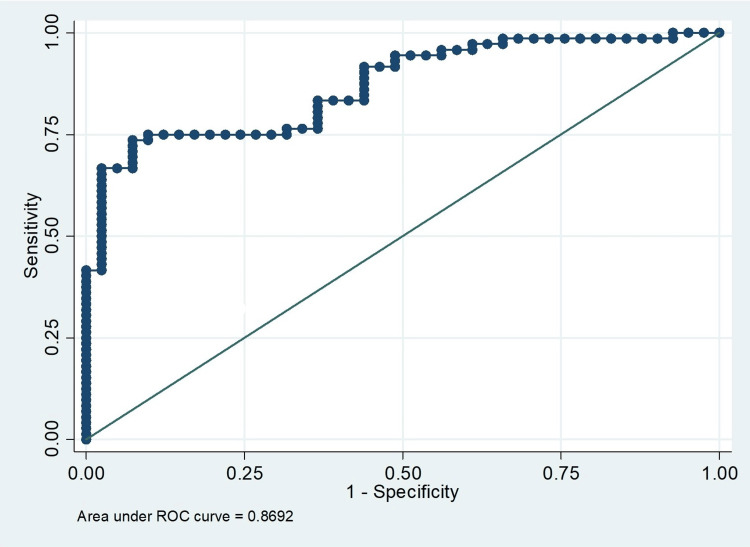
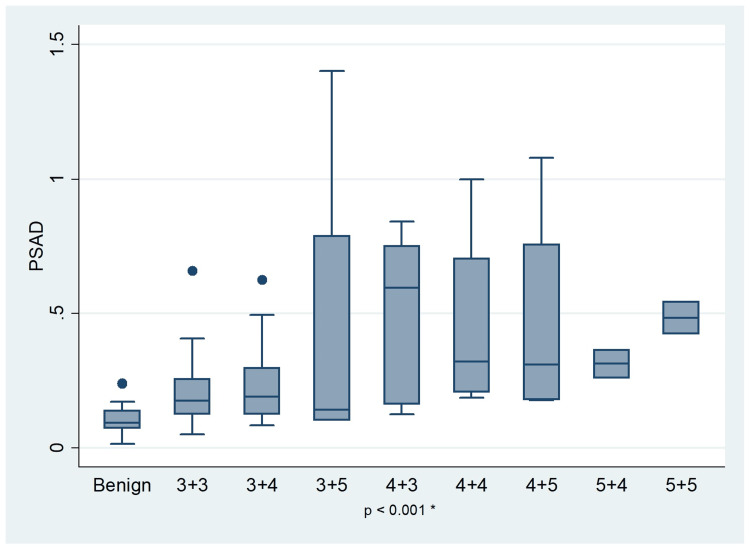
Introduction Prostate-specific antigen density (PSAD), calculated by dividing serum PSA levels by prostate volume, offers greater specificity and accuracy than serum PSA alone in detecting prostate cancer (PCa). This study aimed to evaluate the diagnostic performance of PSAD in PCa detection across different PSA levels and its correlation with Gleason scores. Methods This retrospective, single-center study reviewed data from 154 patients with suspected PCa who underwent prostate MRI between July 2021 and July 2023. Among these, 113 met the inclusion criteria, which required MRI-derived prostate volume measurements, serum PSA levels within three months of biopsy, and transperineal prostate biopsy results. PSAD was calculated by dividing serum PSA levels by prostate volume. Statistical analysis was conducted using STATA/SE 18.0 (StataCorp., College Station, TX, USA). Receiver operating characteristic (ROC) curves identified optimal PSAD cutoff values for PCa detection, and the relationship between PSAD and Gleason scores was analyzed. Results Of the 113 patients, 72 (63.72%) were diagnosed with PCa. The overall PSAD cutoff of 0.158 demonstrated a sensitivity of 73.61% and specificity of 92.68%, with an area under the curve (AUC) of 0.83 (95% CI: 0.77-0.90). For patients with PSA levels between 4-10 ng/ml, the optimal PSAD cutoff was 0.155 (sensitivity 65%, specificity 85.19%). For those with PSA levels >10 ng/ml, the cutoff was 0.175 (sensitivity 96.55%, specificity 66.67%). A significant correlation was found between PSAD and Gleason scores (p < 0.001), with higher PSAD values associated with more aggressive cancers. Conclusion PSAD demonstrates strong diagnostic accuracy for PCa and is significantly correlated with Gleason scores, suggesting its potential in assessing tumor aggressiveness and guiding clinical decisions.
引言 前列腺特异性抗原密度(PSAD)通过血清PSA水平除以前列腺体积计算得出,在检测前列腺癌(PCa)方面比单独的血清PSA具有更高的特异性和准确性。本研究旨在评估PSAD在不同PSA水平下对PCa检测的诊断性能及其与 Gleason评分的相关性。方法 这项回顾性单中心研究回顾了2021年7月至2023年7月期间154例疑似PCa患者的前列腺MRI数据。其中,113例符合纳入标准,包括MRI测量的前列腺体积、活检前三个月内的血清PSA水平以及经会阴前列腺活检结果。PSAD通过血清PSA水平除以前列腺体积计算得出。使用STATA/SE 18.0(美国德克萨斯州大学站市StataCorp公司)进行统计分析。绘制受试者工作特征(ROC)曲线以确定PCa检测的最佳PSAD临界值,并分析PSAD与Gleason评分之间的关系。结果 在113例患者中,72例(63.72%)被诊断为PCa。总体PSAD临界值为0.158时,灵敏度为73.61%,特异性为92.68%,曲线下面积(AUC)为0.83(95%CI:0.77 - 0.90)。对于PSA水平在4 - 10 ng/ml之间的患者,最佳PSAD临界值为0.155(灵敏度65%,特异性85.19%)。对于PSA水平>10 ng/ml的患者,临界值为0.175(灵敏度96.55%,特异性66.67%)。发现PSAD与Gleason评分之间存在显著相关性(p < 0.001),PSAD值越高,癌症侵袭性越强。结论 PSAD对PCa具有很强的诊断准确性,且与Gleason评分显著相关,表明其在评估肿瘤侵袭性和指导临床决策方面具有潜力。