Li Jia, Zhu Qiuyu, Xiang Jiaxin, Wei Yiyong, Zhang Donghang
Department of Anesthesiology, Honghui Hospital, Xi'an Jiaotong University, Xi'an, China.
Department of Anesthesiology, The Second Affiliated Hospital, School of Medicine, The Chinese University of Hong Kong, Shenzhen & Longgang District People's Hospital of Shenzhen, Shenzhen, China.
Front Neurosci. 2024 Dec 11;18:1500353. doi: 10.3389/fnins.2024.1500353. eCollection 2024.
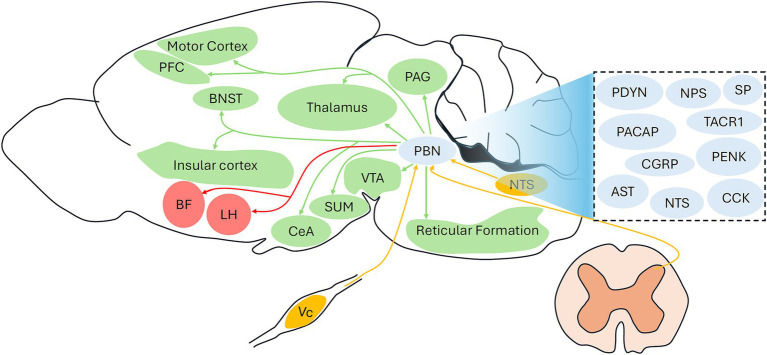
The parabrachial nucleus (PBN), located in the dorsolateral pons, is involved in many important biological functions, such as sensory signaling, feeding, defensive behaviors, fear, anxiety, and sleep-wake cycles. General anesthesia shares the classical feature of reversible loss of consciousness with natural sleep, and accumulating evidence has indicated that general anesthesia and sleep-wake behaviors share some common underlying neural mechanism. In recent years, emerging studies have investigated the involvement of PBN in emergence from general anesthesia, but divergence exists in terms of different types of general anesthetics or different durations of treatment with the same group of general anesthetics. Here, we reviewed the current literature and summarized the evidence about the contribution of PBN to general anesthesia.
臂旁核(PBN)位于脑桥背外侧,参与许多重要的生物学功能,如感觉信号传导、进食、防御行为、恐惧、焦虑以及睡眠 - 觉醒周期。全身麻醉与自然睡眠具有意识可逆丧失的经典特征,并且越来越多的证据表明全身麻醉和睡眠 - 觉醒行为共享一些共同的潜在神经机制。近年来,新出现的研究已经探讨了PBN在全身麻醉苏醒过程中的作用,但在不同类型的全身麻醉剂或同一组全身麻醉剂的不同治疗持续时间方面存在分歧。在此,我们回顾了当前的文献,并总结了关于PBN对全身麻醉作用的证据。