Denijs Frederique Beatrice, Van Poppel Hendrik, Stenzl Arnulf, Villanueva Tiago, Vilaseca Josep Maria, Ungan Mehmet, Deschamps André, Collen Sarah, Roobol Monique J
Department of Urology, Erasmus Cancer Institute, Erasmus University Medical Centre, Rotterdam, The Netherlands.
Department of Urology, KU Leuven, Leuven, Belgium.
BMC Prim Care. 2024 Dec 26;25(1):436. doi: 10.1186/s12875-024-02688-8.
Historical prostate-specific antigen (PSA)-based screening studies reduced prostate cancer-related deaths but also led to overdiagnosis/overtreatment. Since then, opportunistic PSA testing has increased, and late-stage diagnoses and prostate-cancer related deaths are rising.
To review current trends regarding PSA testing in primary care and propose a collaborative approach to improve early prostate cancer detection.
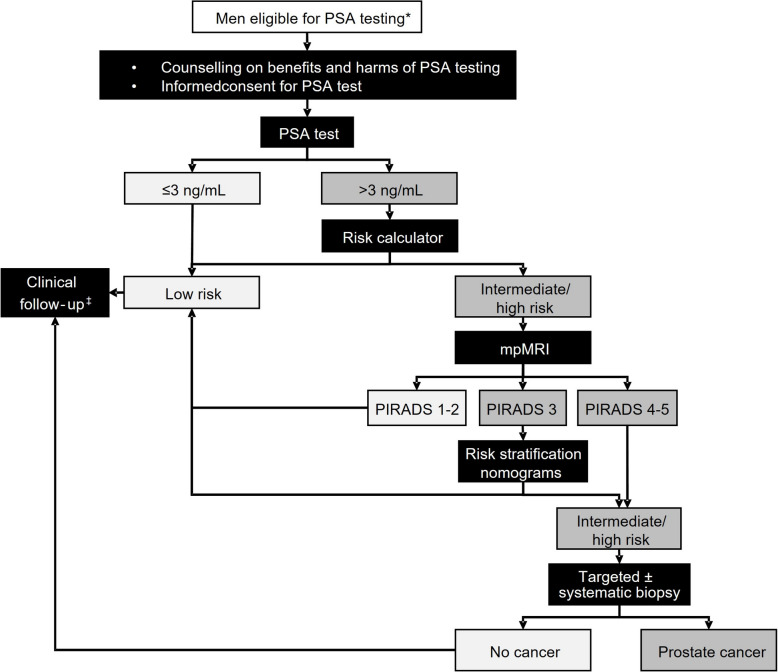
Opportunistic PSA testing patterns vary among General Practitioners (GPs) and Family Doctors (FDs) based on differing guidelines, patient pressure, time constraints and personal views/preferences. However, an organised, risk-adapted strategy, as outlined by the European Association of Urology's guidelines, could facilitate the early diagnosis of significant prostate cancer whilst sparing those unlikely to experience disease-related symptoms from further tests (overdiagnosis) as well as the psychosocial consequences of a cancer diagnosis. This could be achieved by the introduction of national prostate cancer screening programmes, which has been endorsed in the European Commission's publication of the EU Cancer Screening Recommendations. In this scenario, GPs/FDs would still play an important role in supporting men throughout the decision pathway. However, as some men may still request a PSA test from their GP/FD, patient information as well as clear guidance and support to GPs/FDs are needed, including appropriate skills training to facilitate effective counselling and informed decision-making, and the use of risk calculators to inform referral decisions.
GPs/FDs play an important role in counselling healthy men eligible to consider PSA testing. However, clear guidance, training and support is required for them to assume this role.
以往基于前列腺特异性抗原(PSA)的筛查研究降低了前列腺癌相关死亡,但也导致了过度诊断/过度治疗。从那时起,机会性PSA检测增加,晚期诊断和前列腺癌相关死亡人数也在上升。
回顾初级保健中PSA检测的当前趋势,并提出一种协作方法以改善早期前列腺癌的检测。
基于不同的指南、患者压力、时间限制和个人观点/偏好,全科医生(GPs)和家庭医生(FDs)的机会性PSA检测模式各不相同。然而,正如欧洲泌尿外科学会指南所概述的,一种有组织的、风险适应性策略可以促进对有意义的前列腺癌的早期诊断,同时使那些不太可能出现疾病相关症状的人免于进一步检测(过度诊断)以及癌症诊断带来的心理社会后果。这可以通过引入国家前列腺癌筛查计划来实现,该计划已在欧盟委员会发布的《欧盟癌症筛查建议》中得到认可。在这种情况下,全科医生/家庭医生在整个决策过程中对男性的支持仍将发挥重要作用。然而,由于一些男性可能仍会向他们的全科医生/家庭医生要求进行PSA检测,因此需要向患者提供信息,并为全科医生/家庭医生提供明确的指导和支持,包括进行适当的技能培训以促进有效的咨询和知情决策,以及使用风险计算器来为转诊决策提供依据。
全科医生/家庭医生在为有资格考虑PSA检测的健康男性提供咨询方面发挥着重要作用。然而,需要为他们提供明确的指导、培训和支持,以便他们承担这一角色。