Sudheer Aparna Chitra, Anilkumar Gopinathan M, Kuroki Hidenori, Yamaguchi Takeo
Laboratory for Chemistry and Life Sciences, Tokyo Institute of Technology, Yokohama, Kanagawa, 226-8501, Japan.
R&D Center, Noritake Co., Ltd, 300 Higashiyama, Miyoshi-Cho, Aichi, 470-0293, Japan.
Adv Sci (Weinh). 2025 Feb;12(7):e2408614. doi: 10.1002/advs.202408614. Epub 2024 Dec 26.
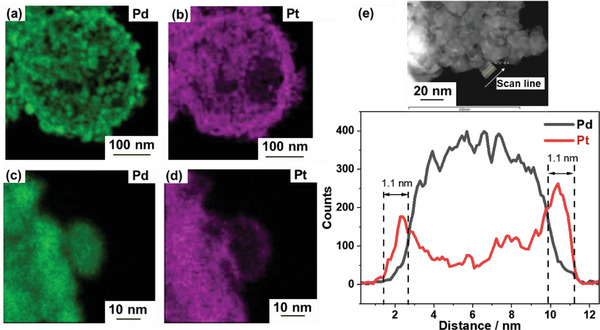
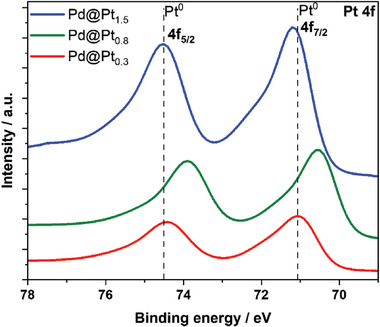
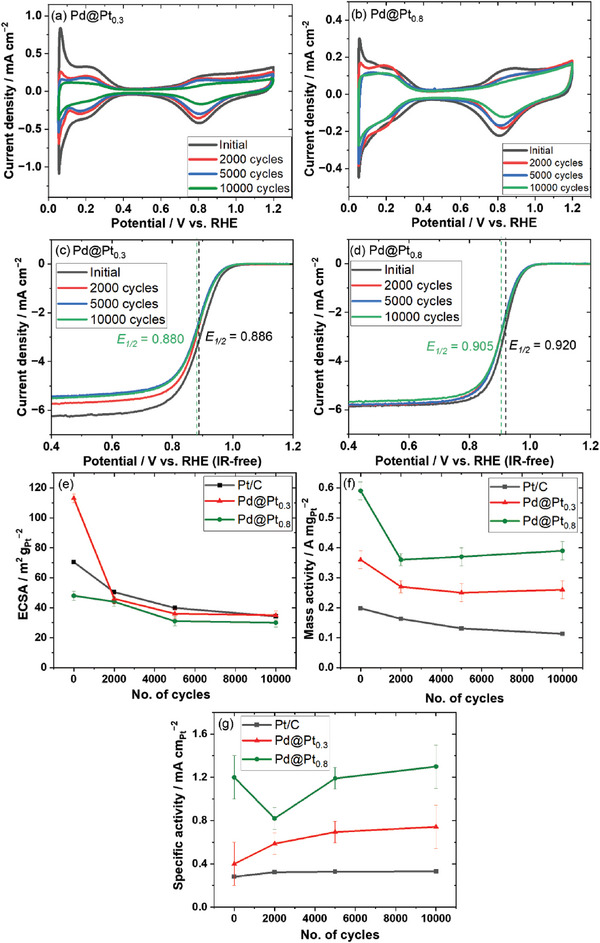
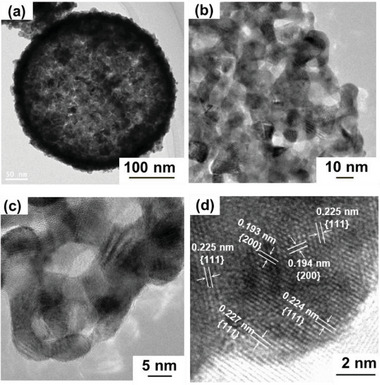
Nanostructured Pt-based catalysts have attracted considerable attention for fuel-cell applications. This study introduces a novel one-pot and low-temperature polyol approach for synthesizing support-free, connected nanoparticles with non-Pt metal cores and Pt shells. Unlike conventional heat treatment methods, the developed support-free and Fe-free connected Pd@Pt (Pd@Pt) nanoparticle catalyst possesses a stable nanonetwork structure with a high surface area. This approach can precisely control the atomic-level structure of the Pt shell on the Pd core at a low deposition temperature. The optimized Pd@Pt catalyst with a Pt/Pd atomic ratio of 0.8 and a Pt shell thickness of 1.1 nm exhibits a threefold improvement in oxygen reduction reaction (ORR) mass activity compared to that of commercial carbon-supported Pt nanoparticle catalyst (Pt/C). Durability evaluation demonstrated 100% retention of specific activity after 10,000 load cycles, owing to the stable nanonetwork and uniform coverage of the Pt shell. In addition, the support-free, connected core-shell nanoparticle catalyst overcomes the carbon corrosion issues commonly associated with conventional carbon-supported catalysts while simultaneously improving both ORR activity and load cycle durability. These findings highlight the potential of this innovative approach to develop support-free catalysts for polymer electrolyte fuel cells and other energy devices.
纳米结构的铂基催化剂在燃料电池应用中引起了广泛关注。本研究介绍了一种新颖的一锅法低温多元醇方法,用于合成具有非铂金属核和铂壳的无载体、相互连接的纳米颗粒。与传统热处理方法不同,所开发的无载体、无铁的相互连接的钯@铂(Pd@Pt)纳米颗粒催化剂具有稳定的纳米网络结构和高表面积。该方法能够在低沉积温度下精确控制钯核上铂壳的原子级结构。优化后的钯@铂催化剂,其铂/钯原子比为0.8,铂壳厚度为1.1纳米,与商业碳载铂纳米颗粒催化剂(Pt/C)相比,氧还原反应(ORR)质量活性提高了两倍。耐久性评估表明,经过10000次负载循环后,比活性保持100%,这归因于稳定的纳米网络和铂壳的均匀覆盖。此外,这种无载体、相互连接的核壳纳米颗粒催化剂克服了传统碳载催化剂常见的碳腐蚀问题,同时提高了ORR活性和负载循环耐久性。这些发现凸显了这种创新方法在开发用于聚合物电解质燃料电池和其他能量装置的无载体催化剂方面的潜力。