Xiao Yue, Gao Jingya, Wang Yiyi, Hao Dan, Yan Wei, Wen Dingke, Zeng Siyi, Yang Shiqi, Shi Yingyu, Li Wei
Department of Dermatology and Venereology, West China Hospital, Sichuan University, Chengdu, China.
Department of Neurosurgery, West China Hospital, Sichuan University, Chengdu, China.
Front Immunol. 2024 Dec 11;15:1487959. doi: 10.3389/fimmu.2024.1487959. eCollection 2024.
Psoriasis is commonly associated with metabolic dysfunction-associated steatotic liver disease, raising concerns about the hepatic effects of systemic treatments on psoriasis and its comorbid conditions. This study evaluates liver stiffness measurement (LSM) alterations and identifies predictors of abnormal LSM in psoriatic patients following systemic treatments, including biologics and methotrexate.
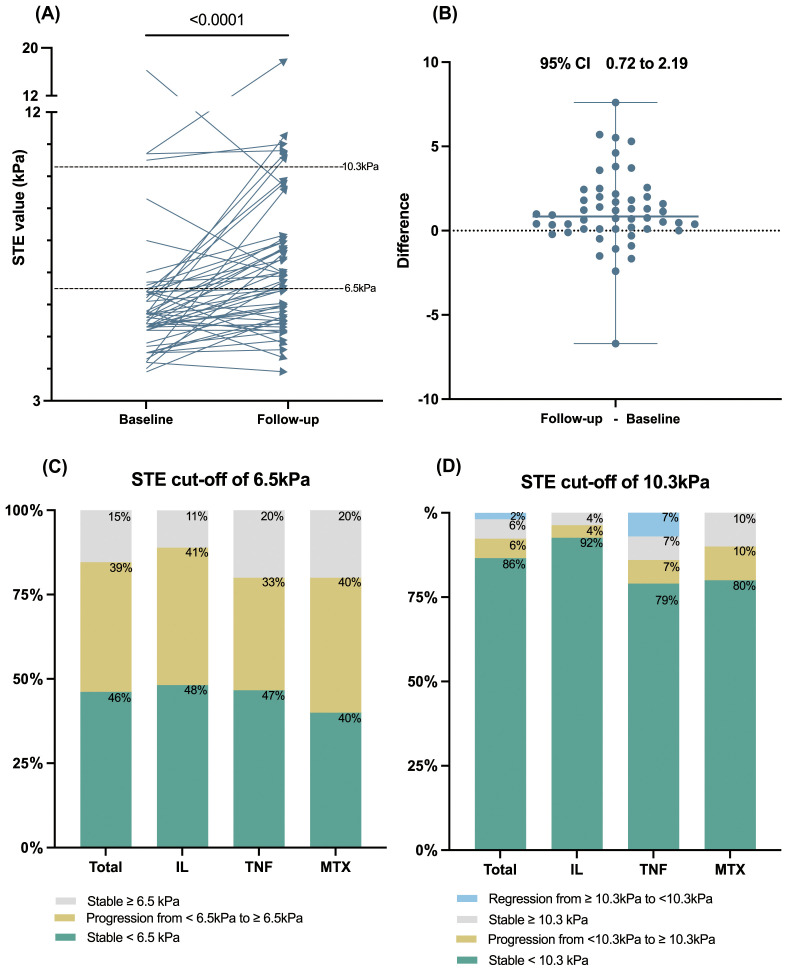
This prospective cohort study is based on the PSOWCH database (Psoriasis Cohort of West China Hospital). We initially included psoriatic patients who had undergone sound touch elastography (STE), then recruited patients who had STE before systemic treatment and reassessed them after at least six months. Three treatment subgroups were formed (interleukin inhibitors, tumor necrosis factor inhibitors, and methotrexate), classifying post-treatment STE outcomes using threshold values of 6.5 kPa and 10.3 kPa.
Among the 52 recruited patients, overall STE values significantly increased during follow-up. Univariate regression analysis showed that age, gender, psoriasis severity, psoriatic arthritis status, and current treatment type were not significantly correlated with abnormal STE outcomes at cutoff values of 6.5 kPa and 10.3 kPa. In the multivariate model, body mass index (BMI) was identified as a risk factor for post-treatment STE ≥ 6.5 kPa (odds ratio [OR], 1.26; 95% CI, 1.04 to 1.60, P=0.031).
This exploratory study reveals that systemic treatment type is not associated with abnormal post-treatment LSM. However, a significant association exists between BMI and abnormal LSM outcomes. These findings highlight the critical importance of BMI management in therapeutic interventions for psoriasis.
银屑病常与代谢功能障碍相关脂肪性肝病有关,这引发了人们对银屑病及其合并症的全身治疗对肝脏影响的担忧。本研究评估了肝脏硬度测量(LSM)的变化,并确定了银屑病患者在接受包括生物制剂和甲氨蝶呤在内的全身治疗后LSM异常的预测因素。
这项前瞻性队列研究基于PSOWCH数据库(华西医院银屑病队列)。我们最初纳入了接受过超声剪切波弹性成像(STE)的银屑病患者,然后招募了在全身治疗前接受过STE检查且至少六个月后重新评估的患者。形成了三个治疗亚组(白细胞介素抑制剂、肿瘤坏死因子抑制剂和甲氨蝶呤),使用6.5 kPa和10.3 kPa的阈值对治疗后STE结果进行分类。
在招募的52例患者中,随访期间STE总体值显著增加。单因素回归分析表明,年龄、性别、银屑病严重程度、银屑病关节炎状态和当前治疗类型与6.5 kPa和10.3 kPa临界值时的STE异常结果无显著相关性。在多变量模型中,体重指数(BMI)被确定为治疗后STE≥6.5 kPa的危险因素(比值比[OR],1.26;95%CI,1.04至1.60,P = 0.031)。
这项探索性研究表明,全身治疗类型与治疗后LSM异常无关。然而,BMI与LSM异常结果之间存在显著关联。这些发现突出了BMI管理在银屑病治疗干预中的至关重要性。