Fischer Elia L, Renaud Alexis, Grivaz Petr, Di Liberto Giovanni, Ryvlin Philippe, Cavassini Matthias, Du Pasquier Renaud A, Sokolov Arseny A
NeuroScape@NeuroTech Lab, Service Universitaire de Neuroréhabilitation (SUN), Département des Neurosciences Cliniques, Centre Hosoitalier Universitaire Vaudois (CHUV), Institution de Lavigny, University of Lausanne, 1011 Lausanne, Switzerland.
Department of Neurology, Inselspital, Bern University Hospital, University of Bern, 3010 Bern, Switzerland.
Brain Commun. 2024 Dec 26;7(1):fcae399. doi: 10.1093/braincomms/fcae399. eCollection 2025.
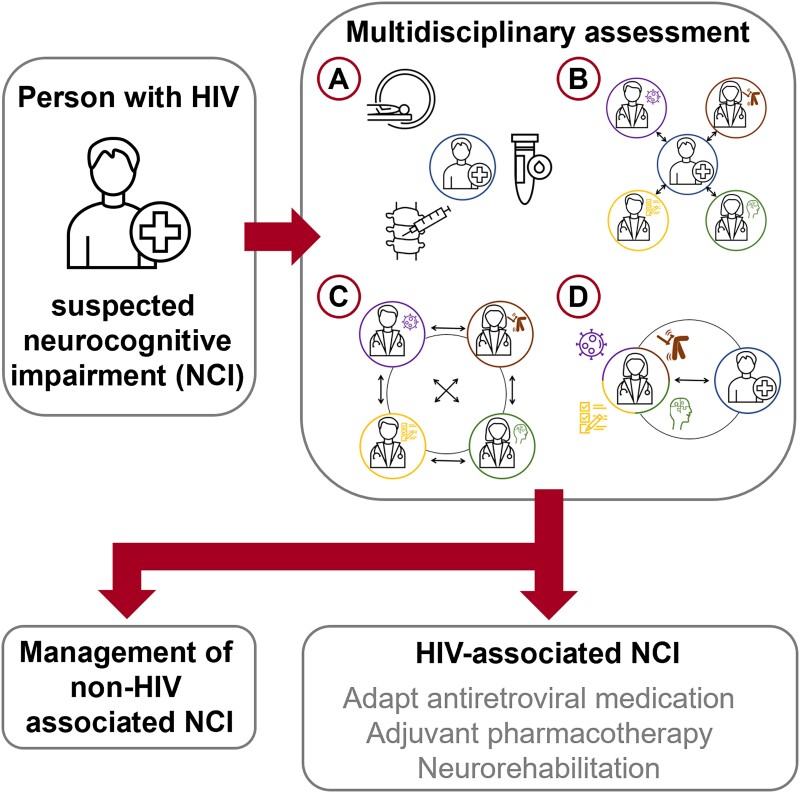
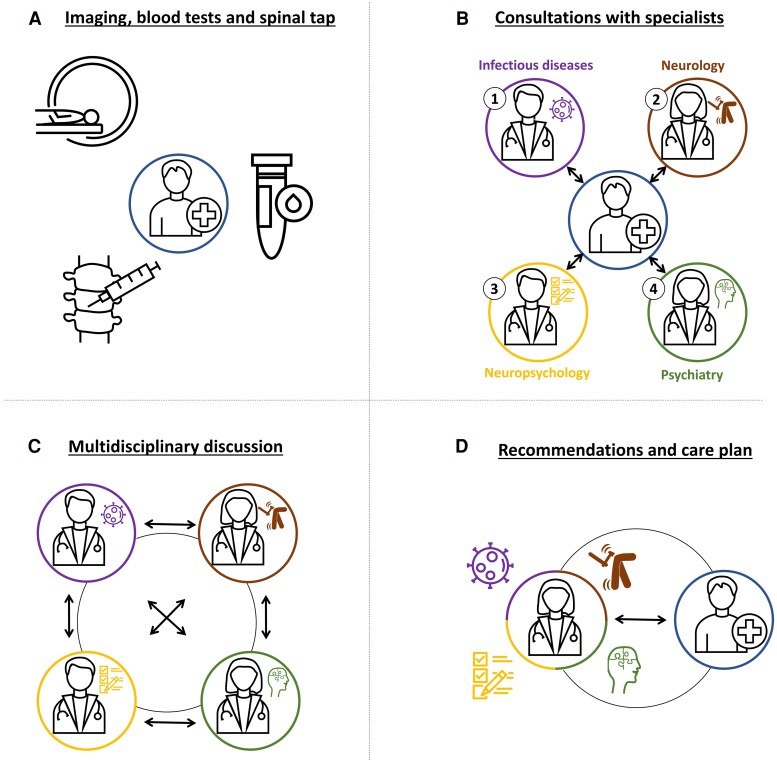
Neurocognitive impairment (NCI) is present in around 40% of people with HIV and substantially affects everyday life, adherence to combined antiretroviral therapy (cART) and overall life expectancy. Suboptimal therapy regimen, opportunistic infections, substance abuse and highly prevalent psychiatric co-morbidities contribute to NCI in people with HIV. In this review, we highlight the need for efficacious treatment of HIV-related NCI through pharmacological approaches and cognitive neurorehabilitation, discussing recent randomized controlled trials in this domain. We also discuss the benefits of a thorough and interdisciplinary diagnostic work-up between specialists in neurology, psychiatry, neuropsychology and infectious diseases, helping to disentangle the various factors contributing to cognitive complaints and deficits in people with HIV. While the advent of cART has contributed to slowing the progression of cognitive deficits in people with HIV and reducing the prevalence of HIV-associated dementia, NCI persists at a significant rate. Adjuvant stimulating or neuroprotective pharmacological agents have shown some potential benefits. Despite promising outcomes, studies on cognitive neurorehabilitation of HIV-related NCI remain sparse and limited in terms of methodological aspects. The access to cognitive neurorehabilitation is also restricted, in particular at the global scale. Novel technology bears a significant potential for restoring cognitive function in people with HIV, affording high degrees of standardization and personalization, along with opportunities for telerehabilitation. Entertaining serious video game environments with immersive graphics can further promote patient motivation, training adherence and impact on everyday life, as indicated by a growing body of evidence, including in seropositive children and older individuals in Africa. Upon validation of technology-assisted cognitive neurorehabilitation for HIV-related NCI in large-scale randomized controlled trials with state-of-the-art methodology, these approaches will promote socio-professional reintegration and quality of life of people with HIV.
约40%的艾滋病毒感染者存在神经认知障碍(NCI),这对日常生活、联合抗逆转录病毒疗法(cART)的依从性及总体预期寿命均有重大影响。治疗方案欠佳、机会性感染、药物滥用以及高度流行的精神共病导致了艾滋病毒感染者出现NCI。在本综述中,我们强调需要通过药物治疗和认知神经康复对与艾滋病毒相关的NCI进行有效治疗,并讨论该领域最近的随机对照试验。我们还讨论了神经病学、精神病学、神经心理学和传染病专家之间进行全面且跨学科诊断检查的益处,这有助于理清导致艾滋病毒感染者认知主诉和缺陷的各种因素。虽然cART的出现有助于减缓艾滋病毒感染者认知缺陷的进展并降低与艾滋病毒相关痴呆的患病率,但NCI仍以相当高的比例存在。辅助性刺激或神经保护药物已显示出一些潜在益处。尽管取得了有前景的结果,但关于与艾滋病毒相关的NCI的认知神经康复研究在方法学方面仍然稀少且有限。获得认知神经康复的机会也受到限制,尤其是在全球范围内。新技术在恢复艾滋病毒感染者认知功能方面具有巨大潜力,可实现高度标准化和个性化,同时提供远程康复机会。越来越多的证据表明,包括非洲的血清阳性儿童和老年人在内,具有沉浸式图形的严肃视频游戏环境可进一步提高患者的积极性、训练依从性并对日常生活产生影响。在采用先进方法进行的大规模随机对照试验中验证技术辅助的认知神经康复对与艾滋病毒相关的NCI的疗效后,这些方法将促进艾滋病毒感染者的社会职业重新融入和生活质量。