He Lina, Xu Qing, Hao Li, Ran Xu, Qiu Yamin, Lin Jie, Chen Wei
Department of Reproductive Medicine, Zigong Hospital of Women and Children Health Care, Zigong, China.
Department of Urology, Zigong Fourth People's Hospital, Sichuan, China.
Front Nutr. 2024 Dec 12;11:1486958. doi: 10.3389/fnut.2024.1486958. eCollection 2024.
The association between vitamin D deficiency and ovarian reserve-specific outcomes of assisted reproductive technology (ART) remains uncertain. This study aimed to investigate the role of ovarian reserve in the association between basal serum vitamin D levels and ART outcomes in patients undergoing controlled ovarian hyperstimulation (COH).
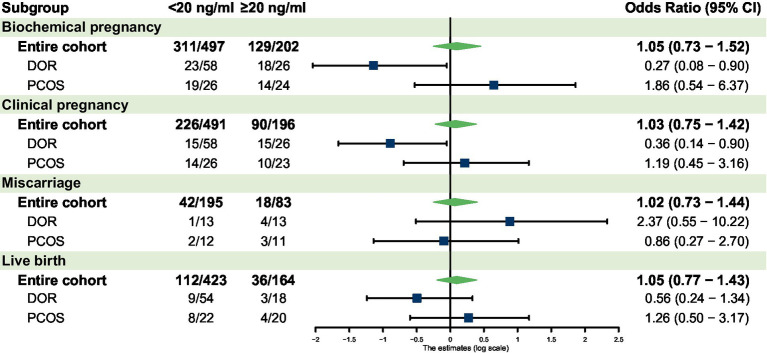
A total of 1,333 infertile women undergoing COH cycles were retrospectively analyzed. Patients were divided into a vitamin D deficiency group (serum vitamin D < 20 ng/mL) and a normal vitamin D group. Univariate and multivariate logistic regression analyses were performed to estimate the relationship between vitamin D deficiency and pregnancy outcomes including biochemical pregnancy rate, clinical pregnancy rate, miscarriage rate, and live birth rate in the overall cohort and subgroups with diminished ovarian reserve (DOR) or polycystic ovary syndrome (PCOS).
In the entire participants' cohort, no correlation between vitamin D deficiency and pregnancy results was observed ( > 0.05). However, in the DOR subgroup, vitamin D deficiency was associated with a lower biochemical pregnancy rate (adjusted OR 0.27; 95% CI 0.08-0.90; < 0.01) and clinical pregnancy rate (adjusted OR 0.36; 95% CI 0.14-0.90; < 0.01). No significant differences were observed in pregnancy outcomes among patients with PCOS ( > 0.05).
Vitamin D deficiency does not affect pregnancy outcomes in the overall patient population, but it may negatively impact women with DOR potentially leading to poorer pregnancy outcomes. Further studies are needed to clarify the mechanisms involved and the potential use of vitamin D screening and supplementation in specific populations.
维生素D缺乏与辅助生殖技术(ART)中卵巢储备特异性结局之间的关联仍不明确。本研究旨在探讨卵巢储备在接受控制性卵巢刺激(COH)的患者中基础血清维生素D水平与ART结局之间关联中的作用。
对1333例接受COH周期的不孕女性进行回顾性分析。患者被分为维生素D缺乏组(血清维生素D<20 ng/mL)和维生素D正常组。进行单因素和多因素逻辑回归分析,以评估维生素D缺乏与总体队列以及卵巢储备功能减退(DOR)或多囊卵巢综合征(PCOS)亚组中妊娠结局(包括生化妊娠率、临床妊娠率、流产率和活产率)之间的关系。
在整个参与者队列中,未观察到维生素D缺乏与妊娠结果之间的相关性(P>0.05)。然而,在DOR亚组中,维生素D缺乏与较低的生化妊娠率(调整优势比0.27;95%置信区间0.08 - 0.90;P<0.01)和临床妊娠率(调整优势比0.36;95%置信区间0.14 - 0.90;P<0.01)相关。PCOS患者的妊娠结局之间未观察到显著差异(P>0.05)。
维生素D缺乏在总体患者人群中不影响妊娠结局,但可能对DOR女性产生负面影响,潜在导致较差的妊娠结局。需要进一步研究以阐明其中涉及的机制以及维生素D筛查和补充在特定人群中的潜在用途。