Narro-Serrano Jennifer, Marhuenda-Egea Frutos Carlos
Department of Physical Chemistry, University of Alicante, 03690 Alicante, Spain.
Department of Biochemistry and Molecular Biology and Soil Science and Agricultural Chemistry, University of Alicante, 03690 Alicante, Spain.
Metabolites. 2024 Dec 22;14(12):724. doi: 10.3390/metabo14120724.
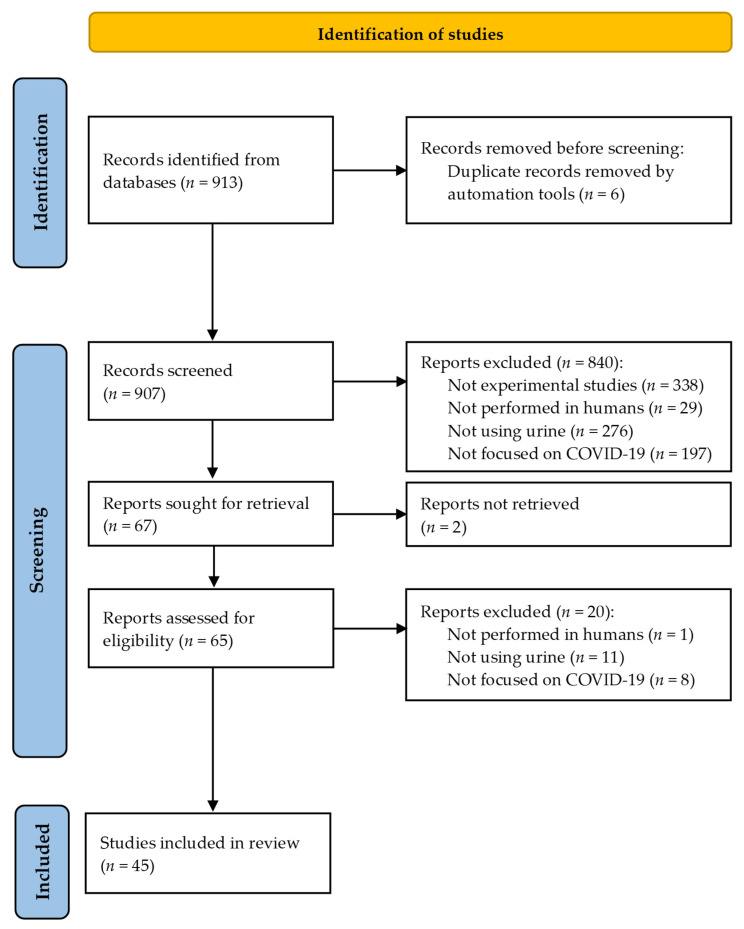
The COVID-19 pandemic, caused by the SARS-CoV-2 virus, has spurred an extraordinary scientific effort to better understand the disease's pathophysiology and develop diagnostic and prognostic tools to guide more precise and effective clinical management. Among the biological samples analyzed for biomarker identification, urine stands out due to its low risk of infection, non-invasive collection, and suitability for frequent, large-volume sampling. Integrating data from omics studies with standard biochemical analyses offers a deeper and more comprehensive understanding of COVID-19. This review aims to provide a detailed summary of studies published to date that have applied omics and clinical analyses on urine samples to identify potential biomarkers for COVID-19. In July 2024, an advanced search was conducted in Web of Science using the query: "covid* (Topic) AND urine (Topic) AND metabol* (Topic)". The search included results published up to 14 October 2024. The studies retrieved from this digital search were evaluated through a two-step screening process: first by reviewing titles and abstracts for eligibility, and then by retrieving and assessing the full texts of articles that met the specific criteria. The initial search retrieved 913 studies, of which 45 articles were ultimately included in this review. The most robust biomarkers identified include kynurenine, neopterin, total proteins, red blood cells, ACE2, citric acid, ketone bodies, hypoxanthine, amino acids, and glucose. The biological causes underlying these alterations reflect the multisystemic impact of COVID-19, highlighting key processes such as systemic inflammation, renal dysfunction, critical hypoxia, and metabolic stress.
由严重急性呼吸综合征冠状病毒2(SARS-CoV-2)病毒引起的2019冠状病毒病(COVID-19)大流行,激发了一场非凡的科学努力,以更好地了解该疾病的病理生理学,并开发诊断和预后工具,以指导更精确和有效的临床管理。在为生物标志物鉴定而分析的生物样本中,尿液因其感染风险低、采集无创且适合频繁、大容量采样而脱颖而出。将组学研究数据与标准生化分析相结合,能更深入、全面地了解COVID-19。本综述旨在详细总结迄今为止发表的研究,这些研究对尿液样本进行了组学和临床分析,以确定COVID-19的潜在生物标志物。2024年7月,在科学网(Web of Science)上使用查询词“covid*(主题)AND urine(主题)AND metabol*(主题)”进行了高级检索。检索结果包括截至2024年10月14日发表的文献。从这次数字检索中获取的研究通过两步筛选过程进行评估:首先审查标题和摘要的合格性,然后检索并评估符合特定标准的文章全文。初步检索得到913项研究,其中45篇文章最终被纳入本综述。确定的最可靠生物标志物包括犬尿氨酸、新蝶呤、总蛋白、红细胞、血管紧张素转换酶2(ACE2)、柠檬酸、酮体、次黄嘌呤、氨基酸和葡萄糖。这些改变背后的生物学原因反映了COVID-19的多系统影响,突出了全身炎症、肾功能障碍、严重缺氧和代谢应激等关键过程。