Jacovides Constantina, Pritsa Agathi, Chrysafi Maria, Papadopoulou Sousana K, Kapetanou Maria G, Lechouritis Eleftherios, Mato Martin, Papadopoulou Vasiliki G, Tsourouflis Gerasimos, Migdanis Athanasios, Sampani Anastasia, Kosti Rena I, Psara Evmorfia, Giaginis Constantinos
Department of Food Science and Nutrition, School of the Environment, University of the Aegean, 81400 Lemnos, Greece.
Department of Nutritional Sciences and Dietetics, School of Health Sciences, International Hellenic University, 57400 Thessaloniki, Greece.
Pediatr Rep. 2024 Dec 17;16(4):1207-1222. doi: 10.3390/pediatric16040102.
Mediterranean diet (MD) constitutes a commonly examined dietary model. It includes a plethora of bioactive ingredients with strong antioxidant, anti-inflammatory, antithrombotic and anticancer properties. Several substantial studies support strong evidence that MD can exert preventing actions against human morbidity and mortality, promoting human well-being and quality of life. The present study aims to evaluate whether childhood MD compliance may be associated with socio-demographic, anthropometric, and lifestyle factors in children at the age of 6-9 years.
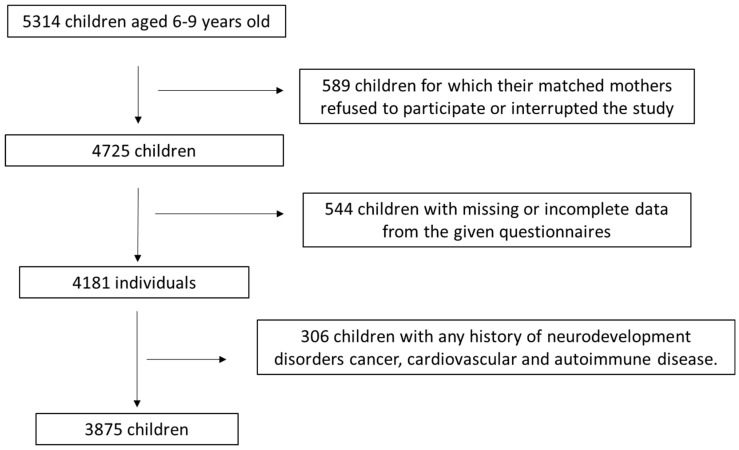
This is a cross-sectional survey on 3875 children aged 6-9 years old with their matched mothers. Qualified questionnaires were used to evaluate and collect by one-to-one interviews with trained professionals the above data.
Elevated MD adherence was observed only in 22.2% of the enrolled children, while 37.5% of children maintained intermediate MD adherence and 40.3% of children adopted lower MD levels. Children MD compliance was related at an independent manner with maternal education level, childhood anthropometric factors such as Body Mass Index (BMI), Waist circumference to Height ratio (WtHR), quality of life, and exclusively breastfeeding behaviors after adjusting for several possible confounders ( ˂ 0.05).
Elevated MD adherence of children aged 6-9 years old showed a lower obesity of overweight/obesity, including abdominal obesity. A higher maternal educational status and adopting exclusively breastfeeding practices were associated with greater levels of children's MD adherence, promoting their quality of life and well-being. Based on the present results, future prospective surveys need to be performed to evaluate if there is a causality relation concerning this topic.
地中海饮食(MD)是一种常被研究的饮食模式。它包含大量具有强大抗氧化、抗炎、抗血栓形成和抗癌特性的生物活性成分。多项重要研究提供了有力证据,表明地中海饮食可对人类发病率和死亡率发挥预防作用,促进人类健康和生活质量。本研究旨在评估6至9岁儿童对地中海饮食的依从性是否可能与社会人口统计学、人体测量学和生活方式因素相关。
这是一项针对3875名6至9岁儿童及其配对母亲的横断面调查。通过由经过培训的专业人员进行一对一访谈,使用合格问卷来评估和收集上述数据。
在纳入的儿童中,仅22.2%的儿童对地中海饮食的依从性较高,而37.5%的儿童保持中等程度的依从性,40.3%的儿童采用较低的地中海饮食水平。在调整了多个可能的混杂因素后(<0.05),儿童对地中海饮食的依从性与母亲教育水平、儿童人体测量学因素如体重指数(BMI)、腰围身高比(WtHR)、生活质量以及纯母乳喂养行为呈独立相关。
6至9岁儿童对地中海饮食的依从性较高表明超重/肥胖,包括腹型肥胖的发生率较低。母亲较高的教育水平和采用纯母乳喂养方式与儿童更高水平的地中海饮食依从性相关,促进了他们的生活质量和幸福感。基于目前的结果,未来需要进行前瞻性调查以评估关于该主题是否存在因果关系。