Zhang Wei, Zeng Weiming, Chen Hongyu, Liu Jie, Yan Hongjie, Zhang Kaile, Tao Ran, Siok Wai Ting, Wang Nizhuan
Lab of Digital Image and Intelligent Computation, College of Information Engineering, Shanghai Maritime University, Shanghai 201306, China.
Department of Neurology, Affiliated Lianyungang Hospital of Xuzhou Medical University, Lianyungang 222002, China.
Tomography. 2024 Nov 28;10(12):1895-1914. doi: 10.3390/tomography10120138.
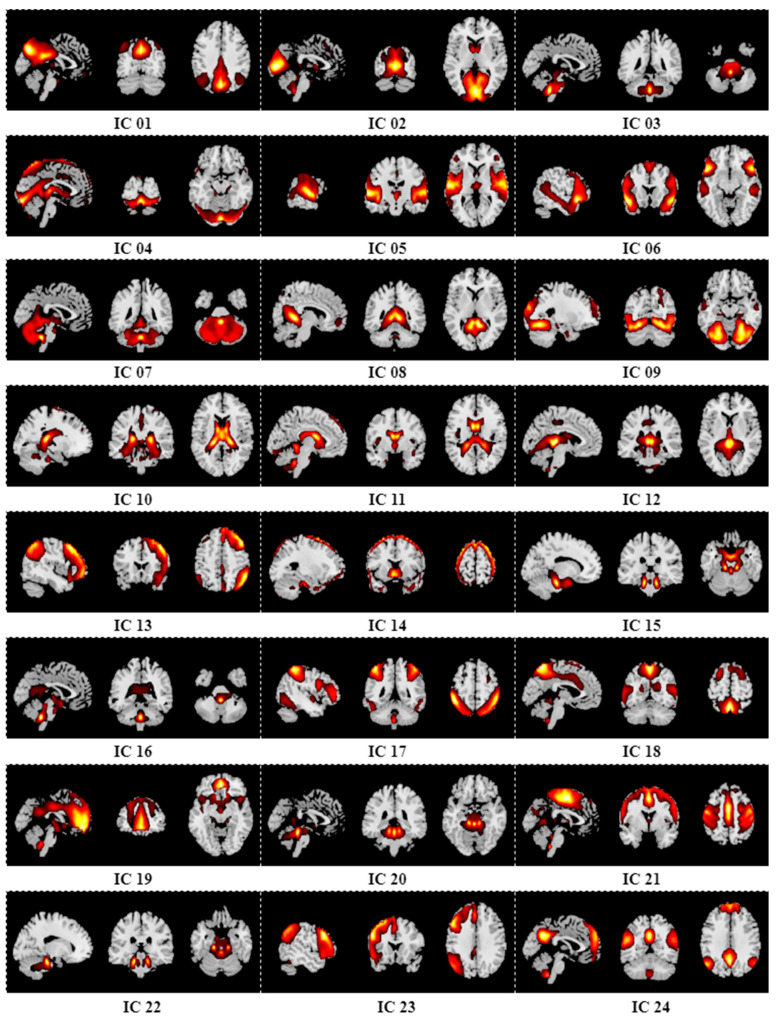
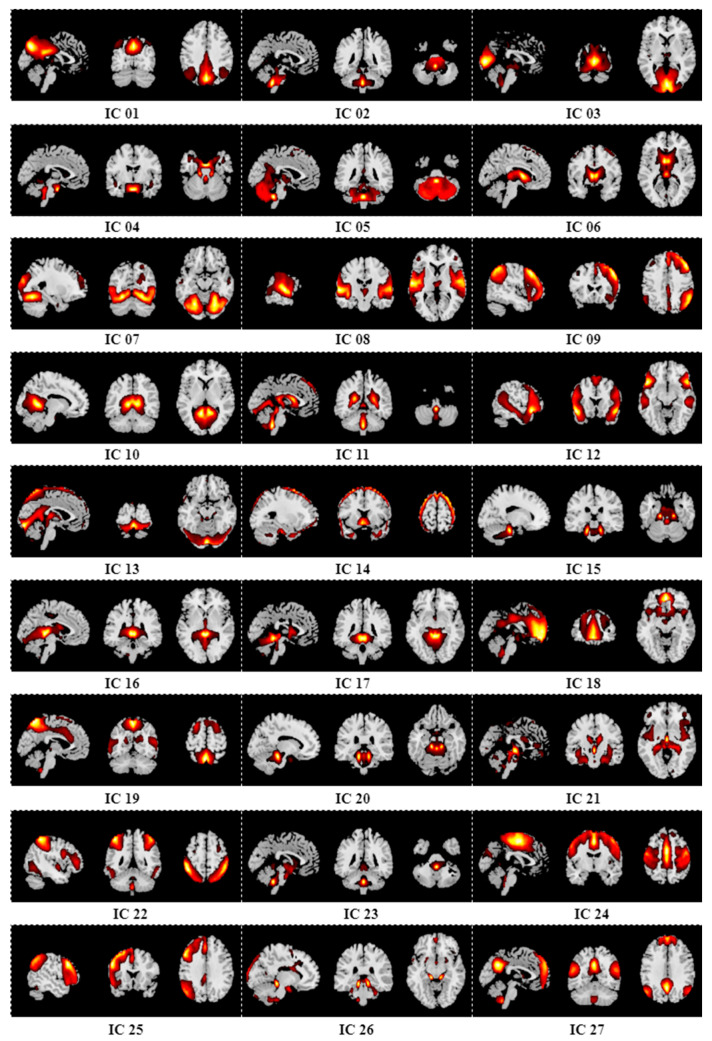
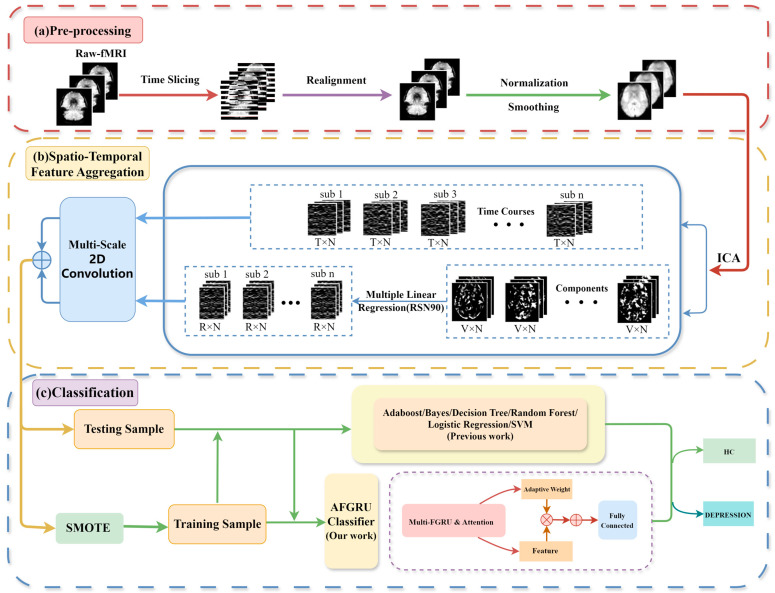
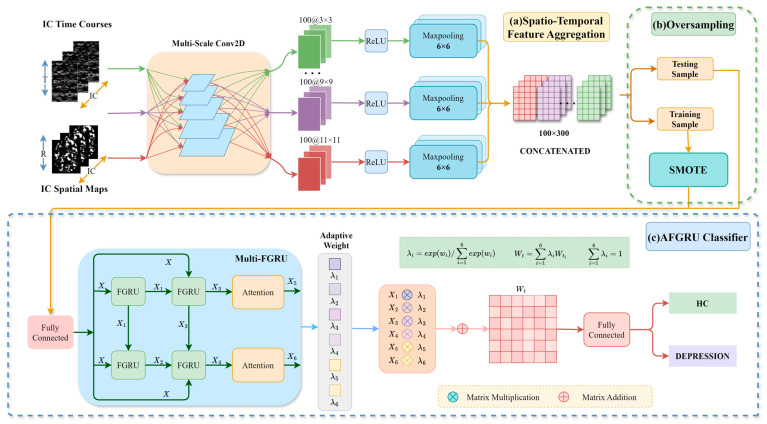
: Early diagnosis of depression is crucial for effective treatment and suicide prevention. Traditional methods rely on self-report questionnaires and clinical assessments, lacking objective biomarkers. Combining functional magnetic resonance imaging (fMRI) with artificial intelligence can enhance depression diagnosis using neuroimaging indicators, but depression-specific fMRI datasets are often small and imbalanced, posing challenges for classification models. : We propose the Spatio-Temporal Aggregation Network (STANet) for diagnosing depression by integrating convolutional neural networks (CNN) and recurrent neural networks (RNN) to capture both temporal and spatial features of brain activity. STANet comprises the following steps: (1) Aggregate spatio-temporal information via independent component analysis (ICA). (2) Utilize multi-scale deep convolution to capture detailed features. (3) Balance data using the synthetic minority over-sampling technique (SMOTE) to generate new samples for minority classes. (4) Employ the attention-Fourier gate recurrent unit (AFGRU) classifier to capture long-term dependencies, with an adaptive weight assignment mechanism to enhance model generalization. : STANet achieves superior depression diagnostic performance, with 82.38% accuracy and a 90.72% AUC. The Spatio-Temporal Feature Aggregation module enhances classification by capturing deeper features at multiple scales. The AFGRU classifier, with adaptive weights and a stacked Gated Recurrent Unit (GRU), attains higher accuracy and AUC. SMOTE outperforms other oversampling methods. Additionally, spatio-temporal aggregated features achieve better performance compared to using only temporal or spatial features. : STANet significantly outperforms traditional classifiers, deep learning classifiers, and functional connectivity-based classifiers. : The successful performance of STANet contributes to enhancing the diagnosis and treatment assessment of depression in clinical settings on imbalanced and small fMRI.
抑郁症的早期诊断对于有效治疗和预防自杀至关重要。传统方法依赖于自我报告问卷和临床评估,缺乏客观的生物标志物。将功能磁共振成像(fMRI)与人工智能相结合,可以利用神经影像指标增强抑郁症诊断,但特定于抑郁症的fMRI数据集通常较小且不均衡,这给分类模型带来了挑战。
我们提出了时空聚合网络(STANet),通过整合卷积神经网络(CNN)和循环神经网络(RNN)来捕获大脑活动的时空特征,以诊断抑郁症。STANet包括以下步骤:(1)通过独立成分分析(ICA)聚合时空信息。(2)利用多尺度深度卷积来捕获详细特征。(3)使用合成少数类过采样技术(SMOTE)平衡数据,为少数类生成新样本。(4)采用注意力-傅里叶门循环单元(AFGRU)分类器来捕获长期依赖性,并采用自适应权重分配机制来增强模型的泛化能力。
STANet实现了卓越的抑郁症诊断性能,准确率为82.38%,曲线下面积(AUC)为90.72%。时空特征聚合模块通过在多个尺度上捕获更深层次的特征来增强分类。具有自适应权重和堆叠门控循环单元(GRU)的AFGRU分类器获得了更高的准确率和AUC。SMOTE优于其他过采样方法。此外,与仅使用时间或空间特征相比,时空聚合特征具有更好的性能。
STANet显著优于传统分类器、深度学习分类器和基于功能连接的分类器。
STANet的成功表现有助于在临床环境中对不均衡且较小的fMRI数据进行抑郁症的诊断和治疗评估。