Zhao Bohao, Yu Yongqi, Sun Shaoning, Cai Jiawei, Bao Zhiyuan, Chen Yang, Wu Xinsheng
College of Animal Science and Technology, Yangzhou University, Yangzhou 225009, China.
Joint International Research Laboratory of Agriculture & Agri-Product Safety, Yangzhou University, Yangzhou 225009, China.
Vet Sci. 2024 Dec 13;11(12):651. doi: 10.3390/vetsci11120651.
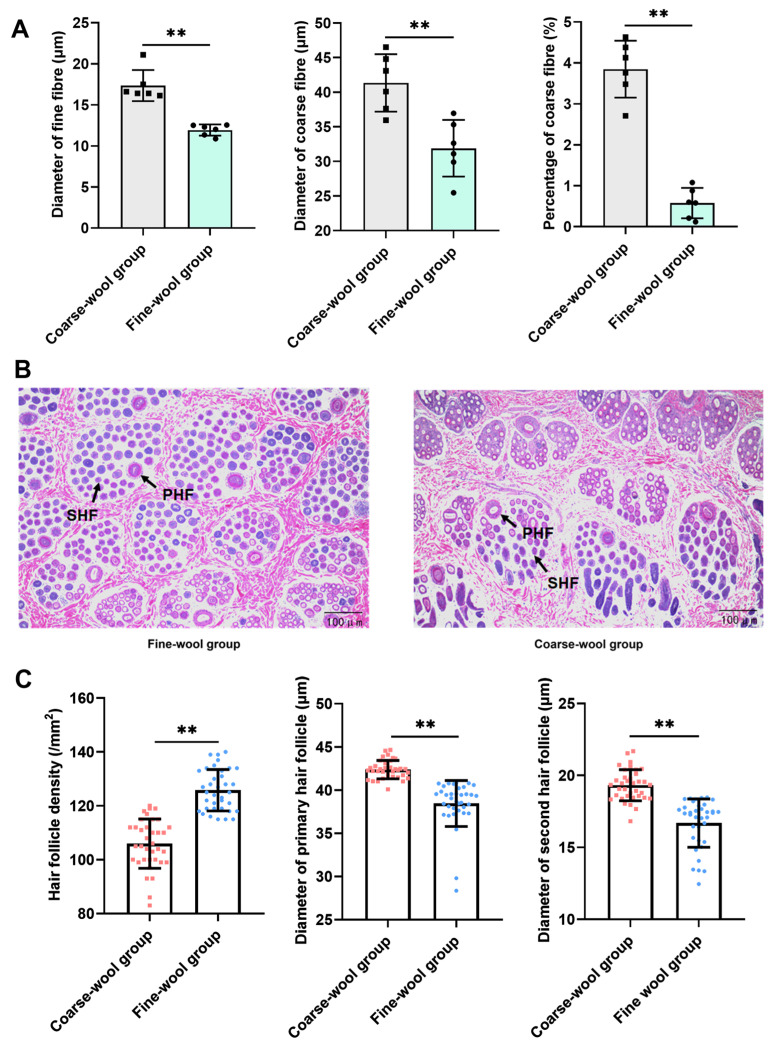
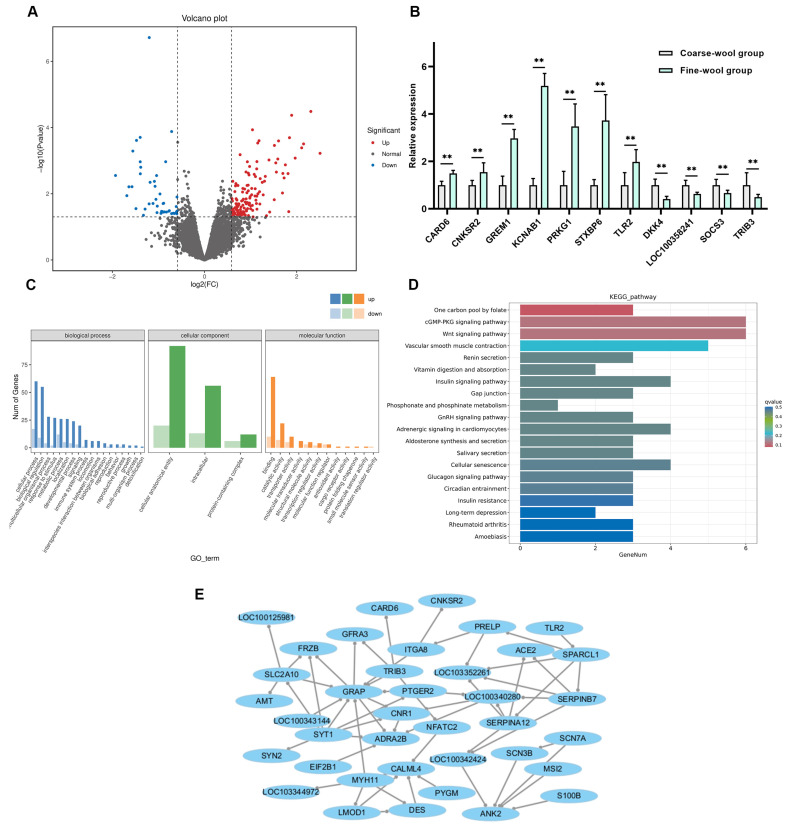
Wool quality is a crucial economic trait in Angora rabbits, closely linked to hair follicle (HF) growth and development. Therefore, understanding the molecular mechanisms of key genes regulating HF growth and wool fiber formation is essential. In the study, fine- and coarse-wool groups were identified based on HF morphological characteristics of Zhexi Angora rabbits. According to the results, the diameters of fine and coarse fibers, and the percentage of coarse fibers, were significantly lower in the fine-wool group than in the coarse-wool group. Additionally, the HF density was higher in the fine-wool group than in the coarse-wool group, and the diameters of both primary hair follicles and second hair follicles were finer in this fine-wool group. Moreover, RNA sequencing (RNA-seq) and whole-genome resequencing (WGRS) were performed to identify key candidate genes and potential genetic variations between fine- and coarse-wool groups. RNA-seq analysis revealed 182 differentially expressed genes (DEGs), with 138 upregulated and 44 downregulated genes in the fine-wool group. The WGRS analysis identified numerous genetic variants including 15,705 InDels and 83,055 SNPs between the two groups. Additionally, the joint analysis of RNA-seq and WGRS showed enrichment of the Wnt, JAK-STAT, and TGF-β signaling pathways. The key overlapping candidate genes such as , , , , , and were identified as potential crucial regulators of wool growth. In summary, this study provides valuable theoretical insights into wool quality and offers the potential for improving the molecular breeding of Angora rabbits.
羊毛品质是安哥拉兔的一个关键经济性状,与毛囊(HF)的生长发育密切相关。因此,了解调控毛囊生长和羊毛纤维形成的关键基因的分子机制至关重要。在本研究中,根据浙西长毛兔的毛囊形态特征确定了细毛组和粗毛组。结果显示,细毛组的细纤维直径、粗纤维直径及粗纤维百分比均显著低于粗毛组。此外,细毛组的毛囊密度高于粗毛组,且该细毛组的初级毛囊和次级毛囊直径均更细。此外,进行了RNA测序(RNA-seq)和全基因组重测序(WGRS),以鉴定细毛组和粗毛组之间的关键候选基因和潜在遗传变异。RNA-seq分析揭示了182个差异表达基因(DEG),其中细毛组有138个上调基因和44个下调基因。WGRS分析在两组之间鉴定出大量遗传变异,包括15,705个插入缺失和83,055个单核苷酸多态性(SNP)。此外,RNA-seq和WGRS的联合分析显示Wnt、JAK-STAT和TGF-β信号通路富集。确定了如 、 、 、 、 和 等关键重叠候选基因作为羊毛生长的潜在关键调节因子。总之,本研究为羊毛品质提供了有价值的理论见解,并为改进安哥拉兔的分子育种提供了潜力。