Kim Dong-Hwan, Lee Joonbum, Suh Yeunsu, Chen Paula R, Lee Kichoon
Department of Animal Sciences, The Ohio State University, Columbus, OH 43210, USA; Department of Animal Science, College of Natural Resources & Life Science, Pusan National University, Miryang 50463, South Korea.
Department of Animal Sciences, The Ohio State University, Columbus, OH 43210, USA.
Poult Sci. 2025 Feb;104(2):104720. doi: 10.1016/j.psj.2024.104720. Epub 2024 Dec 21.
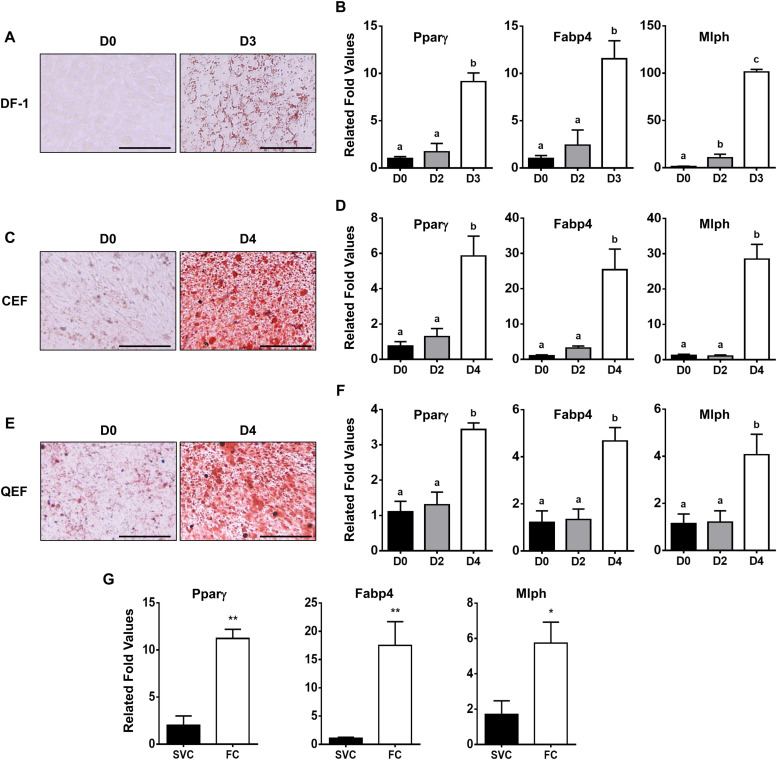
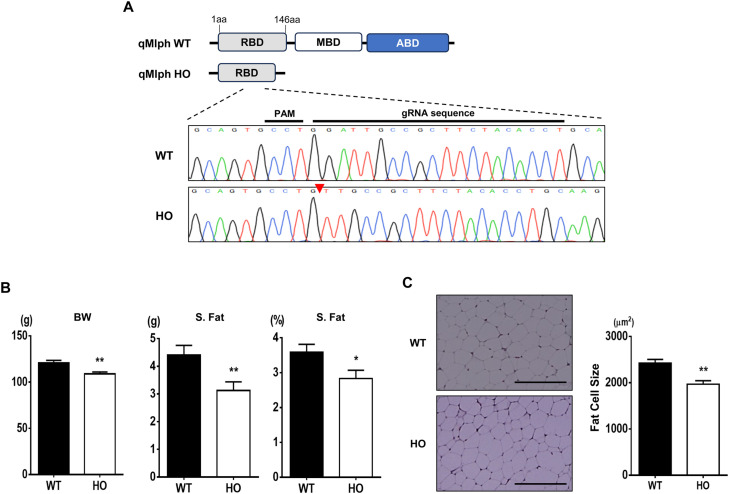
Advanced genetic and nutritional strategies aimed at modulating fat deposition can significantly reduce production costs and enhance profitability in the poultry industry. Melanophilin (MLPH) is recognized as a key gene regulating pigmentation as shown by diluted hair and feather coloration in MLPH mutant animals, including avian models. However, the effects of MLPH during fat accretion have not been studied yet. Therefore, the objectives of the current study are to measure the temporal expression of the MLPH gene during the adipocyte differentiation in vitro and in vivo and to investigate the effect of MLPH loss on fat accretion and adipocyte sizes in vivo using MLPH knockout quail model. The current in vitro studies reveal that MLPH gene expression levels were considerably elevated during adipogenesis in avian cells [101-fold in DF-1, 28.5-fold in chicken embryonic fibroblasts (CEF) and 4-fold in quail embryonic fibroblasts (QEF), compared to the undifferentiated cells of each cell type, p < 0.05]. In addition, fractionated fat cells (FC) showed increased expression levels of MLPH (5.7-fold, p < 0.05) compared to stromal-vascular cells (SVC). Using the MLPH knockout quail, disruption of the MLPH gene resulted in significantly reduced body weight (BW) and subcutaneous fat (S. Fat) pad weights compared to the wild type (WT) (p < 0.05). Further analysis through sectioning and staining of the fat tissues revealed that the mutation in Rab binding domain (RBD) of quail MLPH resulted in decreased fat cell sizes (p < 0.01). Overall, our data clearly demonstrated that MLPH can be a potential adipogenic marker gene, and MLPH may be associated with fat accretion in the gene edited quail model, highlighting the important role of MLPH in adipogenesis.
旨在调节脂肪沉积的先进遗传和营养策略可显著降低家禽业的生产成本并提高盈利能力。黑色素亲和蛋白(MLPH)被认为是调节色素沉着的关键基因,这在包括禽类模型在内的MLPH突变动物毛发和羽毛颜色变浅中得到体现。然而,MLPH在脂肪积累过程中的作用尚未得到研究。因此,本研究目的是测定体外和体内脂肪细胞分化过程中MLPH基因的时序表达,并使用MLPH基因敲除鹌鹑模型研究MLPH缺失对体内脂肪积累和脂肪细胞大小的影响。目前体外研究表明,与每种细胞类型的未分化细胞相比,禽类细胞脂肪生成过程中MLPH基因表达水平显著升高(DF-1中升高101倍,鸡胚成纤维细胞(CEF)中升高28.5倍;鹌鹑胚成纤维细胞(QEF)中升高4倍,p<0.05)。此外,与基质血管细胞(SVC)相比,分离的脂肪细胞(FC)中MLPH表达水平升高(5.7倍;p<0.05)。使用MLPH基因敲除鹌鹑时,与野生型(WT)相比MLPH基因破坏导致体重(BW)和皮下脂肪(S. Fat)垫重量显著降低(p<0.05)。通过对脂肪组织切片和染色的进一步分析显示鹌鹑MLPH的Rab结合域(RBD)突变导致脂肪细胞大小减小(p<0.01)。总体而言,我们的数据清楚表明MLPH可能是潜在的脂肪生成标记基因,并且在基因编辑鹌鹑模型中MLPH可能与脂肪积累有关,突出了MLPH在脂肪生成中的重要作用。