Beltrão Mayara Guimarães, Gonçalves Camila Francisco, Brancalion Pedro H S, Carmignotto Ana Paula, Silveira Luis Fábio, Galetti Pedro Manoel, Galetti Mauro
Museu de Zoologia da Universidade de São Paulo, São Paulo, SP, Brazil.
Programa de Pós-Graduação em Ecologia e Recursos Naturais, Universidade Federal de São Carlos, São Carlos, SP, Brazil.
Sci Rep. 2024 Dec 28;14(1):30837. doi: 10.1038/s41598-024-81483-y.
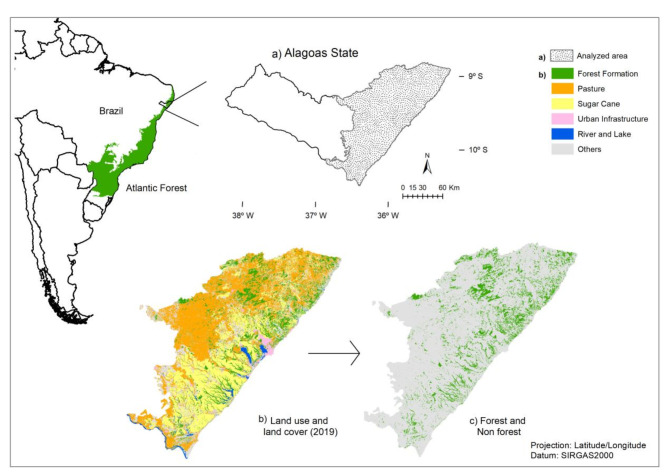
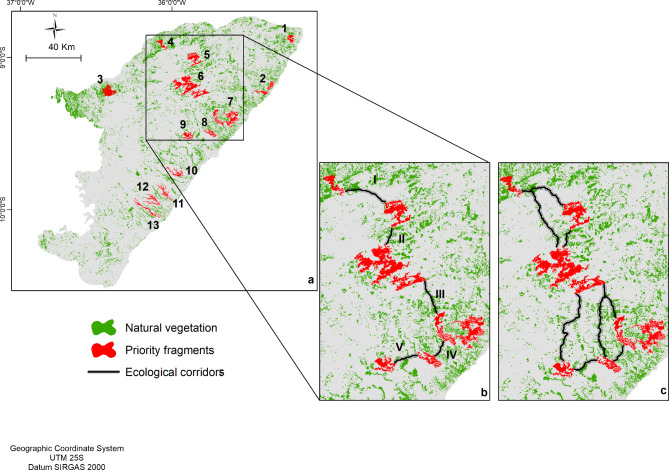
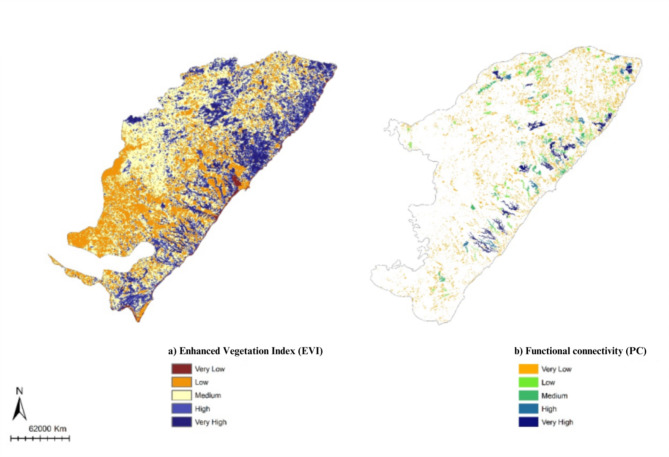
Ecological Corridors (ECs) are proposed as cost-effective solutions to improve ecological connectivity in fragmented landscapes. Planning the implementation of ECs must take into account landscape features as they affect the viability of the endeavor and the ECs associated costs. A novel set of geoprocessing tools were used to assess (i) economic viability; (ii) socioeconomic cost-effectiveness; and (iii) to determine priority targets for ECs establishment in a highly fragmented region of Atlantic Forest. Landscape features (e.g. size, edge density, number of patches), land use and cover, and Enhanced Vegetation Index data were obtained from remote sensing. Composition and configuration landscape metrics were estimated by geostatistical methods. Study area was represented by 35,344 forest fragments, of which 94% were composed of fragments smaller than 10 hectares in size, leading to a landscape characterized by low connectivity. We identified 13 priority fragments for protection and propose five ecological corridors. These five ECs connect six priority fragments, with a total of 283.93 ha of area to restore, on an estimated cost of nearly US$550.000,00. Conserving the biodiversity of one of the most threatened and fragmented tropical rainforest regions could be promoted at modest costs, through the protection of key fragments and their reconnection in the landscape.
生态廊道(ECs)被认为是在破碎化景观中提高生态连通性的经济有效解决方案。规划生态廊道的实施必须考虑景观特征,因为它们会影响该项目的可行性以及生态廊道的相关成本。一套新颖的地理处理工具被用于评估:(i)经济可行性;(ii)社会经济成本效益;以及(iii)确定在大西洋森林高度破碎化地区建立生态廊道的优先目标。景观特征(如面积、边缘密度、斑块数量)、土地利用和覆盖以及增强植被指数数据均通过遥感获得。通过地理统计方法估算景观组成和配置指标。研究区域由35344个森林斑块组成,其中94%由面积小于10公顷的斑块构成,导致该景观的连通性较低。我们确定了13个优先保护斑块,并提出了五条生态廊道。这五条生态廊道连接了六个优先斑块,总共需要恢复283.93公顷的面积,估计成本近55万美元。通过保护关键斑块并在景观中重新连接它们,可以以适度的成本促进保护这一最受威胁且破碎化的热带雨林地区之一的生物多样性。