Liu Yuning, Marciano Laura
Department of Global Health and Population, Harvard T.H. Chan School of Public Health, Boston, MA, USA.
Lee Kum Sheung Center for Health and Happiness, Department of Social and Behavioral Sciences, Harvard T.H. Chan School of Public Health, Boston, MA, USA.
Sci Rep. 2024 Dec 28;14(1):30836. doi: 10.1038/s41598-024-81665-8.
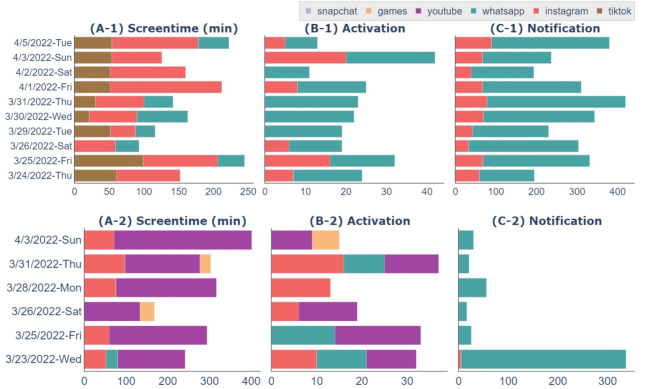
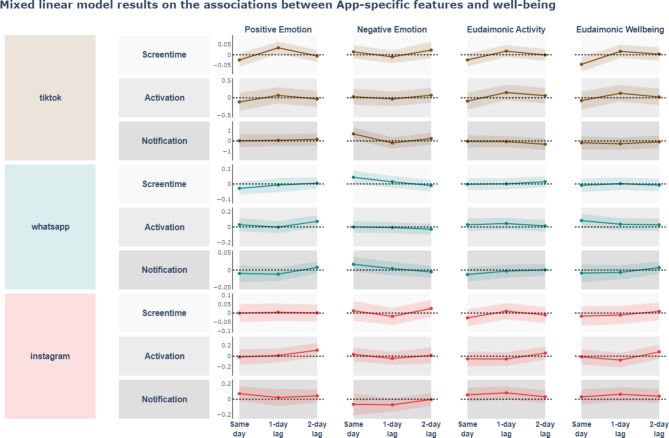
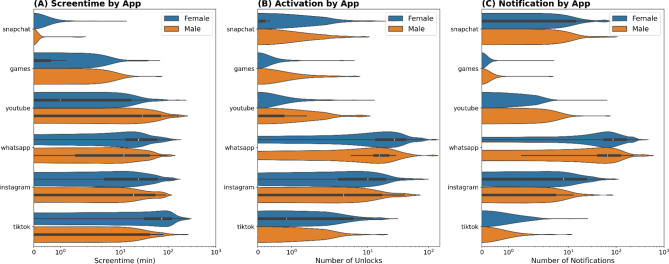
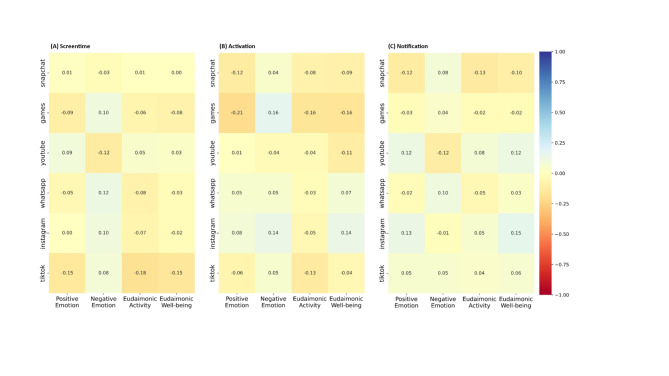
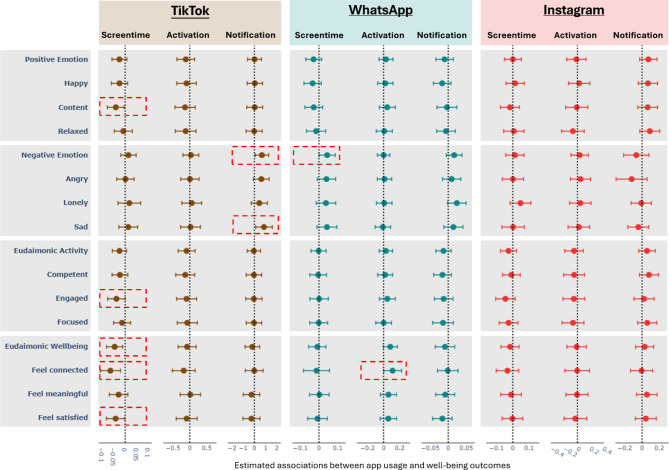
The debate on how social media use (SMU) influences adolescent well-being is mostly based on self-reports of SMU. By collecting data and screenshots donated from 374 Swiss adolescents (Meanage = 15.71; SDage = 0.82) over 2 weeks, we created "Appnomes"-app-specific usage metrics on screentime, number of activations, and number of notifications per participant per day derived, and associated them with daily hedonic and eudaimonic well-being. Longer TikTok time predicted lower eudaimonic well-being (β = - 0.08) daily but higher positive emotions (β = 0.06) the next day; longer use of WhatsApp predicted negative emotions (β = 0.06) while more screen activations for WhatsApp predicted greater feelings of connection (β = 0.08). Instagram notification was positively related to increased feeling of focused (β = 0.06) the next day. YouTube screen unlocks predicted more feeling of meaning (β = 0.07) the next day. More Snapchat screentime predicted less relaxed, less competent, and less positive emotions (with - 0.07 < β < - 0.06). Results pointed towards minimal or no effects, challenging the moral panic on the detrimental impact of SMU on teen well-being.
关于社交媒体使用(SMU)如何影响青少年幸福感的辩论大多基于对SMU的自我报告。通过收集374名瑞士青少年(平均年龄=15.71;标准差年龄=0.82)在两周内捐赠的数据和截图,我们创建了“应用名称”——关于屏幕使用时间、激活次数和每位参与者每天通知次数的特定应用使用指标,并将它们与日常享乐幸福感和实现幸福感相关联。TikTok使用时间越长,预测每日的实现幸福感越低(β=-0.08),但第二天的积极情绪越高(β=0.06);使用WhatsApp的时间越长,预测消极情绪越高(β=0.06),而WhatsApp的屏幕激活次数越多,预测联系感越强(β=0.08)。Instagram通知与第二天注意力增强的感觉呈正相关(β=0.06)。YouTube屏幕解锁次数预测第二天更有意义感(β=0.07)。更多的Snapchat屏幕使用时间预测更不放松、能力更弱和积极情绪更少(-0.07<β<-0.06)。结果表明影响极小或没有影响,对关于SMU对青少年幸福感有不利影响的道德恐慌提出了挑战。