Zhang Tingyu, Si Huili, Liao Jiali, Ma Rulin
Department of Public Health, School of Medicine, Shihezi University, Shihezi, Xinjiang, China.
Key Laboratory for Prevention and Control of Emerging Infectious Diseases and Public Health Security, The Xinjiang Production and Construction Corps. Shihezi University, Shihezi, Xinjiang, China.
Sci Rep. 2024 Dec 28;14(1):30911. doi: 10.1038/s41598-024-81895-w.
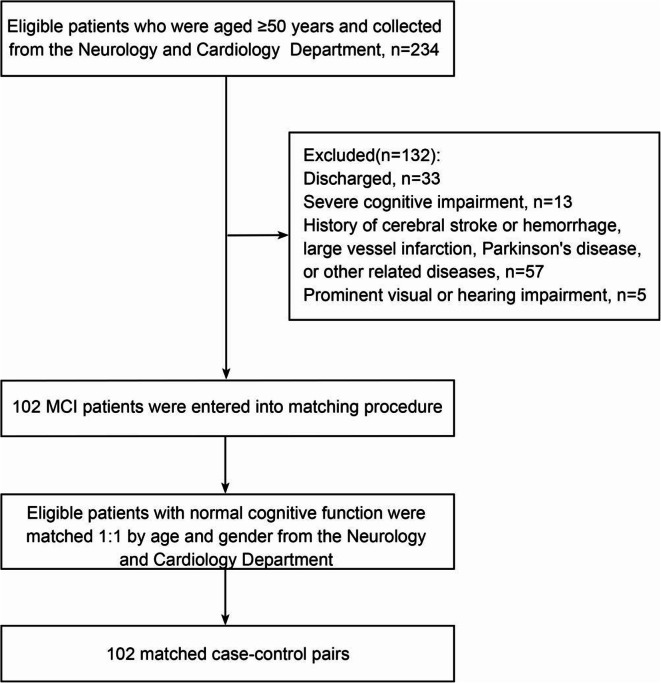
The prevalence of Alzheimer's disease (AD) is on the rise globally, and everyone who develops AD eventually experiences mild cognitive impairment (MCI) first. Timely intervention at an early stage of the disease may mitigate disease progression. Recent studies indicate that BDNF and MMP-9 play a significant role in the pathogenesis of AD. Therefore, this study aims to ascertain whether there are differences in plasma BDNF and MMP-9 levels between individuals with mild cognitive impairment due to AD and those with normal cognition, and to analyze the factors influencing mild cognitive impairment.This case-control study included 102 individuals with mild cognitive impairment and 102 controls, matched by age and sex. Participants completed a series of questionnaires, neuropsychological assessments, and clinical examinations. Plasma concentrations of BDNF and MMP-9 of the participants were quantified using ELISA. Subsequently, the factors influencing MCI were analyzed using univariate and multivariate logistic regression. The differences in plasma BDNF levels, MOCA total scores, and scores in various cognitive domains (including visuospatial and executive abilities, abstract thinking, attention, language, naming, and delayed memory) between the MCI and the control groups showed statistically significant (p < 0.05). Logistic regression analysis revealed that plasma BDNF levels and years of formal education were significantly negatively associated with MCI. This study indicates that plasma BDNF and years of formal education are protective factors influencing cognitive function.
阿尔茨海默病(AD)在全球的患病率正在上升,每个患AD的人最终都会先经历轻度认知障碍(MCI)。在疾病早期进行及时干预可能会减缓疾病进展。最近的研究表明,脑源性神经营养因子(BDNF)和基质金属蛋白酶-9(MMP-9)在AD的发病机制中起重要作用。因此,本研究旨在确定AD所致轻度认知障碍患者与认知正常者之间血浆BDNF和MMP-9水平是否存在差异,并分析影响轻度认知障碍的因素。这项病例对照研究纳入了102例轻度认知障碍患者和102例对照者,按年龄和性别进行匹配。参与者完成了一系列问卷、神经心理学评估和临床检查。使用酶联免疫吸附测定法(ELISA)对参与者血浆中BDNF和MMP-9的浓度进行定量。随后,使用单因素和多因素逻辑回归分析影响MCI的因素。MCI组与对照组之间血浆BDNF水平、蒙特利尔认知评估量表(MOCA)总分以及各个认知领域(包括视觉空间和执行能力、抽象思维、注意力、语言、命名和延迟记忆)的得分差异具有统计学意义(p < 0.05)。逻辑回归分析显示,血浆BDNF水平和正规教育年限与MCI显著负相关。本研究表明,血浆BDNF和正规教育年限是影响认知功能的保护因素。