Hovhannisyan Mariam, Raffaelli Quentin, Chau Nadine, Andrews-Hanna Jessica R, Grilli Matthew D
Department of Psychology, University of Arizona, 1503 E University Blvd, Tucson, AZ, 85721, USA.
Cognitive Science, University of Arizona, Tucson, AZ, USA.
Sci Rep. 2024 Dec 27;14(1):30642. doi: 10.1038/s41598-024-82493-6.
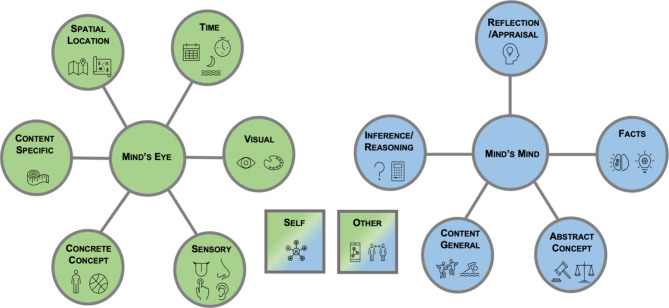
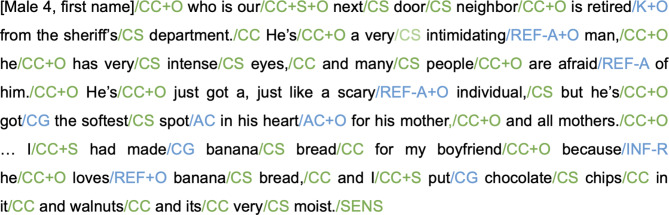
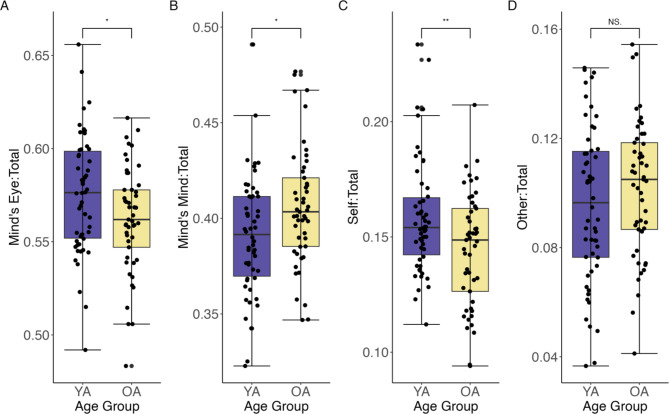
Human imagination has garnered growing interest in many fields. However, it remains unclear how to characterize different forms of imaginative thinking and how imagination differs between young and older adults. Here, we introduce a novel scoring protocol based on recent theoretical developments in the cognitive neuroscience of imagination to provide a broad tool with which to characterize imaginative thinking. The scoring protocol distinguishes between concrete/perceptual forms of imagination termed the "mind's eye" and abstract/reflective forms of imagination termed the "mind's mind." The protocol also captures whether thoughts pertain to the self, others, or both. We applied this scoring protocol with high inter-rater reliability across two studies involving distinct participants and narrative-based imagination tasks. When compared to young adults, older adults showed a bias toward general content, which is a feature of the mind's mind form of thinking while describing aloud their memories of specific, past events (Study 1). Further, older adults made fewer references to the self. In a separate study of only older adults (Study 2), increasing age was not associated with a bias toward the mind's mind while describing specific past or future events. These results reveal that imaginative thinking can be characterized within the Mind's Eye Mind's Mind framework, with implications for understanding cognitively normal older age.
人类的想象力在许多领域都引起了越来越多的关注。然而,目前尚不清楚如何描述不同形式的想象思维,以及年轻人和老年人的想象力有何不同。在此,我们基于想象认知神经科学的最新理论发展,引入了一种新颖的评分方案,以提供一个广泛的工具来描述想象思维。该评分方案区分了被称为“心灵之眼”的具体/感知形式的想象和被称为“心灵之脑”的抽象/反思形式的想象。该方案还能捕捉到思维是与自我、他人还是两者都相关。我们在两项涉及不同参与者和基于叙事的想象任务的研究中应用了这一评分方案,评分者间信度很高。与年轻人相比,老年人在大声描述他们对特定过去事件的记忆时,表现出对一般内容的偏好,这是“心灵之脑”思维形式的一个特征(研究1)。此外,老年人较少提及自我。在另一项仅针对老年人的研究(研究2)中,在描述特定的过去或未来事件时,年龄增长与对“心灵之脑”的偏好并无关联。这些结果表明,想象思维可以在“心灵之眼-心灵之脑”框架内进行描述,这对理解认知正常的老年阶段具有启示意义。