Calatrava Victoria, Gonzalez-Ballester David, Dubini Alexandra
Departamento de Bioquímica y Biología Molecular, Universidad de Córdoba, Campus Universitario de Rabanales, Ed. C6, Planta Baja, Córdoba, 14071, Spain.
BMC Plant Biol. 2024 Dec 27;24(1):1261. doi: 10.1186/s12870-024-05995-5.
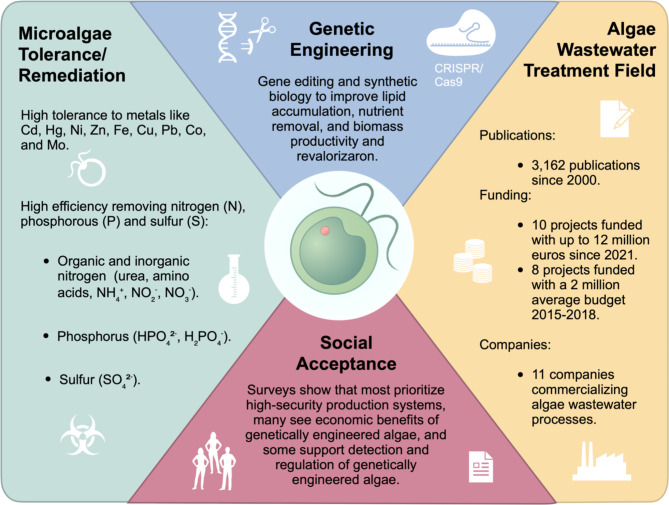
The increase in the global population and industrial activities has led to an extensive use of water, the release of wastewater, and overall contamination of the environment. To address these issues, efficient treatment methods have been developed to decrease wastewater nutrient content and contaminants. Microalgae are a promising tool as a sustainable alternative to traditional wastewater treatment. Furthermore, the biomass obtained from the wastewater treatment can be used in different applications, having a positive economic impact. This review describes the potential of microalgae as a biological wastewater remediation tool, including the use of genetically engineered strains. Their current industrial utilization and their untapped commercial potential in terms of bioremediation are also examined. Finally, this work discusses how microalgal biotechnology is perceived by the public and governments, analyses the potential risks of microalgae to the environment, and examines standard procedures that can be implemented for the safe biocontainment of large-scale microalgae cultures.
全球人口增长和工业活动增加导致水资源的广泛使用、废水排放以及环境的整体污染。为解决这些问题,已开发出高效处理方法以降低废水营养成分和污染物含量。微藻作为传统废水处理的可持续替代方案,是一种很有前景的工具。此外,从废水处理中获得的生物质可用于不同应用,具有积极的经济影响。本综述描述了微藻作为生物废水修复工具的潜力,包括基因工程菌株的使用。还研究了它们目前的工业利用情况以及在生物修复方面尚未开发的商业潜力。最后,这项工作讨论了公众和政府对微藻生物技术的看法,分析了微藻对环境的潜在风险,并研究了可用于大规模微藻培养安全生物防护的标准程序。