Viermyr Hans-Kittil, Tonby Kristian, Ponzi Erica, Trouillet-Assant Sophie, Poissy Julien, Arribas José R, Dyon-Tafani Virginie, Bouscambert-Duchamp Maude, Assoumou Lambert, Halvorsen Bente, Tekin Nuriye Basdag, Diallo Alpha, De Gastines Lucie, Munthe Ludvig A, Murphy Sarah Louise, Ueland Thor, Michelsen Annika E, Lund-Johansen Fridtjof, Aukrust Pål, Mootien Joy, Dervieux Benjamin, Zerbib Yoann, Richard Jean-Christophe, Prével Renaud, Malvy Denis, Timsit Jean-François, Peiffer-Smadja Nathan, Roux Damien, Piroth Lionel, Ait-Oufella Hafid, Vieira Cesar, Dalgard Olav, Heggelund Lars, Müller Karl Erik, Møller Jannicke Horjen, Kildal Anders Benjamin, Skogen Vegard, Aballi Saad, Sjøberg Øgaard Jonas Daniel, Dyrhol-Riise Anne Ma, Tveita Anders, Alirezaylavasani Amin, Costagliola Dominique, Yazdanpanah Yazdan, Olsen Inge Christoffer, Dahl Tuva Børresdatter, Kared Hassen, Holten Aleksander Rygh, Trøseid Marius
Research Institute of Internal Medicine, Oslo University Hospital Rikshospitalet, Oslo, Norway; Faculty of Medicine, Institute of Clinical Medicine, University of Oslo, Oslo, Norway; Section for Clinical Immunology and Infectious Diseases, Oslo University Hospital Rikshospitalet, Oslo, Norway.
Faculty of Medicine, Institute of Clinical Medicine, University of Oslo, Oslo, Norway; Department of Infectious Diseases, Oslo University Hospital Ullevål, Oslo, Norway.
EBioMedicine. 2025 Jan;111:105511. doi: 10.1016/j.ebiom.2024.105511. Epub 2024 Dec 27.
The Bari-SolidAct randomized controlled trial compared baricitinib with placebo in patients with severe COVID-19. A post hoc analysis revealed a higher incidence of serious adverse events (SAEs) among SARS-CoV-2-vaccinated participants who had received baricitinib. This sub-study aimed to investigate whether vaccination influences the safety profile of baricitinib in patients with severe COVID-19.
Biobanked samples from 146 participants (55 vaccinated vs. 91 unvaccinated) were analysed longitudinally for inflammation markers, humoral responses, tissue viral loads, and plasma viral antigens on days 1, 3, and 8. High-dimensional analyses, including RNA sequencing and flow cytometry, were performed on available samples. Mediation analyses were used to assess relationships between SAEs, baseline-adjusted biomarkers, and treatment-vaccination status.
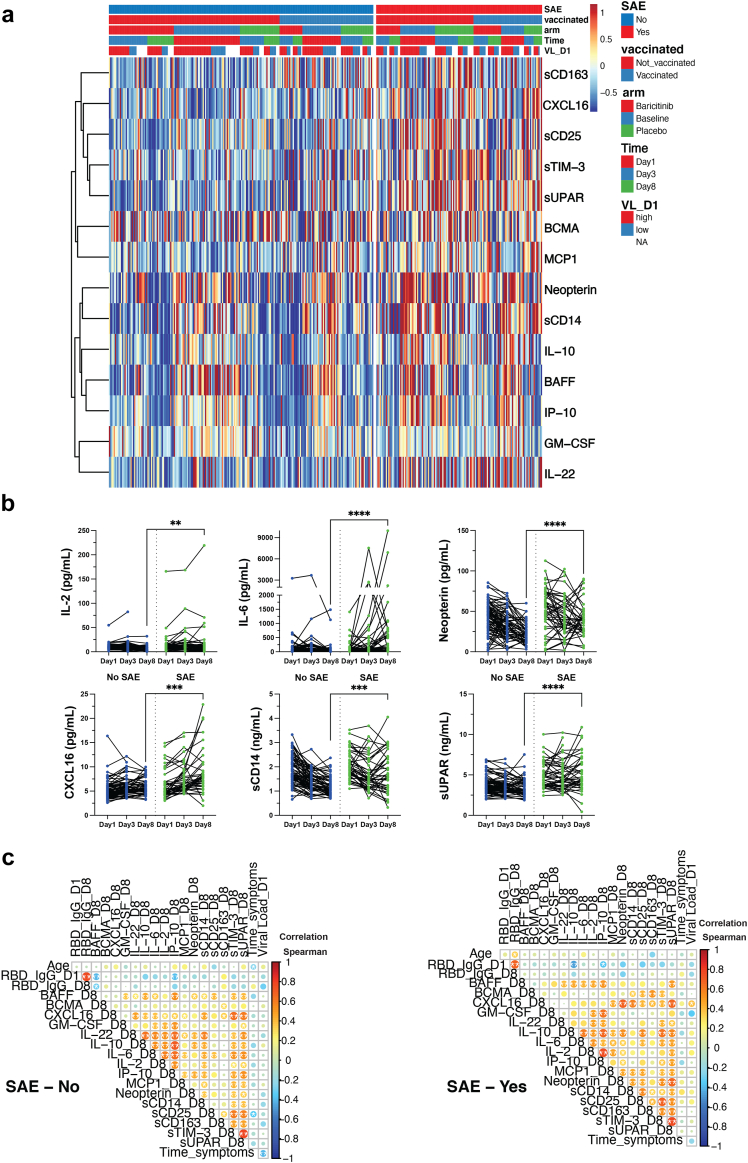
Vaccinated participants were older, more frequently hospitalized, had more comorbidities, and exhibited higher nasopharyngeal viral loads. Baricitinib treatment did not affect antibody responses or viral clearance, but reduced markers of T-cell and monocyte activation compared to placebo (sCD25, sCD14, sCD163, sTIM-3). Age, baseline levels of plasma viral antigen, and several inflammatory markers, as well as IL-2, IL-6, Neopterin, CXCL16, sCD14, and suPAR on day 8 were associated with the occurrence of SAEs. However, mediation analyses of markers linked to SAEs, baricitinib treatment, or vaccination status did not reveal statistically significant interactions between vaccination status and SAEs.
This sub-study did not identify any virus- or host-related biomarkers significantly associated with the interaction between SARS-CoV-2 vaccination status and the safety of baricitinib. However, caution should be exercised due to the moderate sample size.
EU Horizon 2020 (grant number 101015736).
Bari-SolidAct随机对照试验比较了巴瑞替尼与安慰剂在重症新型冠状病毒肺炎患者中的疗效。一项事后分析显示,在接种过严重急性呼吸综合征冠状病毒2(SARS-CoV-2)疫苗且接受巴瑞替尼治疗的参与者中,严重不良事件(SAE)的发生率更高。这项子研究旨在调查接种疫苗是否会影响巴瑞替尼在重症新型冠状病毒肺炎患者中的安全性。
对146名参与者(55名接种疫苗者与91名未接种疫苗者)的生物样本库样本进行纵向分析,在第1、3和8天检测炎症标志物、体液反应、组织病毒载量和血浆病毒抗原。对可用样本进行了包括RNA测序和流式细胞术在内的高维分析。采用中介分析来评估SAE、基线校正生物标志物与治疗-疫苗接种状态之间的关系。
接种疫苗的参与者年龄更大,住院频率更高,合并症更多,且鼻咽病毒载量更高。与安慰剂相比,巴瑞替尼治疗不影响抗体反应或病毒清除,但降低了T细胞和单核细胞活化标志物水平(可溶性白细胞介素-2受体α链[sCD25]、可溶性CD14[sCD14]、可溶性CD163[sCD163]、可溶性T细胞免疫球蛋白和粘蛋白结构域分子3[sTIM-3])。年龄、血浆病毒抗原基线水平、几种炎症标志物以及第8天的白细胞介素-2(IL-2)、白细胞介素-6(IL-6)、新蝶呤、CXC趋化因子配体16(CXCL16)、sCD14和可溶性尿激酶型纤溶酶原激活物受体(suPAR)与SAE的发生有关。然而,对与SAE、巴瑞替尼治疗或疫苗接种状态相关标志物的中介分析未发现疫苗接种状态与SAE之间存在具有统计学意义的相互作用。
这项子研究未发现任何与SARS-CoV-2疫苗接种状态和巴瑞替尼安全性之间的相互作用显著相关的病毒或宿主相关生物标志物。然而,由于样本量适中,应谨慎对待。
欧盟“地平线2020”计划(资助编号101015736)。