Jiang Ran, Yang Guang, Wang Huihui, Fang Junnan, Hu Jingyi, Zhang Tongwei, Kong Yue, Wu Zhaoting, Huang Xianju, Qi Lin, Song Ning, Song Wenyan, Jin Haixia, Yao Guidong
Reproductive Medical Center, Henan Province Key Laboratory of Reproduction and Genetics, The First Affiliated Hospital of Zhengzhou University, No. 1 East Jianshe Road, Erqi District, Zhengzhou, China.
BMC Pregnancy Childbirth. 2024 Dec 28;24(1):870. doi: 10.1186/s12884-024-07080-z.
Is it possible to predict blastocyst quality, embryo chromosomal ploidy, and clinical pregnancy outcome after single embryo transfer from embryo developmental morphokinetic parameters?
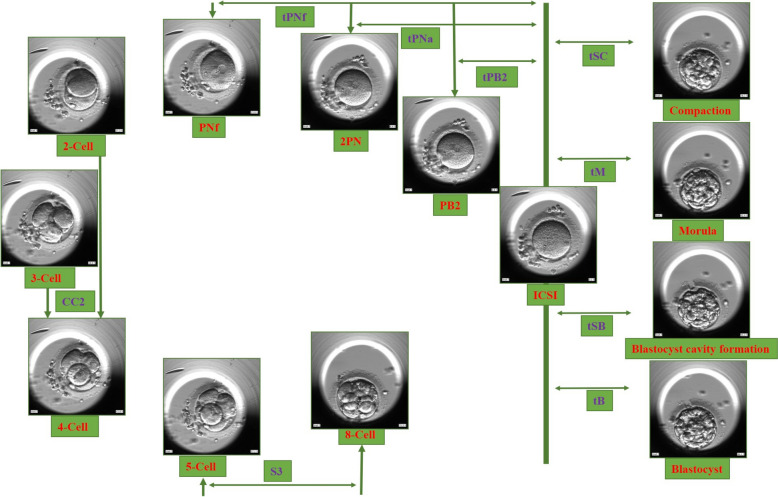
The morphokinetic parameters of 1011 blastocysts from 227 patients undergoing preimplantation genetic testing were examined. Correlations between the morphokinetic parameters and the quality of blastocysts, chromosomal ploidy, and clinical pregnancy outcomes following the transfer of single blastocysts were retrospectively analyzed.
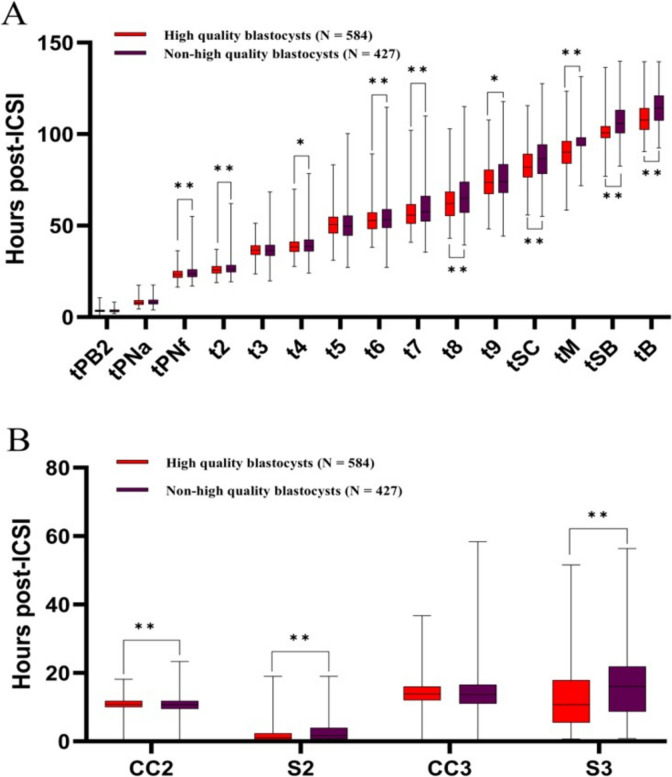
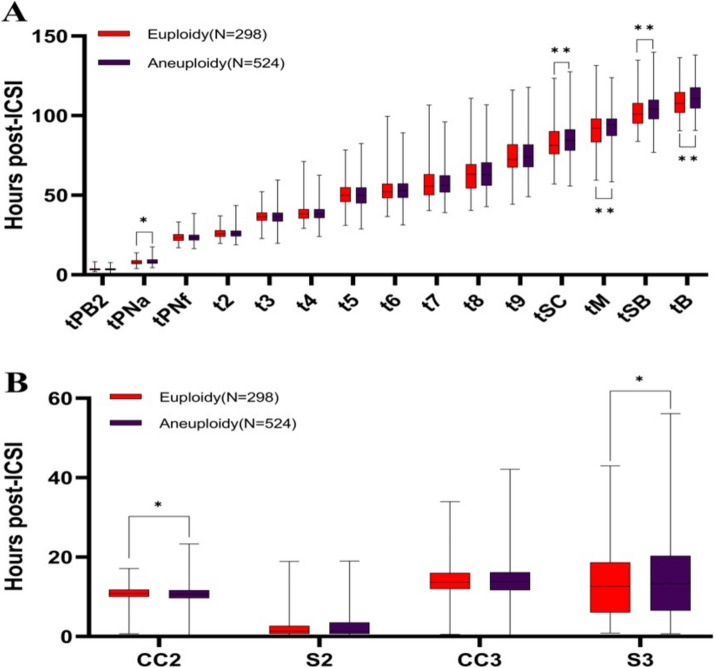
The morphokinetic parameters of embryos in the high-quality blastocyst group were significantly shorter than those in the low-quality blastocyst group (p < 0.05). In contrast, the CC2 time was significantly prolonged (p < 0.05). On chromosomal analysis of biopsy blastocysts nourished by trophectoderm cells, in comparison to euploid embryos, aneuploid embryos exhibited significant extensions in tPNa, S3, tSC, tM, tSB, and tB (p < 0.05), with a simultaneous significant reduction in CC2 time (p < 0.05). After adjusting for age and body mass index through logistic regression analysis, late morphokinetic parameters, namely tM (OR 0.96; 95% CI 0.93-0.99), tSB (OR 0.94; 95% CI 0.90-0.97), and tB (OR 0.93; 95% CI 0.90-0.97), emerged as independent risk factors influencing the development of embryos into high-quality blastocysts. S3 (< 12.01 h), t8 (< 62.48 h), and tPB2 (< 3.36 h) were potential predictors of a successful clinical pregnancy after blastocyst transfer.
Morphokinetic parameters showed correlations with blastocyst quality, chromosomal status, and clinical pregnancy outcomes post-transfer, making them effective predictors for clinical results. Embryos with relatively rapid development tended to exhibit better blastocyst quality, chromosomal ploidy, and improved clinical pregnancy outcomes. The late morphokinetic parameter, S3, demonstrated a strong predictive effect on blastocyst quality, chromosomal ploidy, and clinical pregnancy outcomes.
能否根据胚胎发育的形态动力学参数预测囊胚质量、胚胎染色体倍性以及单胚胎移植后的临床妊娠结局?
对227例行植入前基因检测患者的1011个囊胚的形态动力学参数进行了检查。回顾性分析了形态动力学参数与囊胚质量、染色体倍性以及单个囊胚移植后的临床妊娠结局之间的相关性。
高质量囊胚组胚胎的形态动力学参数明显短于低质量囊胚组(p < 0.05)。相比之下,CC2时间明显延长(p < 0.05)。对由滋养外胚层细胞滋养的活检囊胚进行染色体分析,与整倍体胚胎相比,非整倍体胚胎在tPNa、S3、tSC、tM、tSB和tB方面有显著延长(p < 0.05),同时CC2时间显著缩短(p < 0.05)。通过逻辑回归分析对年龄和体重指数进行校正后,晚期形态动力学参数,即tM(比值比0.96;95%置信区间0.93 - 0.99)、tSB(比值比0.94;95%置信区间0.90 - 0.97)和tB(比值比0.93;95%置信区间0.90 - 0.97)成为影响胚胎发育为高质量囊胚的独立危险因素。S3(< 12.01小时)、t8(< 62.48小时)和tPB2(< 3.36小时)是囊胚移植后临床妊娠成功的潜在预测指标。
形态动力学参数与囊胚质量、染色体状态以及移植后的临床妊娠结局相关,使其成为临床结果的有效预测指标。发育相对较快的胚胎往往表现出更好的囊胚质量、染色体倍性以及改善的临床妊娠结局。晚期形态动力学参数S3对囊胚质量、染色体倍性和临床妊娠结局显示出强大的预测作用。