Su Yu-Jie, Liu Wei, Xing Rui-Rui, Yu Zhang-Bin, Peng Yue-Ming, Luo Wei-Xiang
Department of Nursing, Shenzhen People's Hospital (The Second Clinical Medical College, Jinan University; The First Affiliated Hospital, Southern University of Science and Technology), Shenzhen, Guangdong, China.
Department of Neonatology, Shenzhen People's Hospital (The Second Clinical Medical College, Jinan University; The First Affiliated Hospital, Southern University of Science and Technology), Shenzhen, Guangdong, China.
BMC Pediatr. 2024 Dec 28;24(1):845. doi: 10.1186/s12887-024-05316-7.
Birth asphyxia is a critical condition caused by an insufficient oxygen supply during delivery, and it poses a major threat to the health of newborns. The present meta-analysis aimed to estimate the prevalence of birth asphyxia among neonates and identify its risk factors in China.
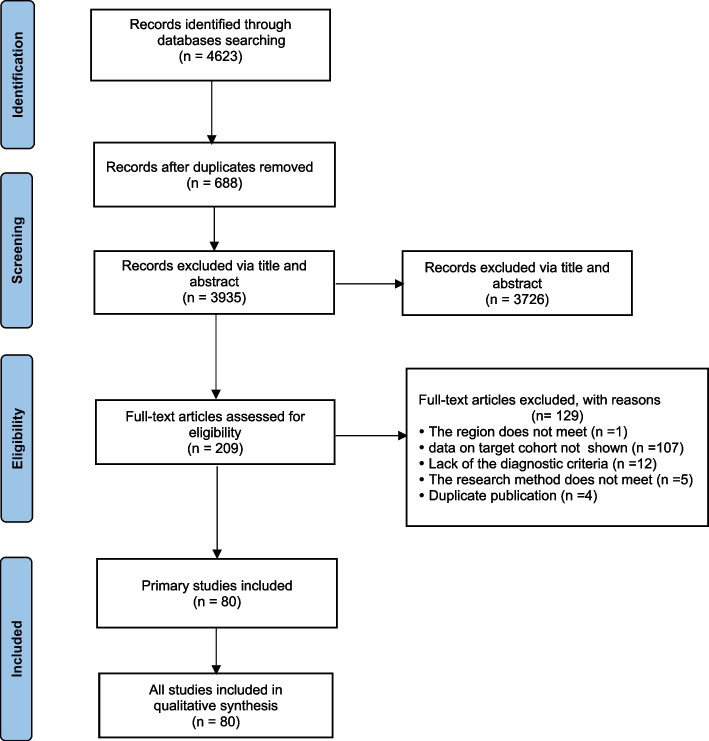
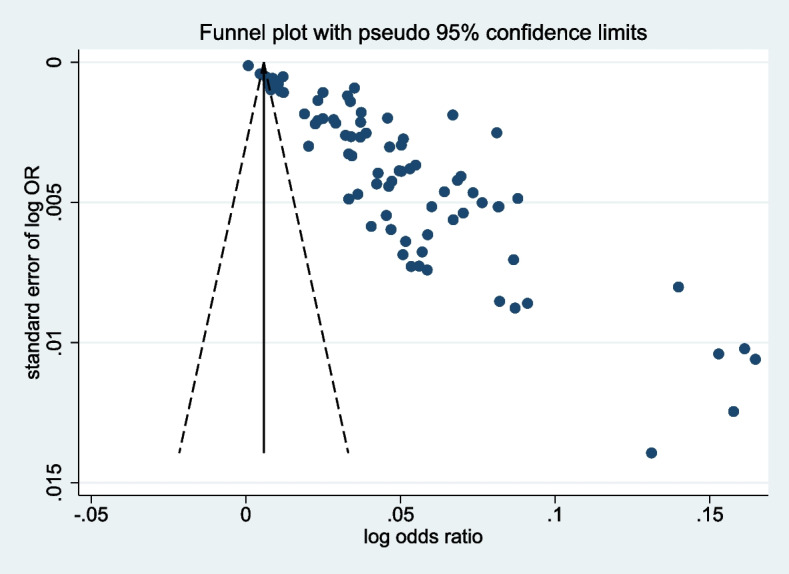
PubMed, EMBASE, Scopus, Web of Science, the China Academic Journals (CNKI), the Chinese Biomedical Literature (CBM), the China Science and Technology Journal Database (VIP), and the WanFang database were searched for related publications. Two researchers independently selected the literature, extracted the relevant data, and assessed its methodological quality. The meta-analysis applied a random-effects model with Stata 17.0 software to calculate the pooled prevalence of birth asphyxia among neonates delivered in China and to merge the odds ratios (ORs) of risk factors. Subgroup analysis was performed on the included studies. Publication bias was assessed by funnel plots and Egger's test.
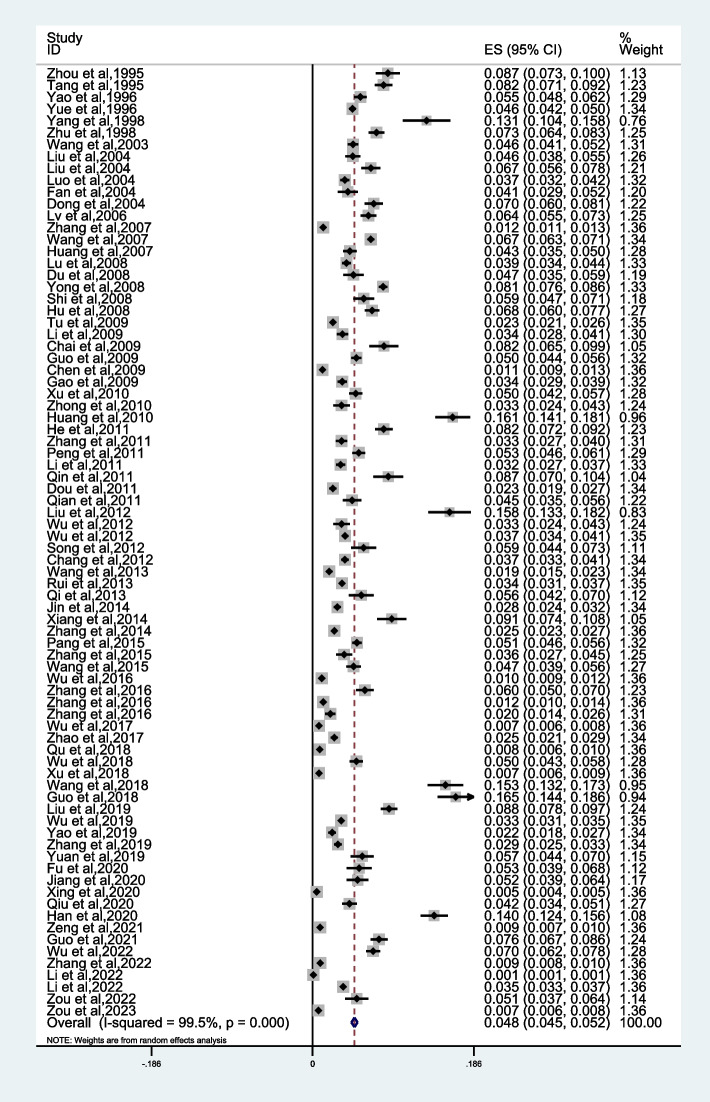
Eighty studies were eligible for inclusion. The overall prevalence of birth asphyxia in newborns was 4.8% (95% CI, 4.5%-5.2%). In the subgroup analyses, the northern area presented the highest prevalence (5.1%; 95% CI, 4.1%-6.3%), followed by the southern area (4.1%; 95% CI, 3.3%-5.1%). The rural setting presented the highest prevalence (6%; 95% CI, 4.6%-7.4%), followed by the urban (4.2%; 95% CI, 4.6%-7.4%) and mixed (5.8%; 95% CI, 5.3%-6.3%) settings. The Apgar score demonstrated the highest prevalence (4.6%; 95% CI, 3.8%-5.4%), followed by the Apgar score with the umbilical artery blood pH (3.7%; 95% CI, 2.2%-5.7%). A significant difference in prevalence was found between studies with sample sizes greater than 5,000 (2.2%; 95% CI, 1.6%-3%) and those with 5,000 or fewer participants (6.2%; 95% CI, 5.5%-7.1%). Furthermore, there was a significant decrease in the incidence of birth asphyxia from 1995-2016 (4.9%; 95% CI, 4.2%-5.9%) to 2017-2023 (3.7%; 95% CI, 2.6%-5%). Placental abruption (OR = 5; 95% CI, 3.08-8.13), placenta previa (OR = 2.57; 95% CI, 1.84-3.58), advanced maternal age (OR = 3.94; 95% CI, 1.46-10.62), primigravida (OR = 5.33; 95% CI, 0.41-68.71), premature birth (OR = 3.36; 95% CI, 2.61-4.32), intrauterine distress (OR = 4.48; 95% CI, 3.47-5.80), stained amniotic fluid (OR = 3.28; 95% CI, 2.25-4.79), macrosomia (OR = 6.30; 95% CI, 0.61-65.22), foetal malformation (OR = 7.44; 95% CI, 1.46-38.02), breech birth (OR = 2.42; 95% CI, 1.24-4.73), caesarean section (OR = 1.72; 95% CI, 0.91-3.24), assisted delivery (OR = 13.62; 95% CI, 5.50-33.73), prolonged second stage of labour (OR = 1.43; 95% CI, 0.68-3.01), and malpresentation (OR = 4.20; 95% CI, 2.21-7.99) were major risk factors.
The prevalence of birth asphyxia among newborns in China is relatively high. In addition, 14 risk factors are related to neonatal birth asphyxia. Urgent attention needs to be focused on regionalized maternal and child management to address this problem in China.
出生窒息是分娩期间氧气供应不足引起的一种危急状况,对新生儿健康构成重大威胁。本荟萃分析旨在估计中国新生儿出生窒息的患病率,并确定其危险因素。
检索PubMed、EMBASE、Scopus、Web of Science、中国学术期刊全文数据库(CNKI)、中国生物医学文献数据库(CBM)、维普中文科技期刊数据库(VIP)和万方数据库,查找相关出版物。两名研究人员独立筛选文献、提取相关数据并评估其方法学质量。荟萃分析使用Stata 17.0软件中的随机效应模型,计算在中国分娩的新生儿出生窒息的合并患病率,并合并危险因素的比值比(OR)。对纳入研究进行亚组分析。通过漏斗图和Egger检验评估发表偏倚。
80项研究符合纳入标准。新生儿出生窒息的总体患病率为4.8%(95%CI,4.5%-5.2%)。在亚组分析中,北方地区患病率最高(5.1%;95%CI,4.1%-6.3%),其次是南方地区(4.1%;95%CI,3.3%-5.1%)。农村地区患病率最高(6%;95%CI,4.6%-7.4%),其次是城市(4.2%;95%CI,4.6%-7.4%)和城乡结合部(5.8%;95%CI,5.3%-6.3%)地区。阿氏评分法诊断的出生窒息患病率最高(4.6%;95%CI,3.8%-5.4%),其次是阿氏评分结合脐动脉血pH诊断的情况(3.7%;95%CI,2.2%-5.7%)。样本量大于5000的研究(2.2%;95%CI,1.6%-3%)与样本量为5000及以下的研究(6.2%;95%CI,5.5%-7.1%)之间的患病率存在显著差异。此外,1995 - 2016年(4.9%;95%CI,4.2%-5.9%)至2017 - 2023年(3.7%;95%CI,2.6%-5%)出生窒息的发生率显著下降。胎盘早剥(OR = 5;95%CI,3.08 - 8.13)、前置胎盘(OR = 2.57;95%CI,1.84 - 3.58)、高龄产妇(OR = 3.94;95%CI,1.46 - 10.62)、初产妇(OR = 5.33;95%CI,0.41 - 68.71)、早产(OR = 3.36;95%CI,2.61 - 4.32)、胎儿窘迫(OR = 4.48;95%CI,3.47 - 5.80)、羊水污染(OR = 3.28;95%CI,2.25 - 4.79)、巨大儿(OR = 6.30;95%CI,0.61 - 65.22)、胎儿畸形(OR = 7.44;95%CI,1.46 - 38.02)、臀位分娩(OR = 2.42;95%CI,1.24 - 4.73)、剖宫产(OR = 1.72;95%CI,0.91 - 3.24)、助产(OR = 13.62;95%CI,5.50 - 33.73)、第二产程延长(OR = 1.43;95%CI,0.68 - 3.01)及胎位异常(OR = 4.20;95%CI,2.21 - 7.99)是主要危险因素。
中国新生儿出生窒息的患病率相对较高。此外,14个危险因素与新生儿出生窒息有关。在中国,迫切需要关注区域化的母婴管理以解决这一问题。