Vanitcharoenkul Ekasame, Unnanuntana Aasis, Chotiyarnwong Pojchong, Adulkasem Nath, Asavamongkolkul Apichat, Laohaprasitiporn Panai
Department of Orthopaedic Surgery, Faculty of Medicine Siriraj Hospital, Mahidol University, 2 Wanglang Road, Bangkok Noi, Bangkok, 10700, Thailand.
BMC Geriatr. 2024 Dec 28;24(1):1043. doi: 10.1186/s12877-024-05637-3.
With the increasing number of older adults, musculoskeletal disorders such as sarcopenia have become increasingly important to research because of their strong association with falls and fractures. Sarcopenia, which is characterized by reduced muscle mass, is common among older adults and significantly increases the risk of falls. This study aimed to assess the effectiveness of the SARC-F and SARC-CalF questionnaires, along with calf circumference measurements, for sarcopenia screening among Thai community-dwelling older adults, following the 2019 criteria of the Asian Working Group for Sarcopenia.
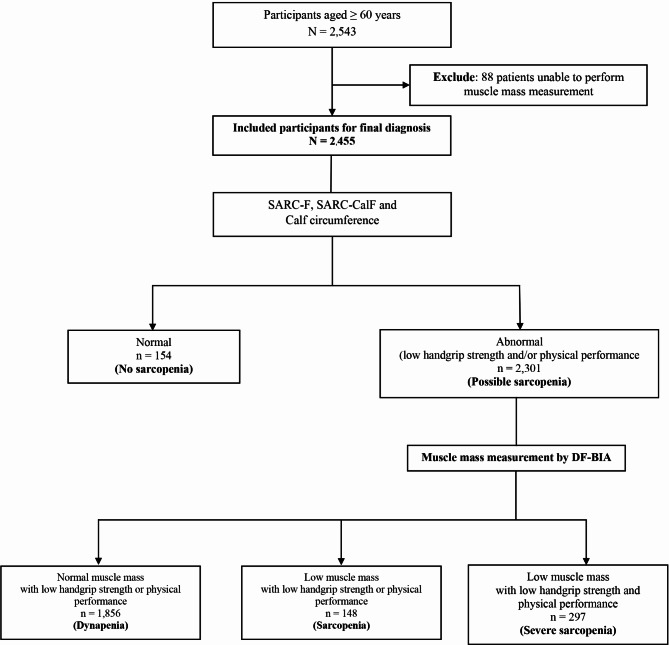
This analysis drew on data from the Thai Musculoskeletal Diseases Nationwide Study, which included 2543 participants aged 60 years or older. The SARC-F, SARC-CalF, and calf circumference data were evaluated against the 2019 Asian Working Group for Sarcopenia criteria. We calculated the sensitivity, specificity, and area under the curve to determine the diagnostic performance of each tool.
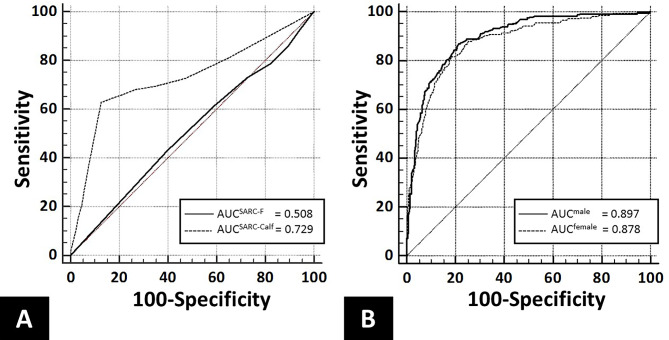
Of the 2455 participants analyzed, 18.1% were diagnosed with sarcopenia. The SARC-F and SARC-CalF questionnaires showed limited effectiveness in diagnosing sarcopenia, with area under the curve values of 0.508 and 0.729, respectively. In contrast, calf circumference demonstrated greater diagnostic accuracy, with area under the curve values of 0.897 in males and 0.878 in females. Adjusting the cutoff points to < 33 cm for males and < 31 cm for females improved the overall diagnostic accuracy from 66.4 to 82%.
Sarcopenia is relatively prevalent in Thailand. The SARC-F and SARC-CalF questionnaires are inadequate for diagnosing sarcopenia, while calf circumference alone is the most effective screening tool. Adding more parameters to the SARC-F questionnaire could enhance its diagnostic accuracy.
This study was registered at ClinicalTrials.gov (NCT06558617). Registration Date 16 August 2024.
随着老年人数量的增加,肌肉减少症等肌肉骨骼疾病因其与跌倒和骨折的密切关联而在研究中变得愈发重要。肌肉减少症以肌肉量减少为特征,在老年人中很常见,并显著增加跌倒风险。本研究旨在依据亚洲肌肉减少症工作组2019年的标准,评估SARC - F和SARC - CalF问卷以及小腿围测量在泰国社区居住老年人中筛查肌肉减少症的有效性。
本分析采用了泰国全国肌肉骨骼疾病研究的数据,该研究纳入了2543名60岁及以上的参与者。根据2019年亚洲肌肉减少症工作组的标准对SARC - F、SARC - CalF和小腿围数据进行评估。我们计算了敏感性、特异性和曲线下面积,以确定每种工具的诊断性能。
在分析的2455名参与者中,18.1%被诊断为肌肉减少症。SARC - F和SARC - CalF问卷在诊断肌肉减少症方面效果有限,曲线下面积值分别为0.508和0.729。相比之下,小腿围显示出更高的诊断准确性,男性曲线下面积值为0.897,女性为0.878。将男性的截断点调整为< 33厘米,女性调整为< 31厘米,总体诊断准确性从66.4%提高到了82%。
肌肉减少症在泰国相对普遍。SARC - F和SARC - CalF问卷不足以诊断肌肉减少症,而单独的小腿围是最有效的筛查工具。在SARC - F问卷中增加更多参数可提高其诊断准确性。
本研究已在ClinicalTrials.gov(NCT06558617)注册。注册日期2024年8月16日。