Adulkasem Nath, Vanitcharoenkul Ekasame, Chotiyarnwong Pojchong, Asavamongkolkul Apichat, Unnanuntana Aasis
Department of Orthopaedic Surgery, Faculty of Medicine Siriraj Hospital, Mahidol University, Bangkok, Thailand.
Clin Interv Aging. 2025 Apr 9;20:425-433. doi: 10.2147/CIA.S513657. eCollection 2025.
The term "possible sarcopenia" was introduced in the Asian Working Group for Sarcopenia (AWGS) 2019 guidelines to characterize individuals at high risk for sarcopenia in primary care settings. However, studies that support the diagnostic accuracy of this criteria remain scarce. Accordingly, the primary aim of this study was to assess the diagnostic accuracy of the AWGS 2019 "possible sarcopenia" criteria for detecting sarcopenia in Thai community-dwelling older adults. Our secondary aim was to explore the use of adjunct variables to improve the diagnostic accuracy of the "possible sarcopenia" criteria for detecting sarcopenia.
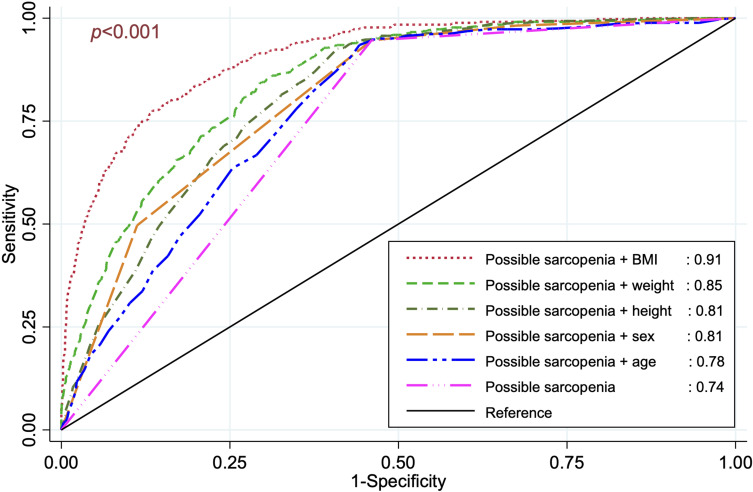
This study is a secondary analysis of an epidemiological investigation of the prevalence of sarcopenia among Thai older adults that was conducted during 2021-2022. We assessed the performance of the "possible sarcopenia" criteria against sarcopenia diagnoses based on the AWGS 2019 guidelines. In an attempt to improve the diagnostic performance of the AWGS 2019 criteria, we combined the AWGS 2019 criteria with age, sex, height, body weight, or BMI to create modified criteria. The variable that influenced the highest area under the receiver operating characteristic curve (AUC) was incorporated in the modified AWGS 2019 criteria.
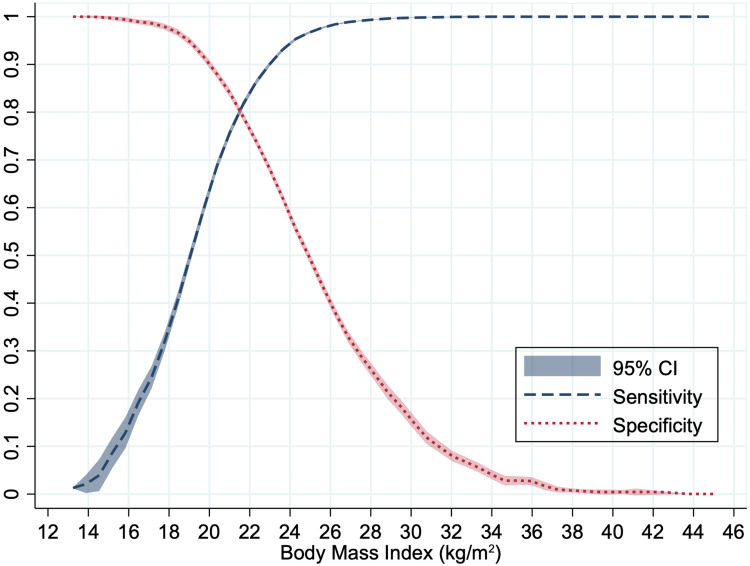
A total of 2456 participants (mean age 69.0 ± 6.1 years, 63.6% female) were included. Of these, 445 (18.1%) patients were diagnosed with sarcopenia. The "possible sarcopenia" criteria showed a sensitivity of 94.6%, a specificity of 54.0%, and an AUC of 74% for detecting sarcopenia. Incorporating BMI improved the AUC by 17%. A BMI cutoff value <24 kg/m² was shown to increase specificity to 72.7%, while maintaining sensitivity at 89.9%.
The AWGS 2019 criteria for "possible sarcopenia" showed excellent sensitivity in detecting sarcopenia but lacked sufficient specificity. The modified AWGS "possible sarcopenia" criteria, which includes a BMI cutoff of <24 kg/m², increased the specificity for detecting sarcopenia while preserving high sensitivity among Thai community-dwelling older adults.
“可能的肌肉减少症”这一术语在亚洲肌肉减少症工作组(AWGS)2019年指南中被引入,用于描述基层医疗环境中肌肉减少症高危个体。然而,支持该标准诊断准确性的研究仍然很少。因此,本研究的主要目的是评估AWGS 2019年“可能的肌肉减少症”标准在检测泰国社区居住老年人肌肉减少症方面的诊断准确性。我们的次要目的是探索使用辅助变量来提高“可能的肌肉减少症”标准检测肌肉减少症的诊断准确性。
本研究是对2021年至2022年期间进行的泰国老年人肌肉减少症患病率流行病学调查的二次分析。我们根据AWGS 2019年指南评估了“可能的肌肉减少症”标准相对于肌肉减少症诊断的性能。为了提高AWGS 2019年标准的诊断性能,我们将AWGS 2019年标准与年龄、性别、身高、体重或BMI相结合,创建了修改后的标准。将影响受试者工作特征曲线(AUC)下面积最大的变量纳入修改后的AWGS 2019年标准。
共纳入2456名参与者(平均年龄69.0±6.1岁,63.6%为女性)。其中,445名(18.1%)患者被诊断为肌肉减少症。“可能的肌肉减少症”标准在检测肌肉减少症方面的敏感性为94.6%,特异性为54.0%,AUC为74%。纳入BMI使AUC提高了17%。BMI截止值<24kg/m²可将特异性提高到72.7%,同时保持敏感性为89.9%。
AWGS 2019年“可能的肌肉减少症”标准在检测肌肉减少症方面显示出优异的敏感性,但缺乏足够的特异性。修改后的AWGS“可能的肌肉减少症”标准(包括BMI截止值<24kg/m²)提高了检测肌肉减少症的特异性,同时在泰国社区居住的老年人中保持了高敏感性。