• 文献检索
  • 文档翻译
  • 深度研究
  • 学术资讯
  • Suppr Zotero 插件Zotero 插件
  • 邀请有礼
  • 套餐&价格
  • 历史记录
应用&插件
Suppr Zotero 插件Zotero 插件浏览器插件Mac 客户端Windows 客户端微信小程序
定价
高级版会员购买积分包购买API积分包
服务
文献检索文档翻译深度研究API 文档MCP 服务
关于我们
关于 Suppr公司介绍联系我们用户协议隐私条款
关注我们

Suppr 超能文献

核心技术专利:CN118964589B侵权必究
粤ICP备2023148730 号-1Suppr @ 2026

文献检索

告别复杂PubMed语法,用中文像聊天一样搜索,搜遍4000万医学文献。AI智能推荐,让科研检索更轻松。

立即免费搜索

文件翻译

保留排版,准确专业,支持PDF/Word/PPT等文件格式,支持 12+语言互译。

免费翻译文档

深度研究

AI帮你快速写综述,25分钟生成高质量综述,智能提取关键信息,辅助科研写作。

立即免费体验

乌干达阿乔利次区域农村在校青少年的饮食质量、贫血患病率及其相关因素

Dietary quality, anaemia prevalence and their associated factors among rural school- going adolescents in Acholi sub -region of Uganda.

作者信息

Adokorach Gloria, Oyet Sunday Mark, Obai Gerald, Muggaga Christopher

机构信息

Faculty of Agriculture and Environment, Department of Food Science and Postharvest Technology, P.O. Box 166, Gulu, Uganda.

Faculty of Medicine, Gulu University, P.O. Box 166, Gulu, Uganda.

出版信息

BMC Nutr. 2024 Dec 28;10(1):166. doi: 10.1186/s40795-024-00982-3.

DOI:10.1186/s40795-024-00982-3
PMID:39732695
原文链接:https://pmc.ncbi.nlm.nih.gov/articles/PMC11681725/
Abstract

BACKGROUND

Globally, iron deficiency anaemia is a widespread public health problem affecting vulnerable populations including adolescents. However, over the years, the Uganda Demographic Health Surveys mostly report the status of anaemia for women of reproductive age (15-49 years) and children up to 5 years, leaving out the focus on adolescents. Moreover, high prevalence of anaemia among children below five years could suggest that anaemia still persists at adolescence. Therefore, the study aimed at determining dietary quality, prevalence of anaemia and their associated factors among school-going adolescents.

METHODS

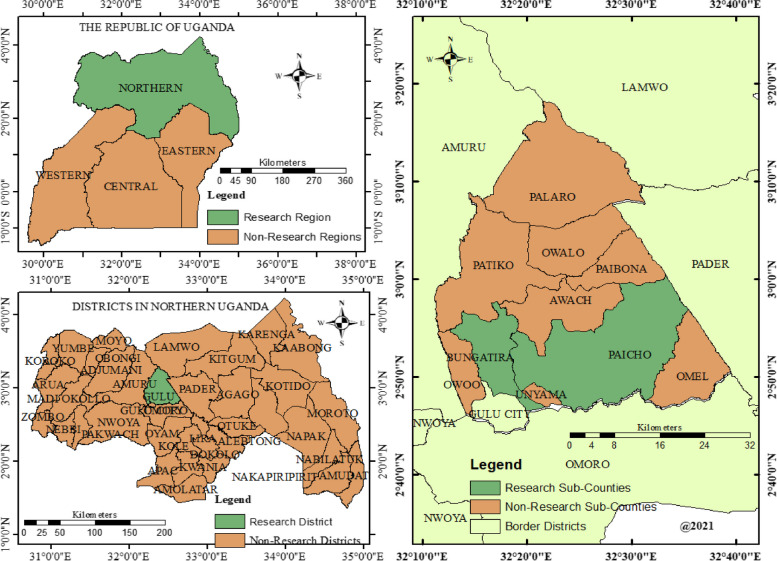
A cross-sectional study involving 341 adolescent boys and girls aged 10-19 years was carried out in two rural schools in Gulu district. Prevalence of anaemia was determined by obtaining blood specimens from a finger prick into a microcuvette and analysed for haemoglobin (Hb) level using Haemoglobin analyser, whereas dietary quality was assessed using the Individual Dietary Diversity Score (IDDS). Socio-economic and demographic data were collected using a semi-structured questionnaire.

RESULTS

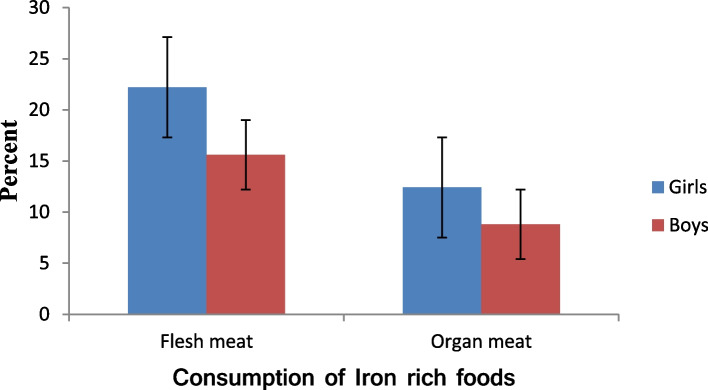
The overall prevalence of anaemia was 16.0% (Girls:18.1%; Boys:13.0%), while the mean Hb level was 13.2 ± 1.4 g/dl (Girls 13.0 ± 1.3 g/dl; Boys 13.5 ± 1.6 g/dl). The mean number of food groups consumed among the adolescents was 3.5 ± 2.1 for girls and 3.0 ± 1.8 for boys (p˃0.05). Animal source foods, fruits and vitamin A-rich vegetables, other fruits and vegetables were consumed by adolescent girls more than the boys. Similarly, a higher proportion of adolescent girls than boys consumed iron-rich foods: fish and meat, organ meat and dark green leafy vegetables. Further, all the socio-demographic factors in the study did not predict dietary diversity (p ˃ 0.05). On the other hand, education attainment by parent/guardian and nature of menstruation predicted the prevalence of anaemia amongst adolescents (p < 0.05).

CONCLUSIONS

The prevalence of anaemia was high among adolescents. Coupled with this, there, was low dietary diversity among the adolescents. The level of education of the parent/guardian and nature of the menstrual discharge were significant predictors of anaemia amongst girls. From this study, we recommend interventions by both health and agricultural-related practitioners to strengthen activities in rural schools such as health and nutrition education to create awareness about dietary diversity and promotion of agricultural practices such as school vegetable gardens, orchards poultry production and rearing of small ruminants to support consumption of diverse foods in schools with the view of reducing the burden from iron deficiency anaemia.

摘要

背景

在全球范围内,缺铁性贫血是一个广泛存在的公共卫生问题,影响着包括青少年在内的弱势群体。然而,多年来,乌干达人口与健康调查大多报告的是育龄妇女(15 - 49岁)和5岁以下儿童的贫血状况,而忽略了对青少年的关注。此外,五岁以下儿童贫血患病率较高可能表明贫血在青少年时期仍然存在。因此,本研究旨在确定在校青少年的饮食质量、贫血患病率及其相关因素。

方法

在古卢区的两所农村学校对341名年龄在10 - 19岁的青少年男孩和女孩进行了一项横断面研究。通过从手指采血到微量比色皿中获取血样,并使用血红蛋白分析仪分析血红蛋白(Hb)水平来确定贫血患病率,而饮食质量则使用个体饮食多样性评分(IDDS)进行评估。使用半结构化问卷收集社会经济和人口数据。

结果

贫血的总体患病率为16.0%(女孩:18.1%;男孩:13.0%),而平均Hb水平为13.2±1.4g/dl(女孩13.0±1.3g/dl;男孩13.5±1.6g/dl)。青少年中女孩平均食用的食物种类数为3.5±2.1种,男孩为3.0±1.8种(p>0.05)。青少年女孩食用动物源性食物、水果和富含维生素A的蔬菜、其他水果和蔬菜的量多于男孩。同样,食用富含铁的食物(鱼和肉、动物内脏和深绿色叶菜)的青少年女孩比例高于男孩。此外,研究中的所有社会人口因素均不能预测饮食多样性(p>0.05)。另一方面,父母/监护人的教育程度和月经情况可预测青少年贫血的患病率(p<0.05)。

结论

青少年贫血患病率较高。与此同时,青少年的饮食多样性较低。父母/监护人的教育水平和月经情况是女孩贫血的重要预测因素。通过本研究,我们建议卫生和农业相关从业者采取干预措施,加强农村学校的活动,如开展健康和营养教育,以提高对饮食多样性的认识,并推广农业实践,如学校菜园、果园、家禽养殖和小型反刍动物饲养,以支持学校多样化食物的消费,从而减轻缺铁性贫血的负担。
https://cdn.ncbi.nlm.nih.gov/pmc/blobs/e5d8/11681725/c76e884f73f4/40795_2024_982_Fig2_HTML.jpg
https://cdn.ncbi.nlm.nih.gov/pmc/blobs/e5d8/11681725/2ec32f23187b/40795_2024_982_Fig1_HTML.jpg
https://cdn.ncbi.nlm.nih.gov/pmc/blobs/e5d8/11681725/c76e884f73f4/40795_2024_982_Fig2_HTML.jpg
https://cdn.ncbi.nlm.nih.gov/pmc/blobs/e5d8/11681725/2ec32f23187b/40795_2024_982_Fig1_HTML.jpg
https://cdn.ncbi.nlm.nih.gov/pmc/blobs/e5d8/11681725/c76e884f73f4/40795_2024_982_Fig2_HTML.jpg

相似文献

1
Dietary quality, anaemia prevalence and their associated factors among rural school- going adolescents in Acholi sub -region of Uganda.乌干达阿乔利次区域农村在校青少年的饮食质量、贫血患病率及其相关因素
BMC Nutr. 2024 Dec 28;10(1):166. doi: 10.1186/s40795-024-00982-3.
2
Predictors of anaemia among adolescent schoolchildren of Ghana.加纳青少年学生贫血的预测因素。
J Nutr Sci. 2020 Sep 18;9:e43. doi: 10.1017/jns.2020.35. eCollection 2020.
3
Folic acid supplementation and malaria susceptibility and severity among people taking antifolate antimalarial drugs in endemic areas.在流行地区,服用抗叶酸抗疟药物的人群中,叶酸补充剂与疟疾易感性和严重程度的关系。
Cochrane Database Syst Rev. 2022 Feb 1;2(2022):CD014217. doi: 10.1002/14651858.CD014217.
4
Vitamin A deficiency among adolescent female garment factory workers in Bangladesh.孟加拉国青少年女性服装厂工人中的维生素A缺乏情况。
Eur J Clin Nutr. 1997 Oct;51(10):698-702. doi: 10.1038/sj.ejcn.1600469.
5
Dietary diversity and associated factors among adolescents in eastern Uganda: a cross-sectional study.乌干达东部青少年的饮食多样性及其相关因素:一项横断面研究。
BMC Public Health. 2020 Apr 19;20(1):534. doi: 10.1186/s12889-020-08669-7.
6
Dietary Diversity and Nutritional Status of Adolescents in Rural Ghana.加纳农村青少年的饮食多样性与营养状况
Nutr Metab Insights. 2023 Mar 10;16:11786388231158487. doi: 10.1177/11786388231158487. eCollection 2023.
7
Prevalence of daily breakfast intake, iron deficiency anaemia and awareness of being anaemic among Saudi school students.沙特在校学生每日早餐摄入量、缺铁性贫血及贫血知晓情况
Int J Food Sci Nutr. 2002 Nov;53(6):519-28. doi: 10.1080/09637480220164370.
8
Low Dietary Diversity and Low Haemoglobin Status in Ghanaian Female Boarding and Day Senior High School Students: A Cross-Sectional Study.加纳走读和寄宿高中女生的低饮食多样性和低血红蛋白状况:一项横断面研究。
Medicina (Kaunas). 2024 Jun 26;60(7):1045. doi: 10.3390/medicina60071045.
9
Animal source food consumption and anaemia among school adolescent girls in Silti District, Central Ethiopia: a public health perspective.埃塞俄比亚中部锡尔蒂地区在校青春期女孩的动物源食物消费与贫血:公共卫生视角
J Nutr Sci. 2024 Dec 5;13:e89. doi: 10.1017/jns.2024.76. eCollection 2024.
10
Anaemia prevalence, its determinants and profile of micronutrient status among rural school adolescent girls aged 14-19 years: a cross-sectional study in Nagpur district, Maharashtra, India.印度马哈拉施特拉邦那格浦尔地区14至19岁农村在校青春期女孩的贫血患病率、其决定因素及微量营养素状况概况:一项横断面研究
Public Health Nutr. 2024 Nov 11;27(1):e248. doi: 10.1017/S1368980024002234.

引用本文的文献

1
Association between nutrition literacy and diet quality among adolescents and young adults in the rural district of Mayuge, Eastern Uganda.乌干达东部马尤盖农村地区青少年和青年成年人的营养知识与饮食质量之间的关联
BMC Public Health. 2025 Jul 3;25(1):2335. doi: 10.1186/s12889-025-23498-2.

本文引用的文献

1
Malnutrition and gender disparities in the Eastern Mediterranean Region: The need for action.东地中海区域的营养不良与性别差异:采取行动的必要性。
Front Nutr. 2023 Mar 7;10:1113662. doi: 10.3389/fnut.2023.1113662. eCollection 2023.
2
Magnitude and associated factors of anemia among adolescent girls in Ethiopia: a systematic review and meta-analysis.埃塞俄比亚青春期女孩贫血的严重程度及相关因素:一项系统评价与荟萃分析
Arch Public Health. 2022 Aug 11;80(1):189. doi: 10.1186/s13690-022-00942-y.
3
Iron Deficiency Anemia: Efficacy and Limitations of Nutritional and Comprehensive Mitigation Strategies.
缺铁性贫血:营养和综合缓解策略的疗效和局限性。
Nutrients. 2022 Jul 20;14(14):2976. doi: 10.3390/nu14142976.
4
Iron Absorption: Factors, Limitations, and Improvement Methods.铁的吸收:影响因素、限制及改善方法。
ACS Omega. 2022 Jun 10;7(24):20441-20456. doi: 10.1021/acsomega.2c01833. eCollection 2022 Jun 21.
5
Determinants of Gender Disparity in Nutritional Intake among Children in Pakistan: Evidence from PDHS.巴基斯坦儿童营养摄入性别差异的决定因素:来自巴基斯坦人口与健康调查的证据
Children (Basel). 2021 Dec 24;9(1):7. doi: 10.3390/children9010007.
6
Iron Status, Anemia, and Iron Interventions and Their Associations with Cognitive and Academic Performance in Adolescents: A Systematic Review.铁状态、贫血、铁干预及其与青少年认知和学业成绩的关系:系统评价。
Nutrients. 2022 Jan 5;14(1):224. doi: 10.3390/nu14010224.
7
Plant-based Diet and Iron Deficiency Anemia in Sundanese Adolescent Girls at Islamic Boarding Schools in Indonesia.印度尼西亚伊斯兰寄宿学校中巽他族少女的植物性饮食与缺铁性贫血
J Nutr Metab. 2021 Sep 11;2021:6469883. doi: 10.1155/2021/6469883. eCollection 2021.
8
Anemia among Women of Reproductive Age: An Overview of Global Burden, Trends, Determinants, and Drivers of Progress in Low- and Middle-Income Countries.育龄妇女贫血:全球负担、趋势、决定因素以及中低收入国家进展的推动因素概述。
Nutrients. 2021 Aug 10;13(8):2745. doi: 10.3390/nu13082745.
9
Frequent Consumption of Micronutrient-Rich Foods Is Associated With Reduced Risk of Anemia Among Adolescent Girls and Boys in Indonesia: A Cross-Sectional Study.经常食用富含微量营养素的食物与印度尼西亚青少年女孩和男孩贫血风险降低有关:一项横断面研究。
Food Nutr Bull. 2021 Jun;42(1_suppl):S59-S71. doi: 10.1177/0379572120977455.
10
Knowledge and practices of dietary iron and anemia among early adolescents in a rural district in Ghana.加纳某农村地区青少年早期膳食铁与贫血的知识及实践情况
Food Sci Nutr. 2021 Apr 2;9(6):2915-2924. doi: 10.1002/fsn3.2249. eCollection 2021 Jun.